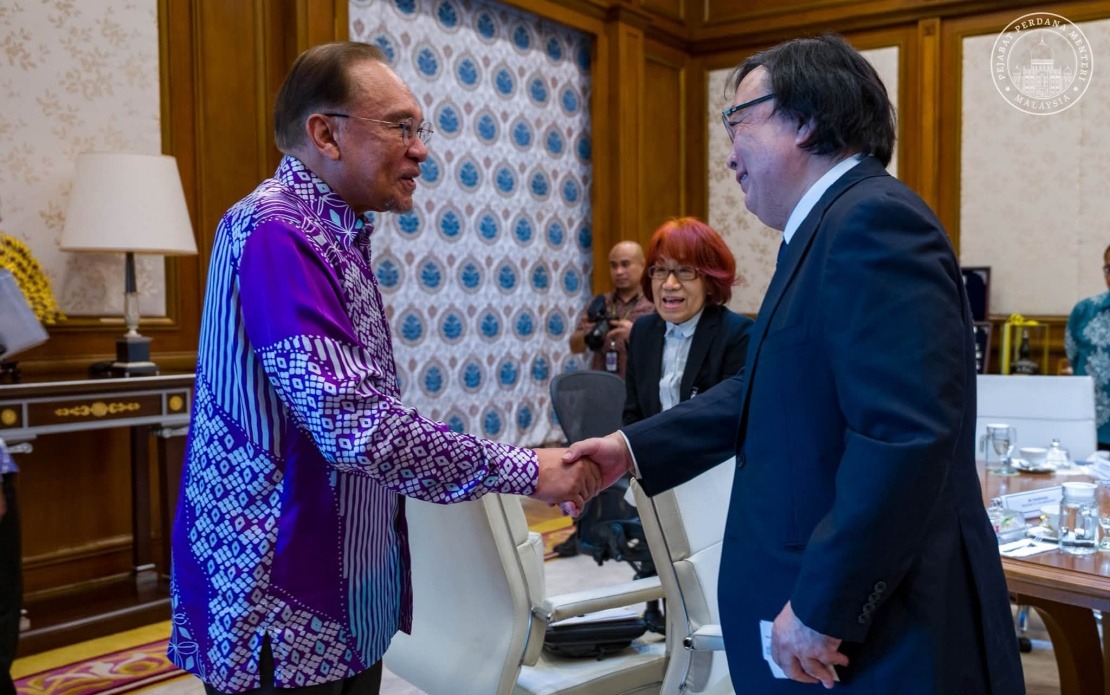
Prime Minister Datuk Seri Anwar Ibrahim held talks with The Genron NPO President Yasushi Kudo in Kuala Lumpur on July 23, focusing on bolstering multilateral cooperation mechanisms and deepening bilateral relations between Malaysia and Japan. The meeting centred on expanding the Asia Leaders Roundtable, an established platform designed to facilitate strategic discussions on pressing regional and global issues among senior policymakers and thought leaders from across the Asia-Pacific.
The Genron NPO, headquartered in Japan, functions as an independent, non-profit research and policy institution that brings together influential figures to examine challenges affecting the broader Asian region. Its role in convening high-level dialogues has made it a significant intermediary in shaping policy conversations among Asian nations seeking to navigate geopolitical complexities and economic interdependencies. By engaging with its leadership, Anwar underscored Malaysia's commitment to participating in structured forums that address transnational challenges.
During the courtesy call, Anwar took the opportunity to express Malaysia's appreciation for Japan's reception during his official visit to the country in June. The warmth of that diplomatic engagement, which included elaborate state protocols and substantive discussions with Japanese counterparts, reflected the mature nature of ties between Kuala Lumpur and Tokyo. Such high-level exchanges serve to reinforce personal relationships among leaders and signal the seriousness with which both governments view their mutual partnership.
At the heart of Anwar's remarks was an emphasis on Malaysia's Comprehensive Strategic Partnership with Japan, a formal framework that positions the Japanese nation among Malaysia's most critical allies across security, economic, and cultural dimensions. This partnership encompasses collaboration in defence, trade, investment, technology transfer, and people-to-people connections. For Malaysia, Japan represents not only a source of advanced technology and industrial expertise but also a stabilising force in regional affairs, particularly given its economic clout and diplomatic influence.
Kudo extended an invitation to Anwar to participate in the Tokyo Conference 2027, a gathering that continues the Genron NPO's tradition of convening region-wide leadership. The Prime Minister's acceptance signals Malaysia's intention to maintain a prominent voice in such forums, where Southeast Asian perspectives on regional architecture and global order remain increasingly important. Additionally, Anwar expressed gratitude for the opportunity to deliver a video message at the 2026 iteration of the conference, demonstrating that Malaysia's engagement extends across multiple years of programming.
The discussion also reflected broader strategic considerations affecting Southeast Asia. Japan, as a mature democracy with significant technological capabilities and regional security interests, has long sought to deepen partnerships with Association of Southeast Asian Nations (ASEAN) members. Malaysia, as a major ASEAN economy and chair holder on various occasions, occupies a pivotal position in shaping regional consensus. Collaborating through think tanks and policy forums like the Genron NPO allows both nations to explore shared interests in maintaining an open, rules-based regional order amid great power competition.
For Malaysia specifically, engagement with Japanese institutions offers valuable opportunities to influence regional discourse on issues ranging from maritime security to trade architecture and technological standards. The Asia Leaders Roundtable provides a neutral space where Malaysian perspectives can be articulated and heard by other influential Asian voices, contributing to the formation of regional positions on contentious matters. This becomes particularly relevant as ASEAN navigates balancing act between major powers.
Anwar's remarks underscored the interconnected nature of contemporary regional challenges, which require sustained dialogue and cooperation among Asian nations. From climate change to pandemic preparedness, from supply chain resilience to artificial intelligence governance, the issues discussed at such roundtables demand collective intelligence and coordinated policy responses. Malaysia's participation in these conversations positions it as an active player in shaping Asia's future rather than a passive observer.
The strengthening of ties between Malaysia and Japan, both bilaterally and through multilateral institutions, also carries economic implications. Japan remains a significant source of foreign direct investment for Malaysia, particularly in manufacturing, automotive, and electronics sectors. Japanese companies operate extensively in Malaysian Special Economic Zones and industrial parks. Enhanced diplomatic cooperation typically facilitates smoother business environments and reduces transaction costs for bilateral investors.
Anwar's emphasis on pursuing shared peace, stability, and prosperity articulated a vision of cooperation grounded in mutual benefit rather than zero-sum competition. This reflects Malaysia's broader foreign policy philosophy of maintaining constructive relationships across the geopolitical spectrum while advancing national interests. By highlighting the alignment between Malaysian and Japanese objectives, the Prime Minister positioned his nation as a reliable partner in regional architecture-building efforts.
The meeting also demonstrated the importance of non-governmental actors in contemporary diplomacy. Think tanks and policy institutions increasingly serve as channels for Track Two diplomacy, allowing officials to explore ideas and positions outside formal negotiating settings. The Genron NPO's role in facilitating such exchanges enhances the quality of decision-making by exposing leaders to diverse perspectives and research-based insights on emerging challenges.
Looking forward, Malaysia's continued engagement with Japanese institutions through the Asia Leaders Roundtable and other forums will likely deepen as regional uncertainties persist. The bilateral relationship with Japan, anchored in the Comprehensive Strategic Partnership, provides a stable foundation for this cooperation. For Malaysian policymakers and observers, the strengthening of such institutional partnerships represents an investment in regional peace and Malaysia's long-term strategic positioning in an increasingly complex Asian environment.

