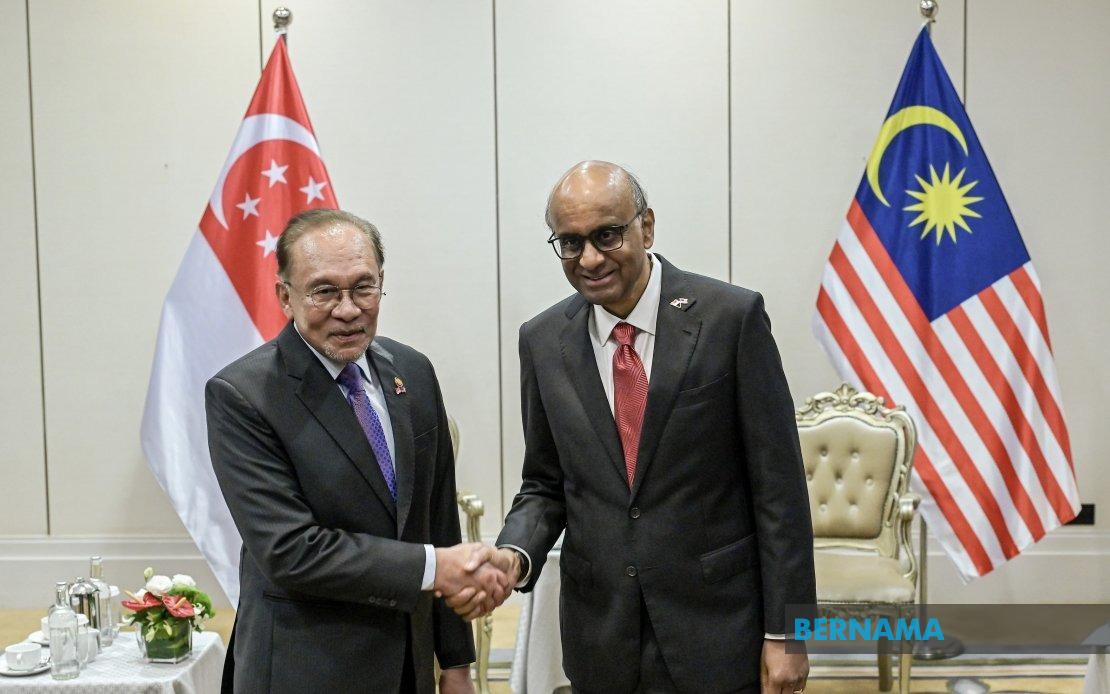
Prime Minister Datuk Seri Anwar Ibrahim received Singapore President Tharman Shanmugaratnam for a high-level courtesy call on Monday as part of the Singaporean leader's three-day state visit to Malaysia. The 40-minute meeting, held in Kuala Lumpur, underscored the continued diplomatic importance both governments place on strengthening bilateral ties. The encounter was bolstered by the presence of key Malaysian cabinet ministers, including Foreign Minister Datuk Seri Mohamad Hasan, Investment, Trade and Industry Minister Datuk Seri Johari Abdul Ghani, and Entrepreneur and Cooperatives Development Minister Steven Sim Chee Keong, alongside senior officials from both nations.
President Tharman's arrival in Malaysia was marked with ceremonial grandeur befitting a visiting head of state. The Yang di-Pertuan Agong Sultan Ibrahim extended a formal state welcoming ceremony at Istana Negara, demonstrating Malaysia's protocol recognition of the Singapore leader's elevated status. The visit runs from July 13 to 15, having been extended an invitation by the Malaysian King himself. This three-day engagement represents a reciprocal diplomatic gesture, following His Majesty's own state visit to Singapore that took place in May 2024, reflecting the cyclical nature of high-level bilateral engagements between the two Southeast Asian neighbours.
The timing of Tharman's visit carries particular significance within the broader context of Malaysia-Singapore relations. The two countries maintain one of the most economically integrated partnerships in Southeast Asia, with Singapore occupying a prominent position in Malaysia's trade ledger. Specifically, Singapore stands as Malaysia's second-largest trading partner globally, a distinction that underscores the depth of commercial interdependence between the two nations. Within the Association of Southeast Asian Nations framework, Singapore emerges as Malaysia's foremost trading partner among fellow ASEAN member states, a position reflecting decades of institutionalised economic cooperation and integrated supply chains.
Bilateral trade figures reveal the substantial economic momentum characterising the Malaysia-Singapore relationship. In 2025, total bilateral trade reached RM402.35 billion, equivalent to approximately US$93.97 billion, representing a modest growth trajectory of 1.5 per cent compared to the previous year. These headline figures, while appearing modest in percentage terms, represent enormous absolute values that illustrate the sheer volume of commercial activity flowing between the two economies on a daily basis. The trade relationship encompasses diverse sectors ranging from petroleum and petrochemicals to electronics, financial services, and value-added manufacturing.
More encouraging signs emerge when examining recent trade momentum over the first five months of 2025. From January through May, bilateral commerce expanded at a notably stronger pace of 14.5 per cent, totalling RM189.90 billion, or approximately US$47.87 billion. This acceleration compared favourably against the RM165.93 billion (US$37.65 billion) recorded during the same January-to-May window in the preceding year. The sharper growth trajectory in the opening months of 2025 suggests that both nations' economies are gaining traction, potentially reflecting post-pandemic normalisation and renewed business confidence in regional supply chains.
For Malaysian policymakers and investors, the sustained strength of the Singapore relationship holds multiple implications. Singapore functions as more than simply a trading partner; it serves as a gateway for Malaysian companies seeking access to global capital markets and international business networks. Many Malaysian enterprises maintain regional headquarters or trading operations in Singapore, leveraging the city-state's sophisticated financial infrastructure, regulatory clarity, and connectivity to international commerce. Conversely, Singaporean investment flows into Malaysia continue to support manufacturing, real estate development, and service sector expansion, particularly in growth corridors near the border.
The diplomatic choreography surrounding Tharman's visit extends beyond ceremonial pleasantries to encompass substantive negotiations on shared regional concerns. Malaysia and Singapore, despite their geographical proximity and close economic ties, occasionally navigate contentious issues spanning maritime boundaries, water agreements, and transport connectivity. The presence of multiple cabinet-level ministers during the courtesy call suggests that discussions likely ranged across these traditional friction points alongside opportunities for deeper integration. Investment and trade discussions probably featured prominently, given the portfolios of attending ministers.
The broader regional context shapes the significance of this bilateral engagement. Southeast Asia faces a complex geopolitical environment characterised by great power competition, supply chain reconfiguration, and evolving security dynamics. Malaysia and Singapore, as two of the region's most economically dynamic members, share mutual interests in maintaining stable trading relationships, open sea lanes, and rules-based regional arrangements. Both countries recognise that their prosperity depends substantially on regional peace and predictable economic governance, creating natural alignment on many strategic questions despite occasional bilateral disagreements.
Looking forward, the momentum evident in this high-level exchange suggests both governments are committed to deepening engagement across multiple domains. The reciprocal state visits between Sultan Ibrahim and President Tharman signal that bilateral relations have returned to a consistently cordial footing following any earlier tensions. For Malaysian observers, the visit reinforces Singapore's enduring importance as both an economic anchor and a diplomatic counterpart in navigating regional challenges. The 14.5 per cent trade growth in early 2025 provides encouraging evidence that economic fundamentals remain solid, even as broader geopolitical uncertainties persist. As the two nations navigate the remainder of 2025 and beyond, maintaining this diplomatic intensity while expanding commercial opportunities will likely remain central to both governments' strategic calculations in Southeast Asia.

