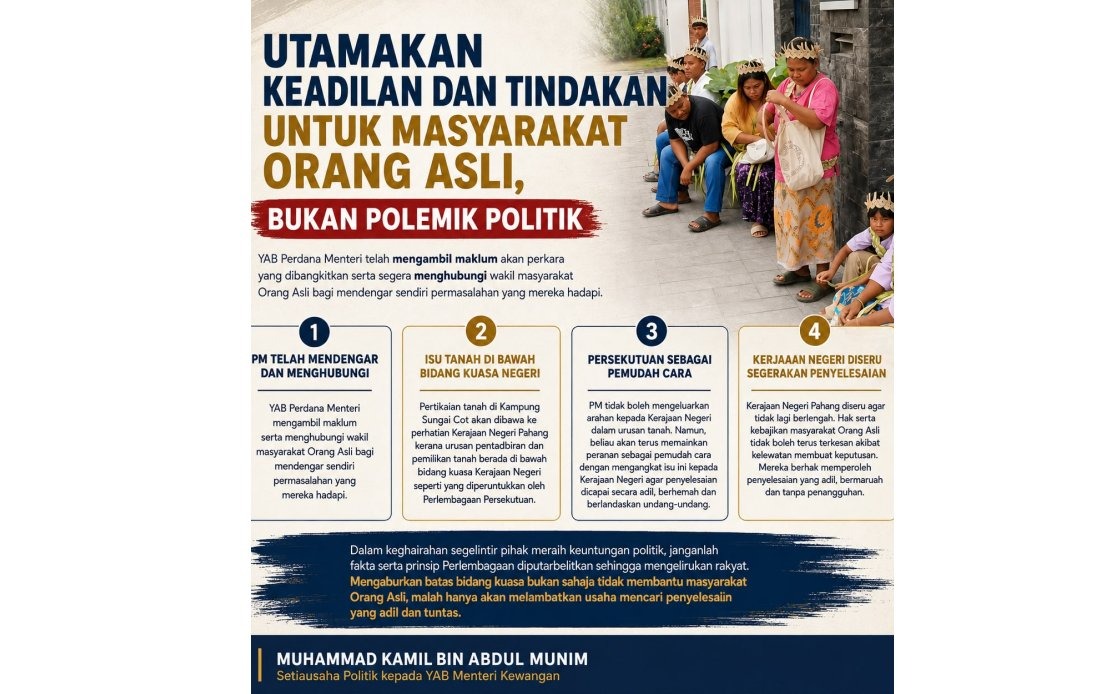
Prime Minister Datuk Seri Anwar Ibrahim has pledged to maintain an active facilitating role in addressing the contentious land ownership dispute affecting the Orang Asli inhabitants of Kampung Sungai Cot in Maran, Pahang. According to Muhammad Kamil Abdul Munim, political secretary to the Finance Minister, the Prime Minister intends to escalate the matter directly to the Pahang State Government with the objective of achieving a resolution that is both legally sound and equitable to the indigenous community members whose livelihoods and settlement rights hang in the balance.
The government's response comes after mounting pressure from civil society advocates and affected residents seeking federal intervention in what has become a protracted ownership dispute. Muhammad Kamil's statement emphasizes that Anwar has personally engaged with community representatives to develop a nuanced understanding of the specific hardships facing Kampung Sungai Cot residents, signalling a willingness to move beyond bureaucratic formality to grasp the human dimensions of the conflict. This direct engagement represents a departure from the customary approach whereby such matters are handled through routine administrative channels without executive-level attention.
Crucially, the statement clarifies the constitutional architecture governing land administration in Malaysia. Under the Federal Constitution, matters pertaining to land ownership, usage rights, and disputes fall squarely within the purview of state governments rather than federal authorities. This jurisdictional limitation means that despite the Prime Minister's evident commitment and capacity to exert influence, he cannot unilaterally impose decisions on the Pahang State Government regarding the fate of the Kampung Sungai Cot lands. The distinction between facilitation and directive authority represents a fundamental boundary that the federal executive must respect in the Malaysian federal system.
However, Muhammad Kamil's statement also conveys an implicit criticism of those who may be weaponizing the Kampung Sungai Cot issue for political gain. The political secretary cautions against distorting constitutional principles or misrepresenting factual circumstances in ways that could mislead the public while simultaneously undermining constructive efforts to reach a fair settlement. This warning appears directed at opposition figures or advocacy groups who might view the indigenous community's predicament as an opportunity to score electoral points against the federal government by portraying it as indifferent or obstructionist.
The Orang Asli community occupies a particularly vulnerable position within Malaysia's legal and social framework. Indigenous peoples across the peninsula have historically faced systematic encroachment on their ancestral lands, whether through development projects, agricultural schemes, or competing claims by other groups. The Kampung Sungai Cot case is emblematic of this broader structural challenge, wherein indigenous residents lack the institutional leverage or financial resources to defend their territorial claims through protracted legal proceedings. Land disputes involving indigenous communities often linger unresolved for years, creating prolonged uncertainty and perpetuating socioeconomic marginalisation.
The timing of Anwar's intervention is noteworthy. The Prime Minister's Friday Facebook announcement and subsequent escalation through his political secretary suggest a recognition that the issue has reached a threshold requiring executive attention. In Malaysian politics, such high-level engagement typically signals either significant grassroots mobilisation, media attention, or electoral considerations. The willingness to involve the Prime Minister's office in what is technically a state matter demonstrates the political salience that indigenous rights disputes can generate when they attract public scrutiny.
Muhammad Kamil's exhortation to the Pahang State Government to accelerate decision-making reflects growing federal frustration with administrative lethargy at the state level. By publicly urging swift action and emphasizing that the indigenous community's welfare should not remain hostage to bureaucratic delays, the statement creates soft political pressure on Pahang authorities without violating constitutional boundaries. This represents a nuanced form of federal leverage—using publicity and moral suasion rather than formal authority to nudge the state government towards resolution.
The broader implications for indigenous rights advocacy in Malaysia are significant. Successful federal facilitation of the Kampung Sungai Cot dispute could establish a constructive precedent for addressing similar conflicts involving Orang Asli communities elsewhere on the peninsula. Conversely, failure to achieve equitable resolution despite prime ministerial involvement might embolden critics to argue that indigenous communities cannot rely on federal institutions to protect their fundamental rights and interests. The case thus carries symbolic weight beyond the immediate circumstances affecting Kampung Sungai Cot residents.
For the Pahang State Government, Anwar's public commitment to support resolution creates a political environment in which inaction or unfair outcomes become increasingly costly. The state administration now faces reputational consequences should it handle the matter in ways perceived as dismissive of indigenous concerns. This dynamic reflects how federal-state coordination on rights issues, even within constitutional constraints, can generate practical incentives for state-level actors to prioritise vulnerable communities' welfare alongside conventional development interests.
The situation also highlights the tension between formal constitutional structure and practical political necessity. While the Federal Constitution reserves land administration to states, the lived experience of governance increasingly demands that senior federal political figures intervene to ensure marginalized communities receive fair treatment. The Anwar government appears to be calibrating this tension by respecting formal jurisdictional limits while exercising substantive political influence to advance indigenous welfare within those boundaries.
Moving forward, the resolution of the Kampung Sungai Cot dispute will depend upon genuine cooperation between federal facilitators and state authorities, combined with willingness from all stakeholders to negotiate in good faith. The Prime Minister's commitment alone cannot solve the matter without corresponding commitment from the Pahang State Government to prioritize the Orang Asli community's rights. The next critical phase involves translating federal political will into concrete state-level action that delivers tangible benefits to residents whose claims deserve recognition and protection under law.

