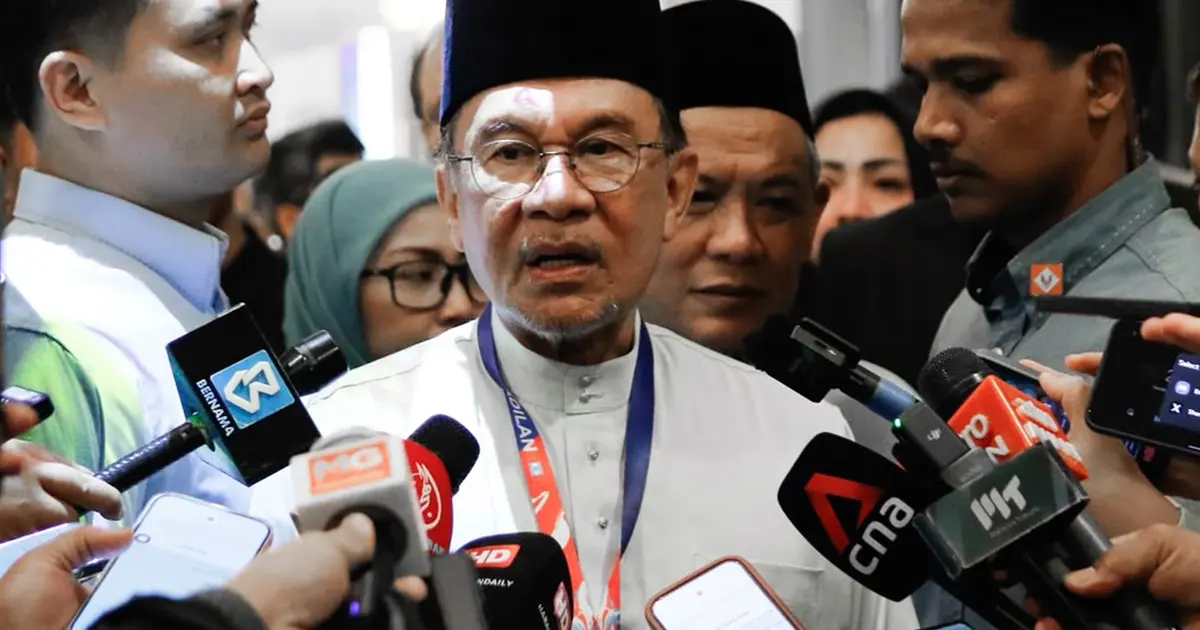
Prime Minister Anwar Ibrahim has firmly denied harbouring trust concerns regarding Deputy Prime Minister Ahmad Zahid Hamzah, instead attributing recent critical remarks to differing viewpoints held by former Umno Youth chief Khairy Jamaluddin. The premier's statement comes in direct response to comments Khairy made during a podcast appearance, where he appeared to suggest underlying tensions in the government's top leadership structure. By reframing the discourse as a matter of perspective rather than substance, Anwar sought to downplay perceptions of internal friction at the highest levels of the Malaysian administration.
Khairy Jamaluddin, who previously held influential positions within Umno's youth wing before departing the party, had aired his views through the podcast medium, a format that has become increasingly influential in shaping political narratives among younger demographics in Malaysia and the wider region. His comments appeared to raise questions about the working relationship between Malaysia's top two political figures, a concern that carries particular weight given the coalition government's dependence on maintaining unity across multiple parties and factions. The fact that such observations emanated from an ex-party official rather than from government sources suggests ongoing undercurrents of criticism emanating from within Umno's broader political ecosystem.
Anwar's response demonstrates a calculated approach to damage control, distinguishing between what Khairy expressed as personal interpretation and what the prime minister characterizes as the actual state of affairs. This rhetorical strategy allows the government to acknowledge the criticism without validating its substance, a common tactic employed when internal party divisions threaten to undermine public confidence in leadership stability. By attributing the remarks to individual perspective, Anwar effectively positioned Khairy's commentary as opinion rather than informed observation based on insider knowledge.
The exchange reflects deeper complexities within Malaysia's coalition government, which operates across traditional party boundaries and ideological divides. The partnership between Anwar's reformist-leaning faction and Umno's establishment wing, represented by Zahid's stewardship of the deputy premier role, represents a pragmatic alignment born from electoral necessity rather than longstanding organizational compatibility. This foundational tension perpetually threatens to resurface whenever questions about cohesion arise, making incidents like Khairy's podcast appearance potentially destabilizing to perceptions of governmental effectiveness.
Khairy's decision to voice concerns through a podcast rather than through formal party or parliamentary channels suggests a calculated effort to reach audiences beyond traditional political establishments. The podcast format allows for more candid conversation than official press statements permit, and the former Umno Youth leader's choice to engage via this medium indicates a desire to influence discourse among segments of the electorate who consume information through digital platforms. This approach reflects broader shifts in how Malaysian political figures communicate with supporters and skeptical observers alike.
The timing of Anwar's rebuttal matters considerably, particularly given the ongoing complexities surrounding legislative coalition management and the need to maintain functional relationships across parties essential to government survival. Any suggestion of fractured relationships between senior cabinet members risks emboldening opposition forces and potentially destabilizing the parliamentary arithmetic that permits the current administration to govern. Anwar's swift and firm denial thus serves crucial political purposes beyond simply addressing Khairy's specific comments.
Zahid Hamzah's position as deputy prime minister represents a significant concession to Umno within the government's power-sharing arrangement, reflecting the historic party's continued relevance despite its electoral decline and ongoing legal challenges facing several of its senior figures. The deputy premier's retention of this crucial portfolio despite these complications underscores the government's calculation that maintaining Umno's institutional support remains essential to cabinet stability. Any genuine deterioration in the relationship between Anwar and Zahid would therefore threaten equilibrium across the coalition as a whole.
The distinction Anwar drew between Khairy's interpretation and objective reality also carries implications for how different political audiences understand the commentary. Within parliamentary circles, the prime minister's response may be received as a reassurance of continued functionality and partnership. For external observers, particularly international partners evaluating Malaysia's political stability, the clarification may help preserve perceptions of governmental coherence. However, for segments of the electorate sceptical of the coalition government's durability, the exchange itself—regardless of Anwar's denial—may reinforce existing doubts about internal unity.
Khairy Jamaluddin's evolving role as a political voice remains noteworthy, particularly given his departure from Umno and the relative freedom this provides him to offer critiques without internal party constraints. As a former government official with insider experience, his observations carry weight among informed observers even if rejected by current leadership. His podcast commentary thus occupies an interesting space between insider perspective and external criticism, lending it credibility that purely oppositional voices might not command.
The fundamental challenge facing Anwar's administration remains balancing the competing interests of coalition partners with vastly different ideological foundations and political bases. The government's ability to maintain functional relationships across these divides directly impacts its capacity to implement policies and sustain legislative majorities. Incidents like Khairy's remarks, whether reflecting genuine internal concerns or simply representing an individual viewpoint as Anwar suggested, test the coalition's resilience and the premier's capacity to manage perceptions of stability.
Moving forward, the government faces ongoing pressure to demonstrate that differences between key figures represent manageable disagreements rather than fundamental fissures. Anwar's response, by minimizing the significance of Khairy's comments and reframing them as personal interpretation, attempts to establish this narrative. Yet the very necessity of issuing such denials suggests that questions about leadership cohesion continue to simmer beneath the surface of Malaysia's complex political landscape, a reality that will likely resurface periodically as coalition partners navigate competing pressures and interests.

