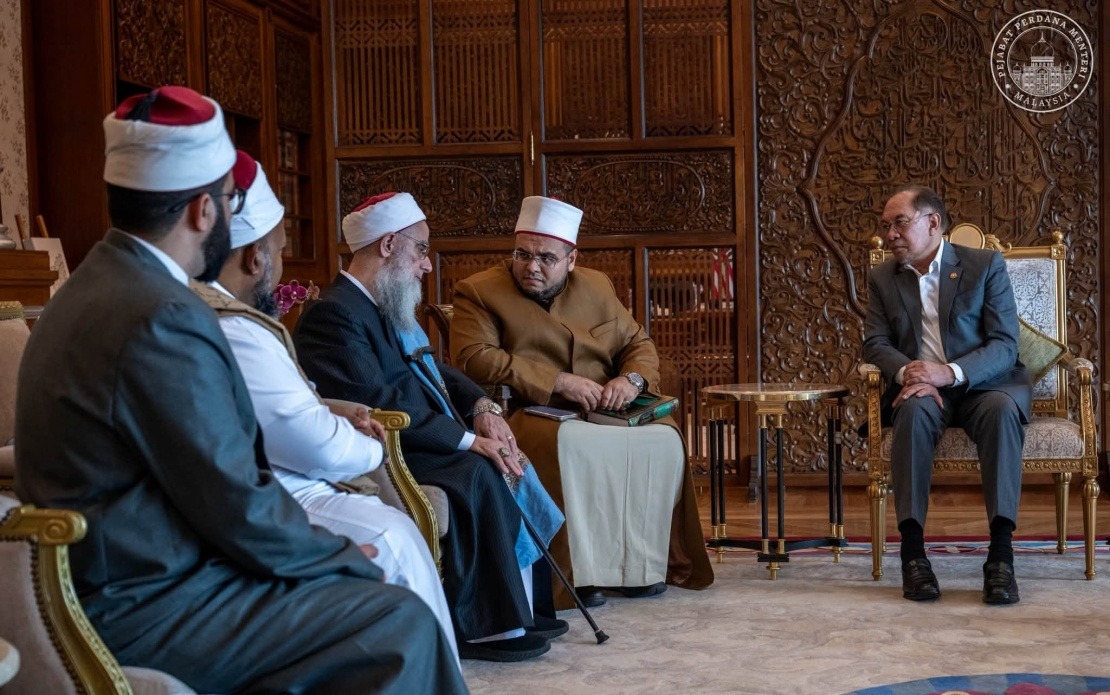
Prime Minister Datuk Seri Anwar Ibrahim received a prominent Egyptian Islamic scholar at his Putrajaya office on July 20, underlining Malaysia's continued engagement with leading religious intellectuals from across the Muslim world. The visit by Sheikh Dr Mustafa An-Nadwi Al-Hasani Mansurah, a scholar based in Mansurah, Egypt, reflects Malaysia's position as a hub for interfaith dialogue and Islamic learning within Southeast Asia. Through a Facebook post detailing the meeting, Anwar characterised his distinguished guest as someone who embodies an approach to Islamic scholarship grounded in rigorous study of hadith and ethical principles rather than sensationalism or theological extremism.
Sheikh Dr Mustafa's credentials extend deeply into Islamic academic circles. He is counted among the accomplished students of the late Sheikh Abul Hasan Ali al-Nadwi, himself a towering figure in twentieth-century Islamic intellectual history whose influence stretched across the Arab world and beyond. This lineage matters considerably for understanding contemporary Islamic thought. Al-Nadwi represented a school of Islamic scholarship that balanced textual fidelity with social awareness, seeking to make Islamic principles relevant to modern societies without compromising doctrinal integrity. By extension, scholars trained in this tradition carry forward an approach that prioritises wisdom and moderation—qualities that Anwar explicitly highlighted in his remarks.
The Prime Minister's characterisation of Sheikh Dr Mustafa's approach carries particular significance at a moment when Malaysia confronts varied interpretations of Islamic practice within its diverse Muslim-majority society. Anwar's emphasis on knowledge arriving "like morning dew, quiet, gentle, yet capable of bringing life" stands in direct contrast to polarising forms of religious discourse that have occasionally threatened social cohesion in Malaysia. This rhetoric reflects broader themes in Anwar's political messaging since assuming office: the conviction that thoughtful scholarship and inclusive governance form the bedrock of national stability. For Malaysian audiences, the visit signals government preference for scholarly, measured engagement with Islamic questions over more ideologically charged approaches.
During their Putrajaya meeting, Anwar and Sheikh Dr Mustafa exchanged perspectives on contemporary issues, though specific details of their substantive discussions remained undisclosed. The Prime Minister noted that his visitor was conducting knowledge-sharing sessions throughout Malaysia during that week, suggesting a more expansive engagement with Malaysian Islamic institutions and perhaps universities. Such visits by foreign Islamic scholars have long served multiple functions: they elevate Malaysia's standing within global Islamic intellectual networks, provide platforms for local Muslim academics and students to encounter diverse scholarly perspectives, and potentially influence how Malaysian Islamic discourse evolves by exposing audiences to different methodological approaches and interpretive traditions.
Anwar's gratitude extended to Sheikh Dr Mustafa's prayers for Malaysia's unity and prosperity, a courtesy typical of high-level diplomatic exchanges but which carries weight within Islamic cultural contexts where supplications by respected scholars are valued. The Prime Minister reciprocated by offering prayers for his guest's continued health, the flourishing of his scholarly work, and his capacity to serve Muslim communities through wisdom and compassion. This reciprocal blessing reflects longstanding Islamic diplomatic traditions and underscores the spiritual dimension that often accompanies high-level engagements between Muslim leaders and scholars.
The visit occurs within a broader context of Malaysia's Islamic institutional landscape. As a nation with significant Sunni Muslim demographics and established Islamic education infrastructure, Malaysia has historically attracted scholars and students from across the Islamic world. Universities like the International Islamic University Malaysia and Al-Azhar's regional presence have made the country a node in transnational Islamic scholarly networks. Visits by figures like Sheikh Dr Mustafa reinforce these connections and position Malaysia as a destination for serious Islamic learning rather than merely tourist or commercial interest.
For Southeast Asian observers, the reception afforded to such scholarly visitors reflects Malaysia's diplomatic strategy of engaging comprehensively with the Islamic world while maintaining secular constitutional governance. Unlike some regional neighbours where government engagement with Islamic scholars might trigger concerns about religious influence on state policy, Malaysia's institutional arrangements permit such encounters as part of cultural and intellectual exchange without suggesting institutional capture by religious authorities. This distinction matters for understanding how Malaysia navigates its identity as a Muslim-majority nation within a religiously pluralistic region.
Sheikh Dr Mustafa's emphasis on hadith scholarship deserves particular note for Malaysian readers. Hadith studies—the rigorous examination of reports about the Prophet Muhammad's sayings and actions—constitute a foundational Islamic discipline requiring mastery of historical methodology, linguistic analysis, and theological reasoning. Scholars specialising in this field typically represent the intellectual backbone of Islamic institutions. By highlighting his guest's expertise in this area, Anwar implicitly advocated for the value of depth and rigour in religious learning, contrasting such scholarship with more casual or literalist approaches to Islamic texts that sometimes gain popular traction.
The timing of this visit, during Malaysia's continuous efforts to position itself as a moderate Islamic voice within global forums, reinforces consistent messaging about the government's intellectual approach to Islamic governance and community relations. Anwar's administration has sought to distance Malaysia from more ideologically rigid interpretations of Islamic law while simultaneously asserting the legitimacy and importance of Islamic principles within the constitutional and legal framework. Hosting visiting scholars who embody scholarly rigour and moderation serves this broader political objective by demonstrating that sophisticated Islamic learning and inclusive governance can coexist productively.
The encounter also reflects how Malaysia maintains soft power through its Islamic institutions and intellectual traditions. By welcoming accomplished foreign scholars and facilitating their engagement with local institutions, Malaysia subtly projects itself as a centre of Islamic learning and dialogue. This positioning carries advantages within Organisation of Islamic Cooperation forums and in Malaysia's broader diplomatic outreach to the Middle East and Muslim-majority regions. The visit thus functions simultaneously as an intellectual exchange, a diplomatic gesture, and a statement about Malaysia's preferred style of Islamic engagement.
Looking forward, the knowledge sessions that Sheikh Dr Mustafa conducted during his Malaysian sojourn may influence how certain Islamic concepts circulate through Malaysian academic and religious circles. Whether through university lectures, seminary discussions, or community forums, the exchange of ideas between such visiting scholars and local intellectuals contributes incrementally to the intellectual currents shaping Malaysian Islamic discourse. For a nation navigating questions about Islamic law implementation, interfaith relations, and the role of religious authority in a secular constitutional system, such scholarly encounters offer valuable opportunities for exposure to diverse methodological approaches and interpretive traditions from across the Islamic world.

