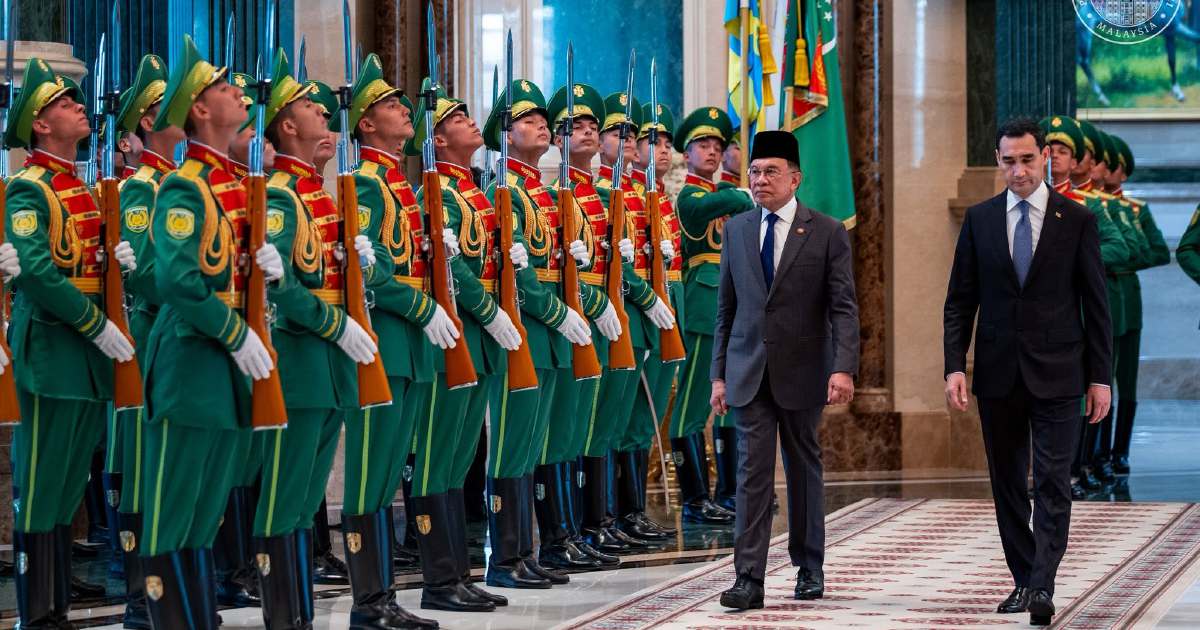
Prime Minister Datuk Seri Anwar Ibrahim's arrival at Turkmenistan's Presidential Palace today signals a significant expansion of Malaysia's diplomatic footprint into Central Asia, a region historically under-represented in Southeast Asian foreign policy priorities. The full ceremonial treatment accorded to the Malaysian premier marks his inaugural state visit to the energy-rich nation since assuming office, positioning it as a key moment in bilateral relations between Kuala Lumpur and Ashgabat.
The formal reception underscores Turkmenistan's strategic importance to Malaysia's broader engagement strategy in the post-pandemic era. As a nation sitting at the intersection of energy politics, cultural exchange, and emerging trade corridors, Turkmenistan represents untapped potential for Malaysian businesses and policymakers seeking to diversify beyond traditional economic partnerships in Southeast Asia and the Middle East. The Presidential Palace welcome reflects the host nation's recognition of Malaysia's significance as a Muslim-majority democratic nation with influence across the ASEAN bloc.
For Malaysia, this visit embodies a deliberate pivot toward Central Asian markets and political actors who have increasingly sought partnerships with Southeast Asian economies. The timing of Anwar's journey demonstrates the government's commitment to forging new alliances that could benefit Malaysian companies in sectors ranging from energy to technology and infrastructure development. Turkmenistan, endowed with substantial natural gas reserves and positioned along critical trade and transportation corridors connecting Europe, Asia, and the Middle East, offers compelling economic opportunities for diversification.
The ceremonial aspect of the reception carries symbolic weight in diplomatic circles. Official welcome ceremonies at presidential palaces are reserved for heads of state and other high-ranking dignitaries whose visits are deemed strategically important. The decision to extend such honours to Anwar reflects Turkmenistan's estimation of Malaysia's potential as a long-term partner and suggests discussions at the highest levels may have already paved the way for substantive bilateral arrangements.
From a regional perspective, Malaysia's enhanced engagement with Central Asia fits within a broader Southeast Asian repositioning. Nations across ASEAN have increasingly recognized that their economic futures are not confined to regional trade arrangements but extend to emerging markets and geopolitical players further afield. By establishing firmer diplomatic and commercial channels with Turkmenistan, Malaysia simultaneously strengthens its standing as a bridge between diverse economic zones and reinforces its role as a leader in exploring new partnership models.
The visit also carries implications for Malaysia's energy security strategy. While Southeast Asia possesses its own hydrocarbon resources, strategic partnerships with major gas-producing nations like Turkmenistan could provide Malaysia with additional supply options and negotiating leverage in global energy markets. This diversification approach has become increasingly relevant as countries reassess their dependencies and seek resilience through multiple sourcing partnerships.
Turkmenistan's response in hosting Anwar at the Presidential Palace suggests the Central Asian nation views Malaysia as a serious diplomatic interlocutor worthy of elevated engagement. For smaller nations seeking to expand their international relevance, such ceremonial receptions serve dual purposes: they honor the visiting dignitary while simultaneously signaling to the international community that their nation commands respect and maintains active relationships with significant regional powers. Turkmenistan's geographical position and hydrocarbon wealth have sometimes resulted in its diplomatic overtures being overlooked by Southeast Asian capitals, making this visit a potential course correction.
The absence of prior official visits by Malaysian prime ministers to Turkmenistan suggests this is genuinely new ground in bilateral relations. Historical patterns indicate that Southeast Asian leaders have typically focused their Central Asian engagement on Kazakhstan, Tajikistan, and Uzbekistan, leaving Turkmenistan somewhat peripheral to mainstream regional diplomacy. Anwar's visit therefore represents a conscious decision to broaden Malaysia's Central Asian footprint and correct this historical imbalance.
Trade and cultural dimensions will likely feature prominently in discussions between the Malaysian delegation and Turkmenistan's leadership. Both nations have Muslim-majority populations, a factor that could facilitate people-to-people exchanges and educational partnerships. Malaysian universities and businesses might explore openings for collaboration with Turkmen counterparts in sectors aligned with each nation's comparative advantages.
The formal reception also provides Anwar with an opportunity to articulate Malaysia's vision for regional cooperation to a Central Asian audience. As Malaysia continues positioning itself as a voice for developing nations and as a bridge between different civilizations, its engagement with Turkmenistan helps demonstrate that commitment extends beyond rhetoric to concrete diplomatic action.
Looking forward, this visit may catalyze further high-level exchanges and institutional linkages between Malaysian and Turkmen officials. The establishment of joint commissions, cultural exchange programmes, or business councils often follows such ceremonial encounters, building momentum toward deeper, more substantive collaboration. Malaysian companies operating in energy, petrochemicals, and infrastructure sectors stand to gain from enhanced government-to-government relationships paving the way for future contracts and joint ventures.
Anwar's reception at the Presidential Palace thus represents more than ceremonial protocol; it reflects evolving geopolitical calculus whereby Malaysia and Turkmenistan recognize mutual benefits in closer association. For Malaysia, it exemplifies the government's determination to expand beyond traditional geographical spheres of influence while maintaining its commitments to existing partnerships. The visit signals that Malaysia's strategic vision encompasses not merely Southeast Asia and the broader Indo-Pacific, but extends purposefully into Central Asia, a region whose economic and political importance continues rising in global affairs.