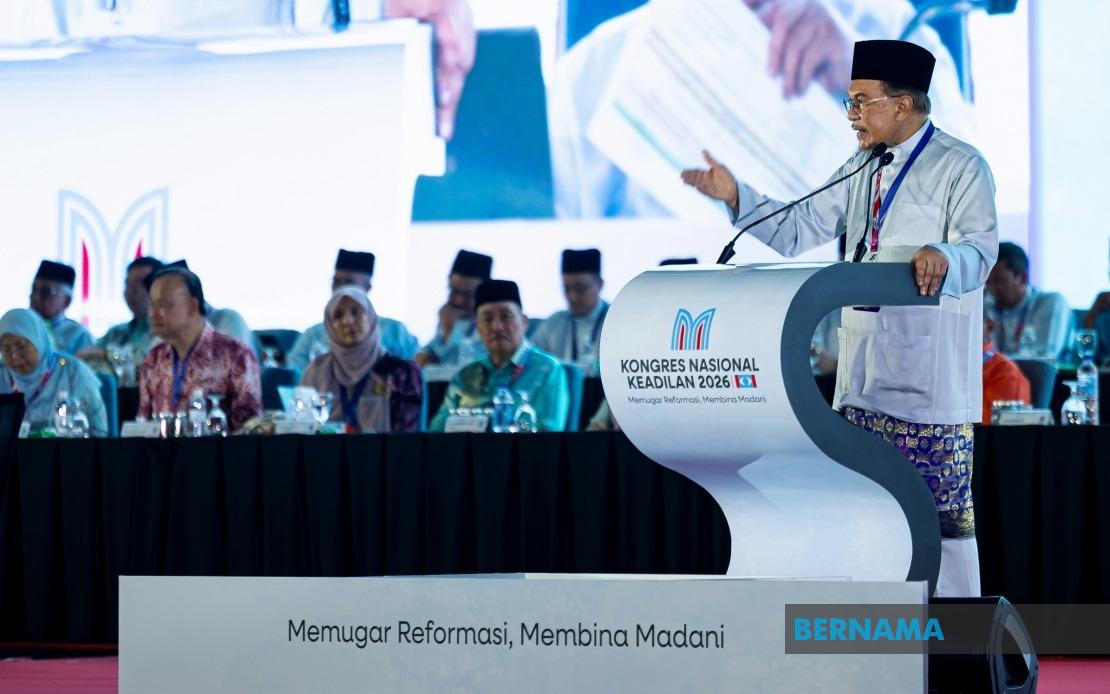
Prime Minister Datuk Seri Anwar Ibrahim has emphatically denied claims that his partnership with Deputy Prime Minister Datuk Seri Dr Ahmad Zahid Hamidi has deteriorated, describing allegations of a rift as merely one individual's subjective interpretation rather than an accurate reflection of their working dynamic. Speaking at the 2026 PKR National Congress in Melaka on August 15, Anwar underscored that his relationship with the BN chairman and UMNO president remains robust and functional, despite recent tensions within the Unity Government coalition.
The prime minister's comments represent a direct rebuttal to former Rembau Member of Parliament Khairy Jamaluddin, who claimed yesterday that trust between Anwar and Ahmad Zahid had reached its lowest point since the Unity Government was established following the 15th General Election in 2022. Khairy's assessment attributed the alleged cooling of relations to mounting friction between Pakatan Harapan and Barisan Nasional, particularly following BN's decision to align with Perikatan Nasional in the recent Negeri Sembilan state election, a move that appeared to undermine the national coalition's unity.
Anwar drew a philosophical distinction between his own approach to governance and Khairy's analytical framework, suggesting that fundamental differences in perspective explain their divergent interpretations of the current political landscape. He characterized his own methodology as peace-oriented and consensus-driven, contrasting this with what he described as Khairy's tendency to perceive political interactions through a lens of conflict and confrontation. This framing suggests that the prime minister views intra-coalition disagreements as manageable through dialogue rather than as harbingers of imminent collapse.
The timing of Anwar's remarks carries particular significance given the precarious nature of Malaysia's Unity Government, which has survived multiple tests since its formation nearly two years ago. The coalition bringing together PKR, UMNO, and various other parties has weathered previous crises through careful navigation and strategic concessions, but the recent Negeri Sembilan outcome illustrated the challenges of maintaining unified positions when component parties pursue divergent state-level strategies. BN's collaboration with the opposition-aligned Perikatan Nasional in that state election sent shockwaves through the national coalition, prompting questions about the sustainability of the arrangement.
During his presidential address at the Melaka International Trade Centre, Anwar took the opportunity to publicly acknowledge Ahmad Zahid's instrumental role in facilitating the initial formation of the Unity Government. By explicitly thanking the UMNO leader for his constructive cooperation in the post-election period, Anwar sought to reinforce the narrative of a functional partnership built on mutual respect and shared commitment to national stability. Such public gestures of appreciation serve multiple purposes within coalition politics, simultaneously shoring up personal relations and sending signals to party members and the broader public about the coalition's operational health.
The distinction Anwar drew between philosophical approaches to politics reflects deeper currents within Malaysian political discourse. His emphasis on peaceful resolution and dialogue contrasts with Khairy's apparent concern that underlying tensions have metastasized beyond repair. For Malaysian observers tracking coalition stability, this divergence highlights the challenge of assessing genuine relationships beneath public posturing. Coalition partners routinely maintain cordial public relations while managing substantive disagreements behind closed doors, making it difficult for outside analysts to determine whether fraying is merely superficial or indicative of structural problems.
Anwar's assertion that differences within parties or between coalition members can be resolved through calm discussion and peaceful methodologies speaks to a broader governing philosophy he has articulated repeatedly since assuming office. This approach has characterized his management of contentious issues ranging from economic policy to internal PKR dynamics, reflecting his conviction that inclusive dialogue yields more durable solutions than confrontational approaches. However, critics might argue that excessive emphasis on consensus and peaceful resolution can obscure fundamental incompatibilities between coalition members with competing interests and ideologies.
The stakes of this dispute extend beyond personal relations between two leaders. The stability of the Unity Government directly impacts Malaysia's political trajectory, economic policy direction, and institutional functioning. Should the coalition fracture along the lines that Khairy suggested, the consequences would ripple through parliament, state governments, and bureaucratic apparatus. Additionally, a collapse of the arrangement would likely benefit opposition forces and potentially trigger another round of electoral volatility that Malaysia's institutions have struggled to absorb in recent years. From this perspective, Anwar's investment in publicly affirming the relationship's health reflects rational coalition management rather than mere rhetoric.
The Negeri Sembilan situation that Khairy cited as evidence of deteriorating relations presents a genuine test case for understanding coalition dynamics. BN's willingness to cooperate with PN in that state election, despite the two blocs maintaining adversarial positions nationally, reveals the complex multilevel nature of Malaysian politics. State-level interests can diverge sharply from national coalition requirements, creating inevitable friction that political leaders must manage through sophisticated balancing acts. Anwar's framing of such disagreements as resolvable through discussion suggests confidence in the mechanism's durability, though others might interpret it as an overly optimistic assessment.
Moving forward, the credibility of both Anwar's assurances about coalition stability and Khairy's concerns about underlying fractures will face regular testing through actual political developments. Upcoming state elections, parliamentary votes on significant legislation, and resource allocation decisions will provide concrete opportunities to observe whether the purported partnership functions as advertised. For Malaysia's business community, foreign investors, and ordinary citizens dependent on effective governance, these behind-the-scenes coalition dynamics carry tangible implications that extend well beyond parliamentary theater. The next several months will likely clarify whether Anwar's optimism about dialogue-driven resolution is warranted or whether Khairy's warnings about eroded trust presage deeper structural problems within the Unity Government framework.

