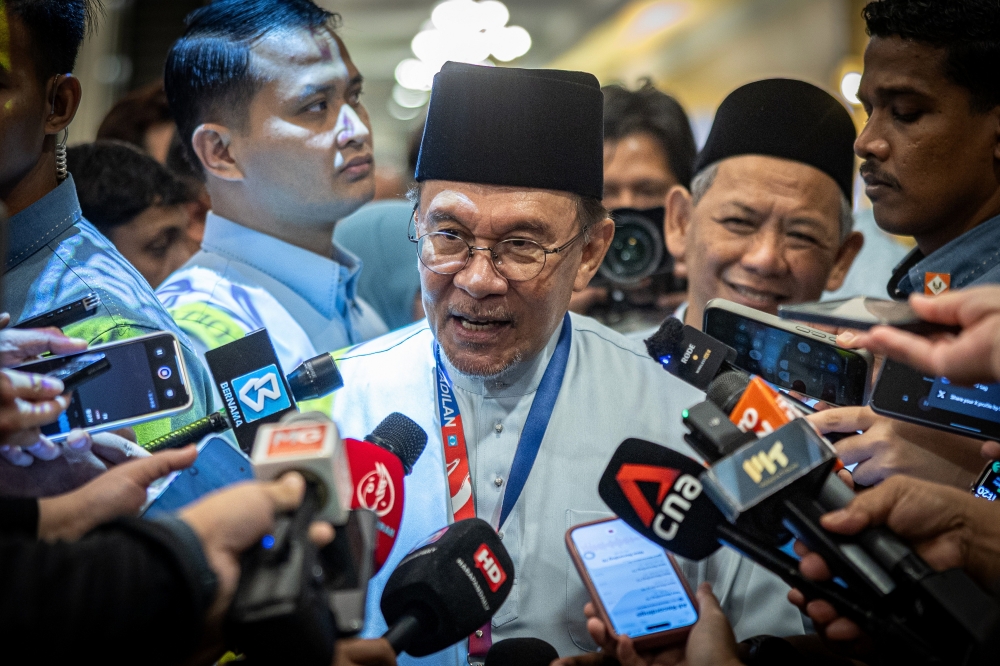
Prime Minister Datuk Seri Anwar Ibrahim moved swiftly to downplay mounting speculation about internal divisions within Malaysia's ruling coalition, asserting that his working relationship with Deputy Prime Minister Datuk Seri Zahid Hamidi remains intact and functional. Speaking in Melaka, Anwar took issue with recent public commentary suggesting cracks in the government's upper echelons, signalling that such narratives misrepresent the reality of day-to-day administration and the coalition's operational cohesion.
The Prime Minister's remarks came in response to observations from former Health Minister Khairy Jamaluddin, who had hinted at possible friction between the two senior leaders. Rather than engage in a prolonged rebuttal, Anwar characterised his approach to governance as deliberately measured and non-confrontational, framing this temperament as essential to maintaining the stability that Malaysia requires during a period of economic and social challenges. By emphasising the peaceful nature of his political philosophy, Anwar sought to position himself as a unifying figure willing to overlook trivial grievances in service of the broader national interest.
The timing of Anwar's statement reflects broader sensitivities within the government coalition. Since taking office, the administration has navigated a complex landscape of competing party interests, with component members occasionally signalling discontent over resource allocation, ministerial positions, and policy direction. The Pakatan Harapan-Barisan Nasional alliance, while formally intact, has shown signs of strain as parties vie for influence and public visibility. Zahid's role as Deputy Prime Minister represents a significant concession to Umno, Malaysia's dominant party, and any perception of marginalisation or conflict with the Premier could destabilise these delicate arrangements.
Zahid himself has occupied an increasingly complex position. As Umno president and deputy to a Pakatan-aligned prime minister, he must balance party loyalty with coalition responsibilities, a juggling act that occasionally generates speculation about his true allegiances and influence. His tenure in this dual role has occasionally been marked by public statements that, while carefully calibrated, hint at areas where the coalition might diverge. Whether intentional or not, such comments create openings for observers to construct narratives of disagreement between him and Anwar, something the Prime Minister appears keen to neutralise before such narratives gain traction.
Khairy's intervention in this dynamic adds another layer of complexity. As a former minister and prominent Umno voice, his commentary carries weight within party circles and the broader political establishment. His suggestions of internal friction, even if couched in measured language, risk amplifying concerns among investors and ordinary Malaysians about government stability. This is particularly significant given Malaysia's need to attract foreign investment and maintain investor confidence as it pursues economic recovery and structural reforms. Perceptions of political chaos, real or exaggerated, can trigger capital flight and constrain policymaking flexibility.
Anwar's emphasis on peaceful governance carries particular resonance given Malaysia's history of political transition and occasional turbulence. The Premier has frequently cast himself as a proponent of institutional stability and democratic norms, values that resonate with audiences concerned about the direction of national politics. By reinforcing this image now, he signals to both domestic and international audiences that the government remains fundamentally sound despite inevitable disagreements that characterise any multi-party coalition.
The coalition format itself requires constant maintenance. Unlike single-party governments, administrations built on alliance principles must accommodate diverse ideologies, regional interests, and constituent expectations. Zahid's presence in the deputy position represents a calculated compromise meant to secure Umno's cooperation with a government otherwise dominated by Pakatan parties. This inherently creates structural tensions that surface from time to time, requiring deft political management to prevent escalation into genuine rupture.
The dispute also illustrates how Malaysian media and political observers closely parse statements from senior leaders for hidden meanings and unstated disagreements. In this environment, Anwar's direct repudiation of rift claims serves to reset the narrative, at least temporarily. By explicitly rejecting characterisations of disharmony, he attempts to starve such speculation of oxygen while simultaneously reaffirming his commitment to coalition stability, a message his government needs to project consistently.
Looking ahead, maintaining coalition equilibrium will remain central to Anwar's political project. The next general election is years away, but the groundwork for political positioning has already begun. Any serious rupture between Anwar and Zahid could trigger a cascade of defections and realignment that would fundamentally alter Malaysia's political map. This high stakes dynamic explains why Anwar moved quickly to address Khairy's comments, attempting to establish definitional control over the narrative before alternative interpretations crystallise into political reality. The Prime Minister's measured tone and emphasis on peaceful resolution underscore that for now, the priority remains preserving the coalition architecture that sustains his government.

