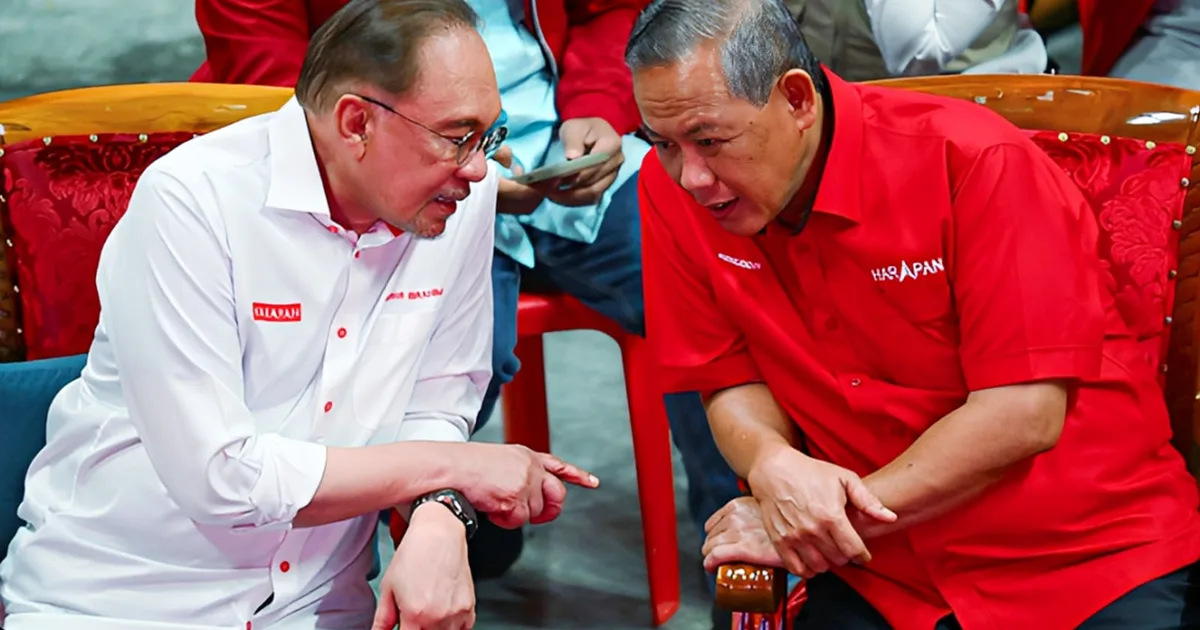
Prime Minister Anwar Ibrahim has underscored the ongoing relevance of Aminuddin Harun, the previous Negeri Sembilan menteri besar, in guiding and developing younger politicians within the PKR party structure. Speaking on the matter, the PKR president emphasized that Aminuddin's services and accumulated experience remain indispensable assets for the party as it looks to cultivate the next tier of capable leadership.
Anwar's remarks centred on a particular quality he identified in Aminuddin's political comportment: his dignified manner in confronting electoral defeat. Rather than deflecting responsibility or attributing setbacks to external factors, Aminuddin has demonstrated a willingness to accept unfavourable outcomes without recourse to blame or excuse-making. This approach, Anwar suggested, carries significant pedagogical weight for party members navigating their own political journeys.
The emphasis on Aminuddin's example speaks to a broader challenge facing Malaysian political parties in the contemporary landscape. As electoral competition intensifies and internal party dynamics grow more complex, the presence of senior figures who model integrity and accountability becomes increasingly valuable. Anwar's characterization suggests that beyond formal policy positions or administrative roles, Aminuddin's conduct itself serves as a training mechanism for younger cadres learning to navigate both victory and disappointment with equanimity.
For PKR specifically, which has experienced significant internal volatility and factional tensions in recent years, the retention of respected mentors carries strategic importance. Younger members observing how senior politicians conduct themselves during difficult periods absorb crucial lessons about institutional loyalty, personal resilience, and the distinction between healthy political competition and corrosive internal conflict. Aminuddin's publicly recognized grace in defeat may help inoculate the party against the recriminations and blame-shifting that sometimes destabilize political organizations.
The timing of Anwar's comments reflects the PKR's broader preoccupation with succession planning and institutional renewal. Having consolidated his position as party president and prime minister, Anwar appears focused on ensuring the party does not become overly dependent on any single individual. By elevating the mentoring role and emphasizing the importance of experienced figures like Aminuddin, Anwar signals an intention to distribute leadership responsibility more widely and create redundancy in the party's intellectual and moral capital.
Aminuddin's tenure as Negeri Sembilan menteri besar provided him substantial experience in state administration and coalition management during a period when Malaysia's political landscape underwent significant realignment. His subsequent role in various capacities within PKR and the broader Pakatan Harapan alliance has positioned him as a repository of institutional memory and practical knowledge about navigating complex political arrangements. For emerging leaders unfamiliar with the mechanics of coalition governance or the delicate balance required in managing competing interests, such experienced hands prove invaluable.
The notion of accepting electoral reversal without recrimination also carries implications for Malaysian democracy more broadly. When senior politicians model gracious acceptance of defeat, they reinforce norms of democratic competition rooted in genuine contest rather than existential struggle. This becomes particularly significant in a political culture where defeated politicians sometimes face legal persecution or institutional marginalization, creating perverse incentives for losers to respond aggressively rather than acceptingly.
Anwar's framing also suggests an understanding that institutional strength depends not merely on policy implementation or electoral success but on the cultivation of individuals capable of exercising leadership across varied circumstances. A party that produces only victorious politicians may lack the resilience to endure inevitable periods of opposition or setback. By valorizing Aminuddin's conduct during difficult periods, Anwar implicitly argues for a different conception of political excellence, one that encompasses the capacity to lose honourably as much as the capacity to govern effectively.
The emphasis on mentoring relationships within PKR further reflects global trends in political party management, where succession and institutional continuity have become pressing concerns. Malaysian political parties historically relied heavily on patriarchal, personality-driven leadership structures, but contemporary challenges—including generational turnover, electoral volatility, and institutional scrutiny—have created pressure to develop more systematic approaches to identifying and preparing future leaders. Anwar's acknowledgement of Aminuddin's mentoring potential suggests an attempt to balance traditional patronage networks with more formalized pathways for leadership development.
For younger PKR politicians seeking advancement, Anwar's comments establish a clear signal about which qualities the party values and rewards. Those who demonstrate integrity, resilience, and a commitment to institutional welfare rather than personal vindication may find themselves identified as suitable candidates for mentoring roles and higher office. Conversely, younger members who exhibit factional aggression or blame-shifting following disappointment may be implicitly marked as falling short of the party's professed standards.
The broader context of Malaysian politics suggests that such mentoring relationships operate under considerable strain. Political defections, constitutional amendments, and shifting coalition mathematics mean that parties cannot assume the permanence of alliances or the stability of factional arrangements that characterize more established democracies. In this environment, the presence of figures like Aminuddin who have navigated these transformations while maintaining institutional credibility provides both practical guidance and symbolic reassurance to younger members worried about the sustainability of their political commitments.

