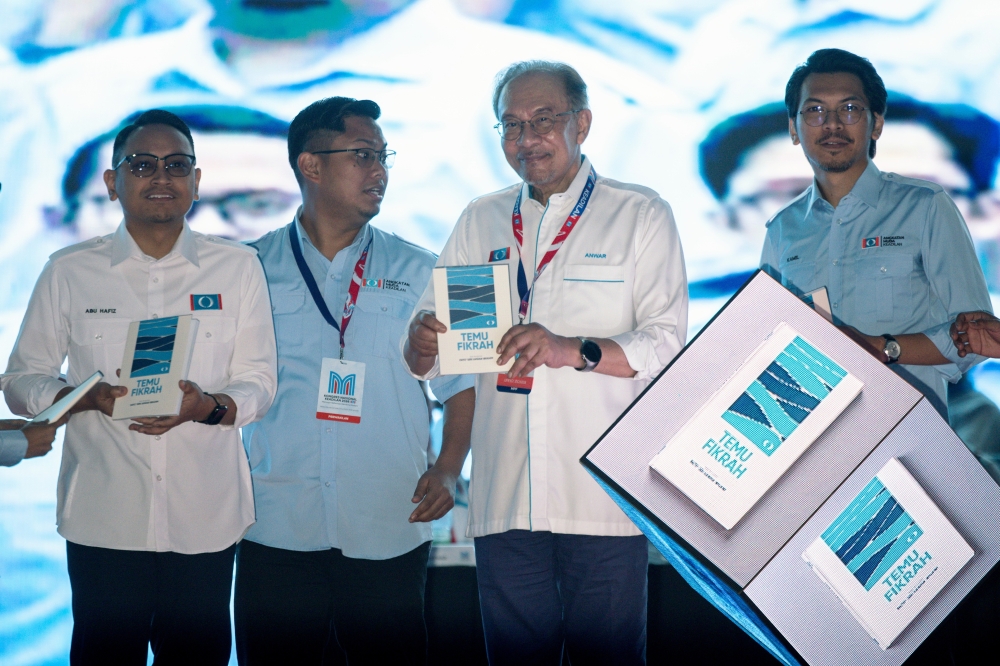
Prime Minister and Parti Keadilan Rakyat (PKR) president Datuk Seri Anwar Ibrahim has unveiled Temu Fikrah, an ambitious policy document crafted by the party's youth wing that merges ideological frameworks with pragmatic governance strategies. The launch, held in Melaka, represents a significant moment for PKR's younger generation, who have been tasked with translating the broader Madani governance agenda into concrete youth-oriented initiatives and leadership principles.
The Temu Fikrah initiative—translatable as a "confluence of ideas"—serves as both manifesto and operational manual, establishing benchmarks for how young PKR members should approach contemporary political challenges while remaining grounded in the party's foundational commitment to reformist values. Rather than functioning as a static policy declaration, the document appears designed as a living guide that encourages flexibility in application whilst maintaining ideological coherence, reflecting evolving understandings of how Madani principles can address diverse community needs across Malaysia's varied socioeconomic landscape.
The emphasis on courage within the Temu Fikrah framework suggests PKR Youth is positioning itself as willing to challenge institutional inertia and conventional thinking within government structures. This directional shift is particularly significant given Malaysia's political climate, where younger party members frequently navigate between demanding meaningful reform from leadership whilst maintaining party discipline. By institutionalizing courage as a governing principle, PKR Youth is essentially creating political space to propose bold ideas without risking accusations of disloyalty or factional dissent.
Creativity, as articulated through this blueprint, signals recognition that governance challenges increasingly demand unconventional solutions. Malaysia's young professionals and entrepreneurs have grown accustomed to innovation-driven sectors and digital-first approaches; embedding creativity into PKR's youth governance framework demonstrates the party's understanding that traditional bureaucratic responses to contemporary problems—from digital divide issues to gig economy regulations—risk appearing antiquated to younger voters. The manifesto likely explores how creative problem-solving can be systematized within government departments whilst preserving accountability.
The Madani governance dimension anchors these ideals to a specific vision that Prime Minister Anwar has been promoting since assuming office. Madani encompasses aspirations for inclusive prosperity, democratic deepening, and civilizational values embedded within Islamic principles, though interpreted through a pluralistic lens acknowledging Malaysia's multicultural character. By having PKR Youth formally adopt and localize these concepts through Temu Fikrah, the party creates institutional mechanisms ensuring that Madani governance doesn't become a top-down slogan but rather develops through bottom-up engagement with younger party members who will implement policies across constituencies.
The timing of this launch carries significance for PKR's internal dynamics and broader coalition politics. By elevating the youth wing's intellectual and programmatic role, Anwar signals commitment to succession planning and long-term party renewal beyond his own tenure. This move potentially addresses concerns among younger party members that decision-making remains concentrated among senior figures, whilst simultaneously strengthening the party's appeal to first-time and younger voters who increasingly expect political parties to demonstrate coherent frameworks addressing issues like climate change, digital rights, and economic opportunity.
For Malaysia's regional standing, PKR's articulation of youth-centered governance innovation holds implications beyond domestic politics. Southeast Asian democracies increasingly scrutinize how established parties adapt to demographic shifts and technological change; PKR's formalization of a youth-driven governance agenda positions Malaysia within regional conversations about modernizing political institutions whilst preserving institutional stability. Indonesia, Thailand, and the Philippines all wrestle with similar dynamics, and Malaysian approaches receive considerable attention among analysts monitoring democratic renewal across the region.
The manifesto-manual hybrid structure suggests sophisticated understanding that contemporary governance requires both principled clarity and operational flexibility. Young PKR members operating in diverse constituencies—from urban centers experiencing rapid gentrification to rural areas struggling with agricultural transformation—require guidance that provides direction without imposing uniform solutions. This flexibility becomes crucial when implementing policies across states with differing demographics, administrative capacities, and political contexts.
Implementation challenges will inevitably test Temu Fikrah's efficacy. Converting inspiring principles around courage and creativity into measurable outcomes within Malaysia's bureaucratic systems requires sustained institutional support, protective space for experimentation, and mechanisms for learning from failures. If the document remains confined to PKR Youth meetings whilst senior party members pursue conventional approaches, credibility will suffer among younger members who expected meaningful empowerment.
The launch also reflects broader shifts within Malaysia's political landscape, where parties increasingly recognize that electoral competitiveness depends on attracting younger voters through demonstrated commitment to their concerns and decision-making participation. PKR's formalization of youth-centered governance innovation suggests recognition that abstract commitments to inclusion prove insufficient; institutional structures must embed youth leadership throughout policy development and implementation.
Moving forward, the Temu Fikrah's ultimate significance will depend on whether PKR's senior leadership genuinely incorporates youth perspectives derived from the document's principles into government decision-making, or whether it functions primarily as symbolic gesture toward younger members. Successful implementation would demonstrate that Malaysian political parties can bridge generational divides through structured engagement while maintaining party coherence, a lesson with implications extending far beyond PKR itself.

