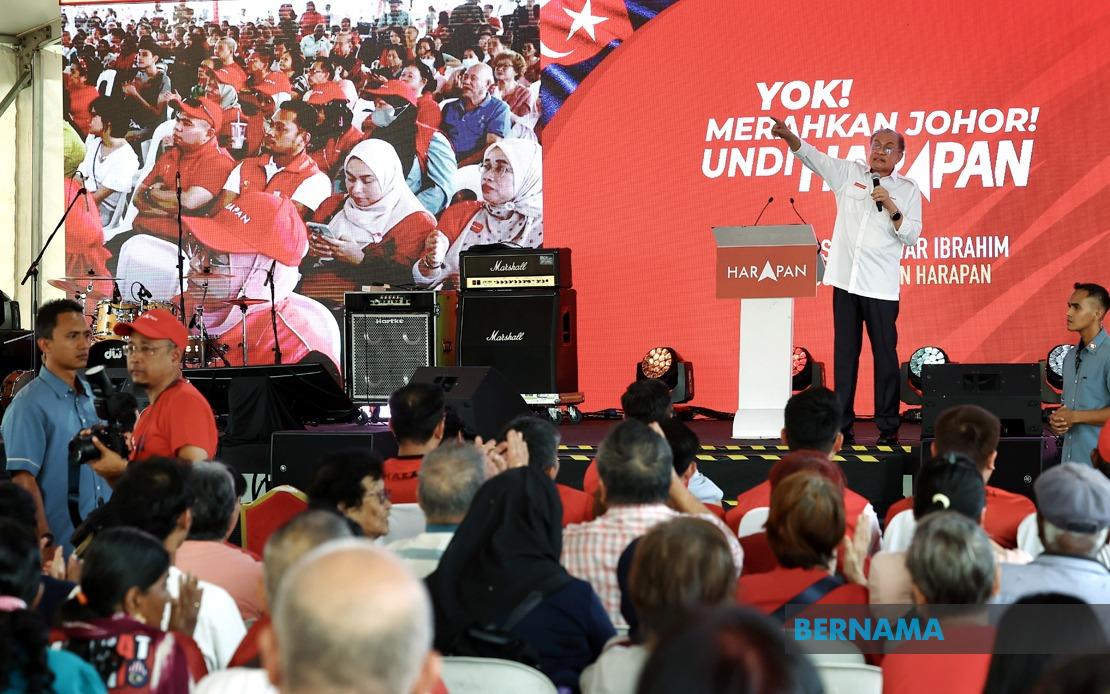
Prime Minister Datuk Seri Anwar Ibrahim has made a direct appeal to all parties campaigning in the upcoming Johor state election to cease deploying the matter of Datuk Seri Najib Razak's imprisonment as a tool for political advantage. Speaking at a Pakatan Harapan rally in Kulai on July 10, Anwar stressed that the public discourse should pivot away from the former premier's criminal conviction and toward substantive policy platforms centred on economic stewardship and improvements to living standards.
The timing of Anwar's intervention reflects growing concern within government circles that the Najib question—which continues to generate heated debate across Malaysian media and social platforms—risks dominating campaign messaging at the expense of forward-looking discussions on governance. By explicitly stating that Najib should be left to serve his sentence without further politicization, Anwar sought to redirect electoral competition toward territory more favourable to his coalition's policy record.
The financial legacy of the 1Malaysia Development Berhad scandal remains an acute vulnerability for Malaysia's public finances. The government currently bears a debt burden stemming from 1MDB that totals RM51 billion, a figure that underscores the scale of misappropriation that occurred under the previous administration. This staggering liability represents funds that could have been deployed toward expanding educational infrastructure, strengthening the healthcare system, upgrading transportation networks, or expanding poverty alleviation programmes.
Anwar's comments illuminate a fundamental tension in Malaysian politics: while the electorate's judgement on past corruption remains psychologically significant, the immediate material needs of voters—access to quality schools, adequate medical facilities, functioning roads, and food security—demand resources currently consumed by debt servicing. The premier's rhetoric attempted to reframe the Najib question from one of moral reckoning to one of opportunity cost, suggesting that continued fixation on his fate diverts attention from the concrete challenges facing ordinary Malaysians.
The gathering in Kulai, dubbed Yok! Merahkan Johor! Undi Harapan (roughly, "Come On! Make Johor Red! Vote for Hope"), included several key figures from the ruling coalition. Youth and Sports Minister Mohammed Taufiq Johari, Deputy Investment, Trade and Industry Minister Sim Tze Tzin, PKR Youth chief Muhammad Kamil Abdul Munim, and Pakatan Harapan candidate Arthur Chiong Sen Sern for the Bukit Batu seat were among those present, signalling the coalition's determination to mobilize grassroots support across the state.
The Johor state election represents a significant electoral contest for Pakatan Harapan, which has sought to consolidate its position in one of Malaysia's most strategically important states. By attempting to cordon off the Najib controversy and establish clearer boundaries around campaign discourse, Anwar appears to be calculating that his coalition benefits more from debates about current economic policy, job creation, and service delivery than from continued litigation of the crimes committed under his predecessor's watch.
Yet the appeal to move beyond the Najib question reveals something paradoxical about Malaysia's contemporary political landscape. Corruption and its consequences cannot be entirely separated from present economic challenges; the debt burden Anwar cited exists precisely because Najib's administration diverted billions through a complex scheme involving multiple financial intermediaries and international transactions. To discuss the RM51 billion overhang is inherently to invoke the scandal that created it, even if Anwar wishes to shift the frame from criminal accountability to fiscal responsibility.
The opposition's response to Anwar's exhortation will prove instructive. Conservative and increasingly Islamist-aligned parties may resist his invitation to deprioritize the Najib narrative, viewing his incarceration as either a cautionary tale about the ruling coalition's supposed vindictiveness or as unfinished business requiring redemption. Meanwhile, other opposition factions might calculate that economic management and public service delivery offer more fertile ground for criticism of the current administration's record.
For voters in Johor and across Malaysia, Anwar's intervention underscores a broader challenge: how societies reckon with past abuses while simultaneously addressing present needs. The premier's implicit argument—that dwelling on Najib's fate is a luxury Malaysia cannot afford—assumes that citizens can neatly partition their concerns. In practice, many voters likely view accountability for high-level corruption and effective current governance as mutually reinforcing rather than competing priorities.
The Johor election will ultimately reflect how persuasive Anwar's reframing proves among the electorate. Should Pakatan Harapan perform strongly, it would suggest that voters prioritize the coalition's promises on economic matters and social provision. Conversely, if opposition parties make gains by highlighting unresolved questions about institutional reform and the pursuit of accountability, it would indicate that the public is not prepared to file away the corruption question, regardless of calls from the prime minister's office.
Anwar's plea also carries implications for Malaysia's institutional development. A maturing democracy ideally manages to address past injustices while building functioning institutions for the future. By calling for a cessation of campaign rhetoric around Najib's case, however, Anwar risks leaving the impression that the ruling coalition regards the episode as closed—a position that may alienate constituencies invested in deeper reforms to prevent future lapses in governance and financial stewardship.

