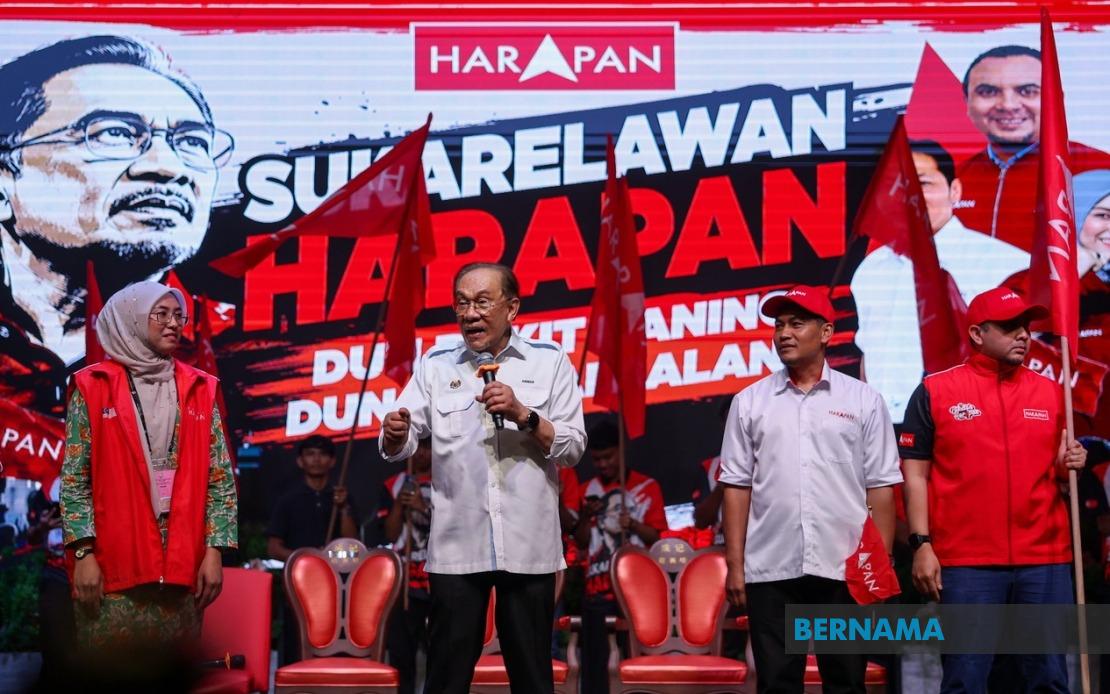
Prime Minister Datuk Seri Anwar Ibrahim has made an impassioned call to young voters in Johor to abandon divisive racial politics and instead harness the upcoming state election as an opportunity to elect leaders genuinely committed to their economic and social wellbeing. Speaking during a campaign stop in Muar on Monday, the Pakatan Harapan chairman framed the contest as a pivotal moment for younger voters to break away from outdated political narratives that exploit communal tensions rather than address substantive challenges affecting their lives.
Anwar's message centred on redirecting electoral choices toward tangible concerns that matter most to young Malaysians: educational quality, job creation prospects, and infrastructure development. He argued that voters, particularly those entering the political process for the first time, must develop the critical awareness to see through manipulation and recognise when political leaders are deliberately stoking fear and resentment as a distraction from their own self-enrichment. The Prime Minister directly challenged what he characterised as a deliberate strategy to pit ethnic communities against one another while elites benefit from the resulting chaos and division.
The remarks represent a broader strategic emphasis within the PH campaign to mobilise youth participation in Johor's 56 contested state seats. With 172 candidates competing in the election scheduled for July 11, the party recognises that younger voter turnout could prove decisive in determining the political complexion of Malaysia's second-largest state by population. Anwar's presence at the Bukit Naning volunteer programme launch, alongside PH candidates Nazri Abd Rahman and Md Ysahrudin Kusni, underscored the coalition's intention to saturate electoral discourse with anti-corruption and pro-development messaging.
The Prime Minister expressed visible enthusiasm about what he described as extraordinary youth participation at campaign events. Drawing on his extensive track record spanning more than a decade in opposition politics, Anwar characterised the contemporary moment as historically distinctive in its manifestation of generational desire for systemic change. He explicitly encouraged young volunteers to become grassroots advocates in villages, neighbourhoods, and districts, tasking them with communicating a coherent narrative about the coalition's capacity to deliver genuine transformation beyond rhetorical promises.
Yet Anwar's campaign rhetoric also contains a deeper critique of what he identifies as an outmoded political methodology employed by what he terms the "old guard." His invocation of Malaysia's multi-ethnic founding principles as fundamentally incompatible with race-baiting politics frames the election partly as a generational contest over the nation's political identity. By characterising communal discord narratives as analogous to sabotaging national unity—Malaysia's historical strategic advantage in a diverse Southeast Asian context—Anwar presents cross-ethnic solidarity not merely as a moral imperative but as a pragmatic necessity for national competitiveness and stability.
The election campaign occurs within a complex political environment where Johor has traditionally served as a stronghold for the Barisan Nasional coalition. PH's efforts to recapture ground in the state following mixed results in previous electoral contests suggest genuine strategic competition that goes beyond symbolic campaigning. Early voting scheduled for July 7, two days before the main election, provides a mechanism to test preliminary momentum and voter mobilisation effectiveness across different demographic segments.
Anwar's specific exhortation that young people must reject passivity and assume responsibility for constructing an inclusive future carries particular weight given Malaysia's ongoing conversations about institutional reform and good governance. The emphasis on youth agency rather than top-down leadership prescription reflects a recognition that generational change typically requires younger voters to become active shapers of political outcomes rather than merely choosing between pre-determined alternatives. This framing potentially energises supporters while simultaneously creating a standard against which subsequent PH performance can be measured.
The Prime Minister's references to Malaysia's religious and ethnic diversity—mentioning Malays, Chinese, Indians, and Orang Asli specifically—are calculated to reinforce an inclusive political vision that contrasts with any competitor messaging premised on communal advantage or hierarchical protectionism. His invocation of mutual respect and collective care as binding principles attempts to reorient electoral competition away from zero-sum identity contests toward shared development objectives that theoretically benefit all communities proportionally.
For Malaysian readers and regional observers, the Johor contest represents a significant test of whether anti-corruption and development-focused messaging can successfully compete with identity-based political appeals in a state where such appeals have historically demonstrated considerable electoral traction. The outcome will likely influence both domestic political calculations and the broader trajectory of Malaysia's democratic culture heading into subsequent electoral cycles. Whether youth mobilisation translates into actual voter behaviour changes remains to be determined when Johor residents cast ballots in the coming week.

