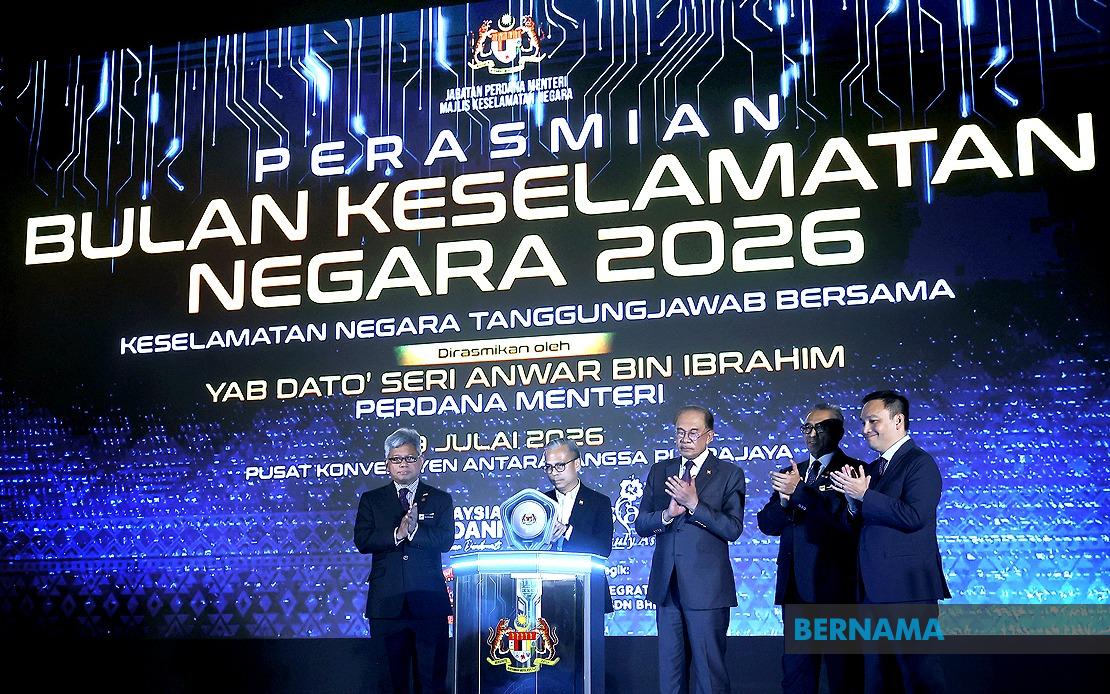
Prime Minister Datuk Seri Anwar Ibrahim has issued a pointed warning against the persistent exploitation of state, race and religious sentiments in Malaysian politics, contending that such divisive narratives threaten to undermine national cohesion precisely when the country confronts its most serious security challenges. Speaking at the launch of National Security Month 2026 in Putrajaya on July 9, Anwar articulated growing frustration with the tendency of political actors to relitigate long-standing communal and identity disputes even as Malaysia grapples with technological, cyber and digital security threats that demand urgent, coordinated attention.
The Prime Minister's remarks carry particular weight given his position overseeing both national security policy and the country's finances. His observation that parliamentary debates continue to circle around established fault lines of ethnicity, religion and provincial allegiances reflects a broader concern within government circles that Malaysia's political establishment remains trapped in older patterns of contestation that diminish capacity to address contemporary security imperatives. This disconnect between the substance of ongoing political arguments and the actual nature of threats confronting the nation represents a structural vulnerability in Malaysia's ability to respond cohesively to emerging dangers.
Anwar emphasised during his address that the proliferation of identity-focused political rhetoric obscures a fundamental reality: Malaysia now inhabits a threat environment characterised by rapid technological change, sophisticated digital vulnerabilities, and security challenges that transcend conventional frameworks. The rise of cyber-enabled attacks, disinformation campaigns, and technologically-mediated security risks requires a departure from the adversarial political patterns that have long structured Malaysian public discourse. By framing divisive sentiments as both strategically counterproductive and morally indefensible given current circumstances, Anwar has sought to reposition national unity not merely as an aspirational value but as a pragmatic necessity.
The gathering at the National Security Council headquarters included senior government figures across multiple portfolios, underscoring the whole-of-government approach that Anwar believes necessary to confront evolving threats. Communications Minister Datuk Fahmi Fadzil, Chief Secretary to the Government Tan Sri Shamsul Azri Abu Bakar, and National Security director-general Datuk Raja Nurshirwan Zainal Abidin all participated in the event, signalling institutional buy-in for the Prime Minister's security-focused agenda. The presence of these officials reflected recognition that addressing complex security challenges requires coordination across administrative, communications and national security apparatus.
Crucially, Anwar moved beyond mere criticism of divisive politics to articulate an affirmative vision of institutional responsibility. He called upon leaders throughout government departments, agencies and ministries to adopt fundamentally proactive postures rather than awaiting emergencies before mobilising response capabilities. This distinction between reactive and anticipatory governance speaks to a broader philosophical divergence in how Malaysia should approach its security challenges. Traditional bureaucratic approaches that operate within established procedures and precedents prove insufficient when confronting security threats that evolve with technological innovation and global strategic shifts.
The Prime Minister's insistence that government officials develop rapid understanding of emerging technologies and novel security vectors addresses a critical gap in Malaysia's institutional capacity. Many government agencies operate according to protocols and procedures established in earlier eras, creating lag times between the emergence of new threats and the formulation of appropriate responses. By explicitly tasking government leaders with accelerating their comprehension of technological security challenges, Anwar has identified a source of institutional vulnerability that demands immediate remediation. The complexity of twenty-first-century security threats exceeds the expertise typically embedded in traditional government structures designed for earlier periods.
Anwar's warnings about the persistence of "old political polemics" carry implicit acknowledgment that Malaysian politicians across the spectrum continue leveraging identity-based appeals despite their diminishing relevance to actual security concerns. The Prime Minister's characterisation of these recurring debates as distractions rather than substantive matters reflects frustration that political actors have not yet internalised the transformation in Malaysia's threat landscape. Whether this reflects genuine ideological commitment to communal politics or strategic calculation about the electoral salience of identity issues, the effect remains problematic: domestic political energy devoted to historical grievances and communal positioning diminishes capacity for collective action on shared security imperatives.
The timing of Anwar's remarks during National Security Month 2026 provided an institutional platform for reframing the national conversation around threats and governance priorities. By elevating this message through an official security-focused programme, the government sought to signal that the transition from identity-based political conflict toward security-centred governance represents not merely the Prime Minister's personal preference but official policy orientation. National Security Month serves partly as a symbolic occasion to reorient public and institutional attention toward security imperatives that otherwise remain peripheral to ongoing political debate.
For Malaysia's civil service and security apparatus, Anwar's emphasis on proactive institutional adaptation carries significant implications. Agencies must invest in developing technological literacy, establishing forward-looking threat assessment capabilities, and creating organisational structures nimble enough to respond to rapidly evolving security challenges. The traditional hierarchical bureaucratic model, while providing clarity of command and accountability frameworks, often struggles to accommodate the adaptive learning and rapid decision-making that contemporary security governance demands. Anwar's message implicitly calls for institutional modernisation alongside the geopolitical and technological reorientation of security thinking.
The Prime Minister's intervention into these debates also reflects recognition that Malaysian political discourse has not adequately processed the transformation in security threats confronting Southeast Asia more broadly. Regional developments including great power competition, maritime security challenges, and transnational criminal networks operating across digital and physical domains require coherent national responses that cannot emerge from political systems preoccupied with historical communal grievances. By attempting to redirect political energy and institutional focus toward these contemporary challenges, Anwar has positioned himself as advocating for strategic rationality and institutional modernisation against the gravitational pull of established political patterns.

