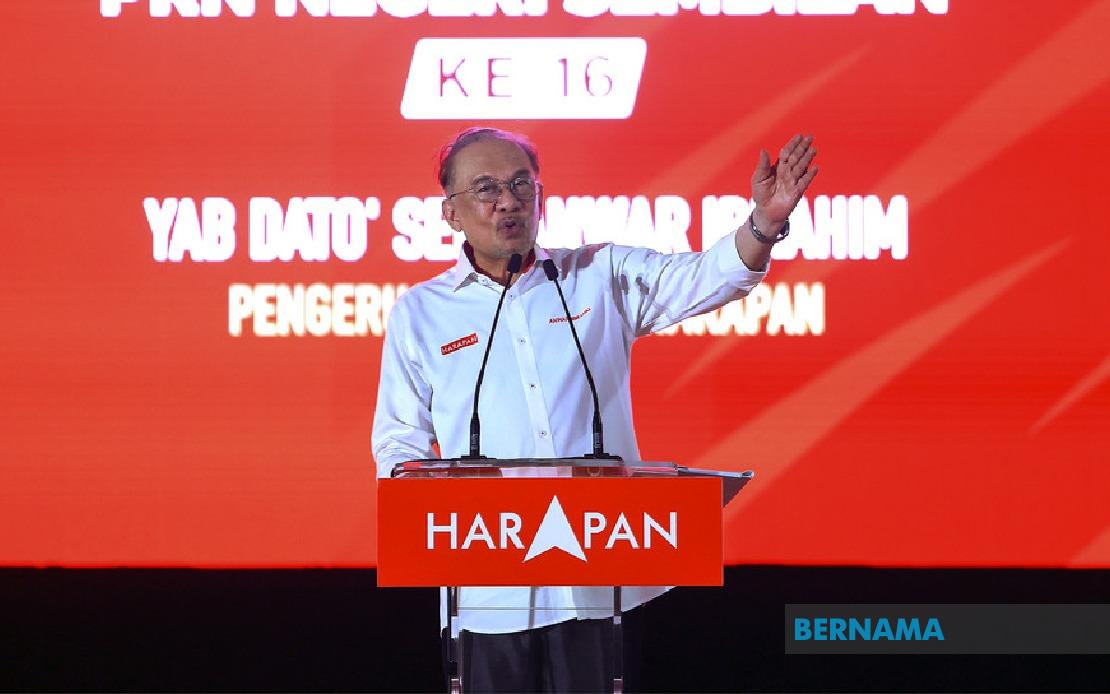
Prime Minister Datuk Seri Anwar Ibrahim has made a direct appeal to voters in Negeri Sembilan to sustain their backing for Pakatan Harapan, arguing that continued electoral support is essential to maintaining the development trajectory the state has experienced in recent years. In a social media statement released ahead of the 16th Negeri Sembilan state election, Anwar, who leads PH as its chairman, framed the upcoming ballot as a pivotal moment for the state's future, emphasizing that voter confidence is prerequisite to completing unfinished projects and launching new initiatives.
The partnership between the state administration under Menteri Besar Datuk Seri Aminuddin Harun and the federal government has proven instrumental in accelerating infrastructure and development work, Anwar suggested. This inter-governmental alignment, he contended, has allowed for streamlined decision-making and more efficient deployment of resources across multiple sectors. However, Anwar cautioned that this productive collaboration and its tangible results remain contingent on political continuity at the state level, implying that a change in administration could jeopardize ongoing programmes or disrupt planned initiatives.
Anwar offered a personal endorsement of Aminuddin Harun, whom he referred to by his commonly used nickname "Tok Min," describing the Menteri Besar's tenure since 2018 as exemplary. He cited integrity, humility, and a demonstrated commitment to public accountability as defining characteristics of Aminuddin's leadership. This characterization serves as an implicit contrast to potential alternative administrations, suggesting that governance quality and ethical standards are central to PH's campaign positioning in the state.
The Prime Minister's invocation of religious sentiment through the phrase "Alhamdulillah" and "Insya-Allah" resonates with the predominantly Muslim electorate in Negeri Sembilan and reflects a broader strategy of embedding PH's political message within familiar cultural and spiritual frameworks. This rhetorical approach has become increasingly common in Malaysian electoral discourse, where appeals to faith and moral governance carry considerable persuasive weight.
Anwar's plea to voters not to allow progress to "come to a halt halfway" carries implications about the risks of political disruption. The phrase suggests that abandoning PH would mean discarding achievements already secured and losing momentum toward future milestones. This framing positions a PH victory not merely as a preference but as a necessity for uninterrupted development—a particularly effective argument in states where residents have witnessed concrete improvements in infrastructure, public services, or economic activity under incumbent administrations.
The timing of Anwar's appeal is strategically significant. With nominations scheduled for Saturday, early voting set for July 28, and polling day on August 1, the electoral campaign is entering its intensive final phase. At this juncture, PH's leadership is mobilizing high-profile figures to consolidate support and address any wavering voters, recognizing that margin of victory could prove decisive in determining whether PH maintains its grip on the state assembly or faces unexpected challenges.
For Malaysian readers and Southeast Asian observers, this election holds broader implications for national politics. Negeri Sembilan's outcome will serve as a barometer of public sentiment toward the federal PH administration, which has navigated significant political turbulence since its 2022 formation. A decisive PH victory would reinforce Anwar's claim that his government retains public confidence, while a diminished majority or loss of control could embolden opposition forces and complicate his legislative agenda in Parliament.
The emphasis on clean and stable governance reflects PH's core messaging since the party's 2018 electoral breakthrough, when anti-corruption and institutional reform became central to its electoral appeal. By reiterating these themes in Negeri Sembilan, Anwar is attempting to maintain the moral authority that underpinned PH's earlier successes, even as his administration has faced criticism from some quarters for not delivering sufficiently on earlier reform promises.
Aminuddin Harun's political profile has grown substantially during his tenure as Menteri Besar, and his re-election would likely strengthen his position within PH's leadership hierarchy. Given the competitive dynamics within the coalition, particularly between the party's three constituent members, state-level electoral victories become crucial for factional positioning and resource allocation within the broader PH structure. A strong showing in Negeri Sembilan would enhance Aminuddin's standing and potentially influence his trajectory toward higher office.
The state election also reflects Malaysia's transition toward more competitive federalism, where state governments increasingly exercise meaningful autonomy in policy-making and budget allocation. Negeri Sembilan's development outcomes under PH are thus not merely matters of local concern but test cases for the viability of PH's governance model across Malaysia's diverse states. Success here could be leveraged in upcoming elections in other states where PH seeks to expand or consolidate control.
For opposition parties, particularly those that retained significant presence in Negeri Sembilan during the 2022 general election, this state contest represents an opportunity to demonstrate alternative governance capacity or to exploit any dissatisfaction with the incumbent administration. The closeness of the expected competition underscores the fragility of political dominance in contemporary Malaysia, where electoral outcomes increasingly depend on localized issues and campaign execution rather than national factors alone.

