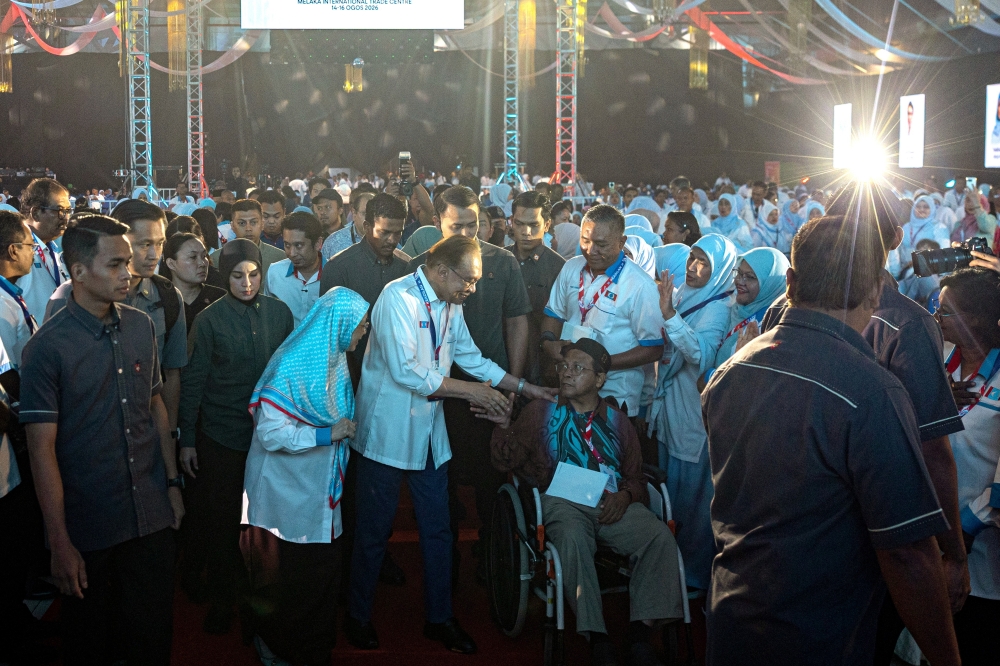
Prime Minister Anwar Ibrahim has set clear parameters for his party's engagement with Umno, emphasizing that tactical decisions must be rooted in rational assessment of public benefit rather than reactive emotion. Speaking to PKR delegates in Melaka, the PKR president stressed the importance of maintaining focus on substantive governance outcomes when evaluating the party's relationship with its coalition partner, a stance that reflects the delicate balancing act required in managing Malaysia's current political architecture.
The statement carries significant weight within the context of Malaysian coalition politics, where historical grievances between parties often threaten the stability of working partnerships. Anwar's intervention appears designed to inoculate his party against internal pressure from delegates who may harbour reservations about collaborating with Umno, a party with which PKR has traditionally maintained an adversarial relationship. By framing the issue as one of pragmatic governance rather than ideological purity, the Prime Minister is attempting to establish a benchmark for evaluating coalition performance that transcends personality-driven politics.
The timing of this message suggests heightened awareness within the government of latent tensions between coalition partners. Malaysia's political landscape remains fragmented, with no single party commanding an absolute parliamentary majority without strategic alliances. PKR's continued partnership with Umno represents a pragmatic necessity rather than a natural ideological alignment, making the relationship inherently vulnerable to fluctuations in sentiment among party activists and rank-and-file members. Anwar's emphasis on welfare-centred decision making serves as a defensive mechanism against dissent that could undermine coalition cohesion.
This approach has particular resonance for Malaysian voters who have grown weary of politics characterized by personal vendettas and factional squabbling. Public opinion research consistently demonstrates that ordinary citizens prioritize delivery on bread-and-butter issues—economic stability, employment, education quality, and healthcare provision—over abstract political principles. By anchoring coalition management in demonstrable benefits to the population, Anwar is positioning his leadership as mature and future-oriented, contrasting with the zero-sum political culture that previously dominated Malaysian governance.
The emphasis on people's welfare rather than partisan anger also reflects lessons from Malaysia's recent political history. The country has experienced multiple cycles of coalition breakdown and realignment, each characterized by acrimonious public disputes that eroded public confidence in institutions. The Sheraton Move of 2020, which dramatically reshuffled political alignments, demonstrated the destabilizing consequences of prioritizing factional victory over coherent governance. Anwar's statement appears designed to prevent a repetition of such destabilizing events by establishing a principled framework for coalition conduct.
For PKR delegates, the message functions as both instruction and reassurance. The instruction is clear: criticisms of Umno collaboration must be evaluated against measurable improvements in citizens' lives rather than historical animosity. The reassurance addresses concerns that partnership with Umno represents capitulation or betrayal of PKR's reformist mission. By tying continuation of the alliance to demonstrated welfare outcomes, Anwar is effectively creating accountability mechanisms while defending the coalition's legitimacy. Should the partnership fail to deliver tangible benefits, the framework provides intellectual justification for recalibration without loss of face.
The statement also carries implications for Umno's internal dynamics. The party has undergone significant transformation since the 1MDB scandal and subsequent electoral defeat, with younger leadership seeking to reposition the organization as genuinely reformist. Anwar's measured approach provides political space for moderate elements within Umno to strengthen their position by demonstrating commitment to concrete governance improvements. Conversely, hardliners who view the PKR partnership as temporary expedience face pressure to demonstrate that their approach also serves public interests rather than merely accumulating power and patronage.
Regionally, Malaysia's coalition management serves as a case study for other Southeast Asian democracies struggling with fractious multi-party systems. Thailand, Myanmar, and Cambodia have experienced repeated instability stemming from inability to build durable coalitions based on shared governance objectives. Malaysia's evolution toward explicitly welfare-based coalition criteria represents a potential institutional innovation worth observing, though translating principles into practice remains challenging amid competing party interests and historical grievances.
The broader governance context also shapes the significance of Anwar's statement. Malaysia faces economic headwinds, with inflation affecting lower-income households and employment pressures among youth. The coalition government's ability to deliver tangible improvements in living standards will likely determine both the durability of current political arrangements and the Prime Minister's political capital. By making welfare outcomes the measure of coalition success, Anwar is accepting significant political risk: failure to improve conditions would not only jeopardize PKR's electoral prospects but could also validate critics who argue that the coalition arrangement serves elite interests rather than public welfare.
Moving forward, the framework established in Melaka will likely shape how internal PKR discussions regarding Umno are conducted. Rather than purely emotional or historical arguments, party forums will increasingly feature evidence-based assessments of coalition performance on specific policy metrics. This represents a maturing of Malaysian political discourse, even if perfect adherence to rational criteria remains unlikely given the deeply emotional nature of partisan identity. Whether this principled approach can survive the inevitable tensions and disappointments of coalition governance remains an open question, but Anwar's deliberate positioning suggests recognition that Malaysia's political stability depends on transcending the cycles of conflict that have repeatedly destabilized the country.

