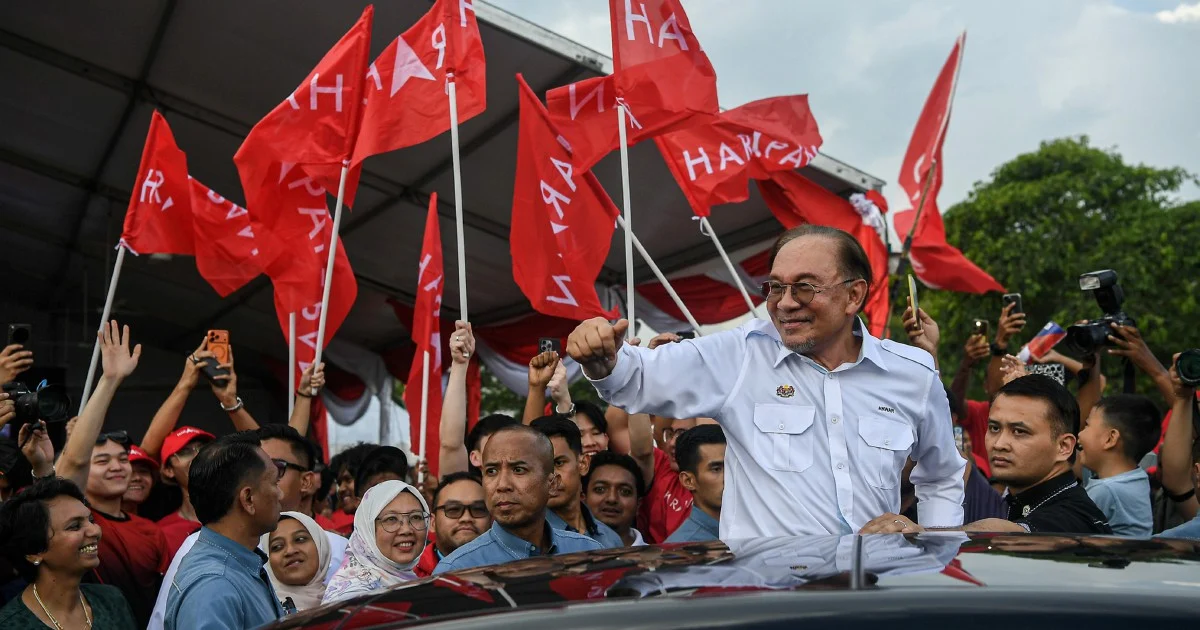
Prime Minister Datuk Seri Anwar Ibrahim launched a pointed critique of political rivals in Segamat, addressing what he characterises as an unwillingness among some politicians to engage constructively with DAP within coalition frameworks. His comments signal ongoing tension within Malaysia's political landscape, where certain parties maintain reservations about working alongside the Democratic Action Party despite Pakatan Harapan's electoral victories.
Anwar, who leads Pakatan Harapan as chairman, contended that politicians who refuse to occupy the same platform as DAP are engaging in behaviour detrimental to Malaysia's democratic fabric. The remark reflects deeper concerns within the ruling coalition about fragmentation along ideological and communal lines, even after voters endorsed PH-led governance in recent electoral cycles. Such boycotts or avoidance strategies, Anwar suggested, represent a fundamental failure to honour the democratic mandate that Malaysian citizens have granted.
The Segamat statement arrives at a juncture when coalition unity faces periodic strain, particularly around questions of DAP's role and representation. Political observers note that certain Malay-majority parties and constituencies harbour lingering apprehension regarding DAP's positioning on religious and communal issues, creating friction within broader ruling arrangements. Anwar's intervention appears designed to reframe this conversation, positioning acceptance of DAP not as ideological capitulation but as respect for electoral outcomes.
For Malaysian voters and political analysts, Anwar's message carries implications beyond symbolic reconciliation. The Pakatan Harapan coalition depends on functional cooperation between parties with distinct constituencies and policy priorities. When senior components refuse collaborative arrangements with others, governance capacity diminishes, and legislative effectiveness suffers. Anwar's critique thus touches on practical governance challenges, not merely ideological disagreements.
The timing of these remarks within PH's broader political strategy warrants attention. The coalition faces pressure from both internal critics questioning its unity and external opponents seeking to exploit divisions. By framing DAP cooperation as a democratic principle rather than a controversial political choice, Anwar attempts to shift discourse away from identity-based objections toward procedural and legitimacy-based frameworks. This rhetorical reorientation matters for how political elites and ordinary citizens understand coalition governance.
DAP, as Malaysia's largest Chinese-majority party, occupies a peculiar position within national politics. Its coalition partners frequently face criticism from opponents who characterise DAP's presence as unrepresentative or problematic. These attacks have gained traction in certain electoral zones, particularly where communal sensitivities run high. Anwar's defence of DAP's partnership rights thus serves party interests while also advancing broader arguments about coalition legitimacy.
The Prime Minister's statement also addresses a pattern observable across Southeast Asian democracies, where governing coalitions struggle to maintain internal cohesion. Thailand, Indonesia, and other regional neighbours have experienced similar coalitional tensions, often exacerbated when minorities or particular communities face exclusion from power-sharing arrangements. Malaysia's particular challenge involves balancing constitutional protections for Bumiputera interests with inclusive governance frameworks that accommodate diverse political forces.
Regional analysts monitoring Malaysian political development view Anwar's interventions as indicative of his commitment to maintaining coalition stability despite obvious strains. His leadership style emphasises procedural legitimacy and democratic principles rather than sectarian appeals. Whether this approach proves sufficient to sustain PH unity through upcoming electoral cycles remains an open question, particularly if opposition parties successfully mobilise communal anxieties around DAP's presence.
For ordinary Malaysians navigating political choices, statements such as Anwar's attempt to legitimise coalition partnerships on democratic grounds. The implicit argument holds that voters who selected PH endorsed its constituent parties collectively, rendering subsequent rejection of individual components inconsistent with democratic respect. This framing invites citizens to view inter-party disputes within coalitions as secondary to the primary mandate delivered through elections.
The broader context includes Malaysia's relatively young democracy, where institutional norms around coalition building and power-sharing remain contested. Unlike established democracies with deep traditions of coalition governance, Malaysian political culture continues negotiating these arrangements. Anwar's emphasis on democratic principle and voter respect represents one effort to anchor such negotiations in procedurally defensible ground.
Moving forward, the success of Anwar's argument depends partly on whether coalition governance under PH demonstrates real benefits to voters—economic growth, reduced corruption, equitable service delivery—that transcend intercommunal suspicions. Alternatively, if the coalition proves administratively ineffective, arguments about respecting democratic mandates lose persuasive force. Political rivals seeking to exploit divisions will emphasise governance failures rather than engaging substantive debates about democratic principle.
The Segamat remarks thus deserve interpretation as part of a larger strategic effort by PH leadership to establish coalition governance on firmer institutional and ideological foundations. Whether Anwar succeeds in shifting political conversation away from communal anxieties toward democratic legitimacy frameworks will meaningfully influence Malaysian politics across multiple electoral cycles.

