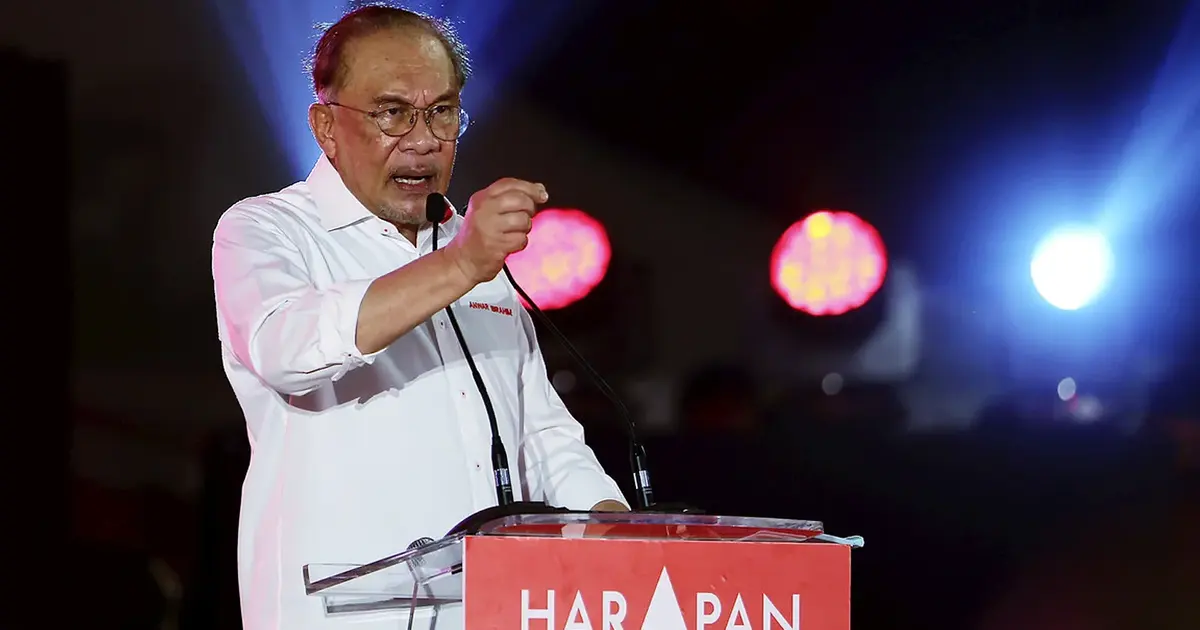
Prime Minister Anwar Ibrahim has issued a pointed warning to political parties contesting in the Negeri Sembilan state election, urging them to refrain from dragging the state's royal institution into the electoral fray. Speaking in his capacity as chairman of Pakatan Harapan, Anwar emphasised that matters touching on the monarchy must remain insulated from the rough-and-tumble of campaign politics, a position that reflects the delicate constitutional status accorded to Malaysia's royal families.
The caution comes as Negeri Sembilan approaches a state election cycle, during which political competition typically intensifies and parties jostle for electoral advantage. Anwar's intervention signals concern that some contenders might be tempted to weaponise royal or institutional matters—a tactic that could inflame sensitivities around the constitutional role and dignity of the state's monarchy. Such concerns are not merely procedural; they touch on fundamental aspects of Malaysia's constitutional settlement, which accords special status and protection to the institution of rulers.
Negeri Sembilan holds particular significance in Malaysia's monarchical system. Unlike other states with hereditary rulers, Negeri Sembilan operates under a unique arrangement where the Yang di-Pertuan Besar is elected from among the state's nine chiefs every five years, making its royal governance distinctly collegial. This electoral system within the royal institution itself makes the state's monarchy both more complex and more sensitive to external political pressures. Any attempt to instrumentalise royal succession or the role of the chiefs could potentially destabilise this carefully balanced mechanism.
Anwar's emphasis on keeping the institution neutral reflects a broader commitment within PH to respecting constitutional boundaries, even as the coalition pursues its electoral objectives. The injunction carries implicit recognition that Malaysia's social cohesion depends partly on maintaining clear delineation between the political sphere and constitutionally protected institutions. When parties blur these lines, they risk not only inflaming passions but also undermining the institutional independence that serves as ballast in a competitive democracy.
The timing of Anwar's statement is significant. Election campaigns generate heightened emotionalism and competition for attention; they can tempt politicians to deploy any available rhetorical weapon. Royal or institutional matters, precisely because they command deep respect and emotional resonance among the public, might seem attractive targets for parties seeking to differentiate themselves or attack opponents. Anwar's warning is essentially a pre-emptive appeal for restraint, signalling that PH will not tolerate such tactics from allied or rival parties.
For Negeri Sembilan specifically, this appeal carries practical weight. The state has long been seen as a relative bright spot for PH and its predecessors in peninsular Malaysia, though recent electoral trends have been volatile. Election campaigns there have occasionally touched on sensitive matters involving state governance and traditional authority. By staking out this position now, Anwar is attempting to establish guardrails that protect not just the monarchy's dignity but also the integrity of the electoral process itself.
The broader context underscores why such reminders matter. Malaysia's experience shows that when political competition seeps into domains nominally protected from partisan contestation—whether involving royalty, religion, or ethnicity—the consequences can include polarisation that extends far beyond the immediate election. Voters themselves may become more divided along lines that transcend ordinary policy disagreement, potentially fracturing social bonds that elections should ideally test without destroying.
Anwar's intervention also reflects the philosophy of the PH coalition, which has positioned itself as committed to constitutional governance and institutional respect. For a government that came to power partly on promises of reform and rule of law, maintaining fidelity to constitutional norms becomes an important part of its political narrative. Violations of those norms by allies would undercut this positioning and invite accusations of hypocrisy.
The warning extends implicitly to all parties contesting in Negeri Sembilan, not just PH members. Opposition parties face an equivalent responsibility to avoid exploiting royal or institutional matters for electoral gain. Such mutual restraint, while often imperfectly observed, represents an unwritten convention that responsible political systems maintain to protect their most sensitive institutions from weaponisation during competitive elections.
Moving forward, implementation will matter more than rhetoric. Whether all parties heed Anwar's counsel will become apparent as the campaign unfolds. Observers will be watching to see if any candidates or campaign materials breach these boundaries, and whether Anwar and other PH leaders take corrective action if they do. Such enforcement, or the lack thereof, will signal how seriously the coalition takes its own standards regarding institutional respect.
The Negeri Sembilan election therefore becomes more than a routine state-level contest. It serves as a test of whether Malaysia's political class can engage in vigorous democratic competition while maintaining respect for institutions that stand outside the electoral arena. Anwar's statement plants a flag on that principle, though translating principle into consistent practice across multiple parties and months of campaigning remains the genuine challenge ahead.

