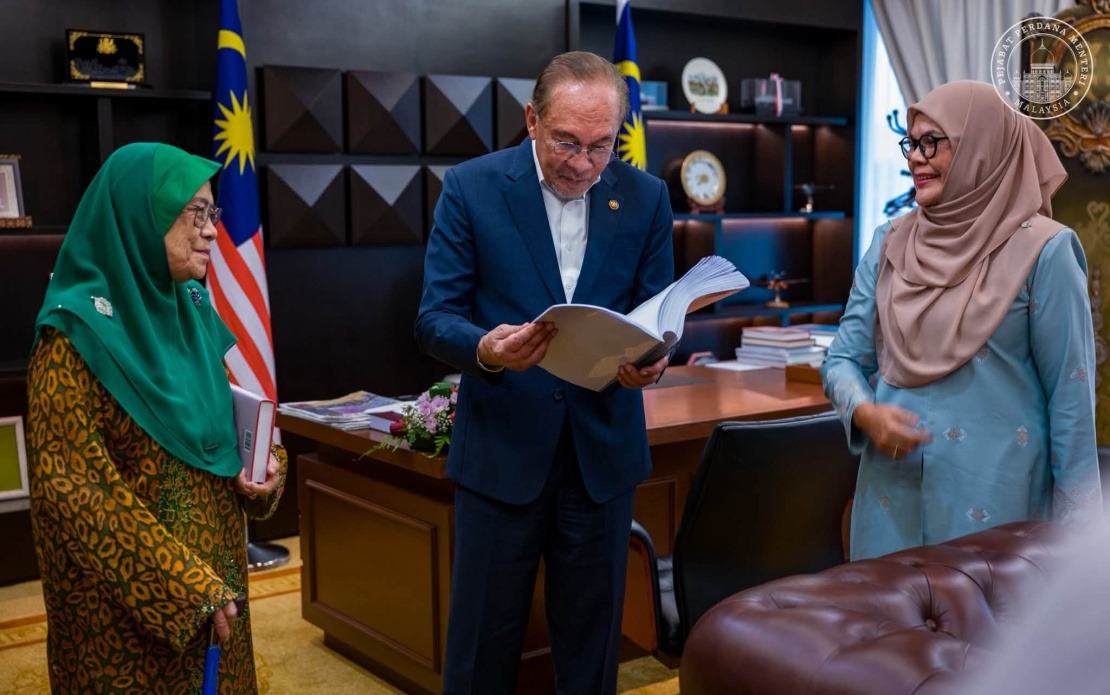
Prime Minister Datuk Seri Anwar Ibrahim has thrown his support behind a scholarly work that captures his political philosophy and intellectual journey, expressing hope that it will become a foundational text for future policymakers and citizens grappling with Malaysia's development challenges. The book, authored by Professor Dr Salinah Ja'afar, a linguist and academic at Universiti Malaya's Academy of Malay Studies, represents an ambitious attempt to systematically document the prime minister's thinking across multiple dimensions of governance and personal conduct.
Anwar revealed his involvement with the project through a social media statement, indicating that he had actively participated in shaping the manuscript by reviewing drafts and offering substantive feedback. This level of personal engagement suggests the work goes beyond a typical biographical account, instead functioning as an authorised exposition of his intellectual framework. The decision to commission such a formal documentation reflects broader institutional trends among Southeast Asian leaders to codify their governing philosophies for posterity, particularly as political systems become increasingly complex and succession planning more deliberate.
The academic credibility of the enterprise rests significantly on the involvement of two prominent scholars from Universiti Malaya. Professor Emeritus Datuk Dr Nik Safiah Abdul Karim, a nationally respected figure in Malay linguistics and language studies, served as the book's academic adviser throughout its development and preparation phases. Her involvement lends scholarly rigour to what might otherwise be dismissed as mere political self-promotion, effectively bridging the gap between contemporary political narrative and historical documentation. This collaboration between political leadership and university-based academia reflects Malaysia's intellectual establishment taking seriously the preservation of high-level political thought.
Beyond Nik Safiah's advisory role, Salinah Ja'afar herself conducted exclusive interviews with Anwar to ensure comprehensive coverage of the intended subject matter. These structured conversations presumably delved into the formative experiences, intellectual influences, and personal convictions that have shaped Anwar's approach to governance. The dual-scholar approach—combining a language specialist with someone positioned in Malay Studies—suggests the book may attempt to explore not just policy positions but also the cultural and linguistic dimensions through which Anwar articulates his vision for Malaysia.
Anwar's statement emphasised that the book will explore ideas shaped by his life experiences and extensive reading habits, two elements he highlighted as central to his intellectual development. This framing positions the work as something more substantial than a campaign manifesto or policy platform. Instead, it suggests a retrospective analysis of how personal and intellectual formation translates into governance philosophy. For Malaysian readers and policymakers, this distinction matters considerably—a document grounded in philosophical consistency carries different weight than one merely cataloguing political positions.
The prime minister's explicit hope that this publication will serve future generations on nation-building particularly resonates given Malaysia's ongoing political volatility and the recurring question of institutional continuity across administrations. In contexts where policy frameworks often shift with changes in leadership, a documented philosophical foundation could potentially provide stabilising reference points. Anwar's framing positions the book not as a temporary political instrument but as a lasting contribution to Malaysian political thought and nation-building discourse.
The emphasis on personal values development as a parallel theme to nation-building suggests the authors intended to explore how individual character and ethics intersect with public administration. This dual focus reflects recognition that governance quality depends not solely on institutional structures or policy frameworks but also on the personal integrity and value systems of those wielding power. For a nation that has periodically grappled with leadership scandals and institutional corruption, such an emphasis carries implicit commentary on the standards expected from public officials.
Within the Southeast Asian context, Malaysia's relatively mature democratic institutions and established intellectual tradition create particular resonance for such systematic documentation of political thought. Unlike some neighbouring nations where such projects might face constraints, Malaysia's vibrant academic sector and publishing industry provide space for rigorous engagement with political philosophy. The involvement of Universiti Malaya, one of the region's oldest and most respected universities, underscores the legitimacy conferred on this endeavour through institutional association.
The book's potential utility extends beyond immediate political circles. Academic institutions, governance training programmes, and policy research organisations throughout the region may find value in examining how a sitting Malaysian prime minister conceptualises nation-building in the contemporary Southeast Asian context. This could prove particularly instructive for scholars studying how established democracies navigate the challenge of balancing reform with institutional continuity, a puzzle many Malaysian observers consider urgent.
Anwar's gratitude towards both scholars explicitly acknowledges the intellectual labour required to translate political experience into coherent documented form. The work of articulating, organising, and rendering comprehensible a leader's complex thinking represents substantial scholarly contribution beyond the obvious political dimension. This recognition points to how documentation of political thought functions as collaborative endeavour between political actors and the intellectual establishment, each bringing distinct but complementary expertise.
The publication timeline remains undisclosed in available statements, but the project's progression through manuscript review and finalisation suggests formal release may be imminent. Malaysian readers should anticipate a text that attempts to provide philosophical scaffolding for understanding Anwar's governance approach across multiple policy domains. Whether the work achieves its stated ambition of becoming a genuine reference for future generations will ultimately depend on how comprehensively it addresses persistent questions about contemporary Malaysian nation-building, institutional reform, and the integration of diverse communities and values within democratic frameworks.

