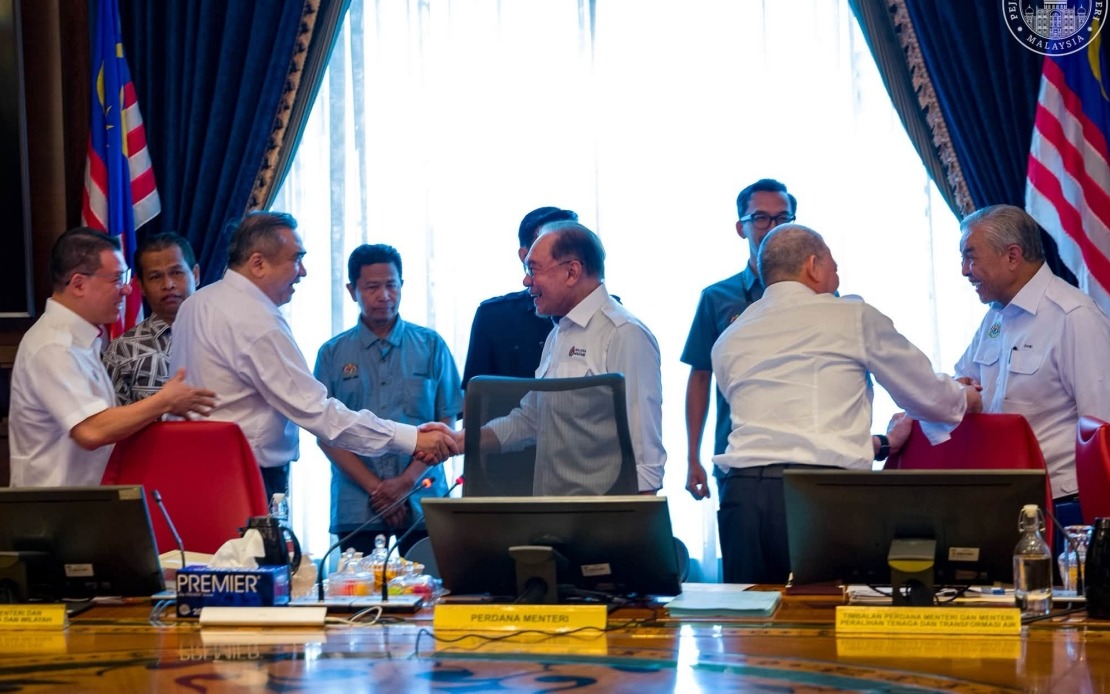
Prime Minister Datuk Seri Anwar Ibrahim took to social media on July 22 to share a carefully crafted message rooted in Malaysia's literary tradition, posting a four-line Malay pantun that centred on the themes of friendship, unity, and consensus. The post, published on his official Facebook page, struck a notably different chord from the ordinary political messaging seen during election season, instead drawing on a classical poetic form long regarded as a cornerstone of Malay cultural expression. The accompanying visuals, including photographs from a Cabinet meeting featuring Deputy Prime Minister Datuk Seri Dr Ahmad Zahid Hamidi and Transport Minister Anthony Loke, reinforced a narrative of governmental cohesion and collective purpose.
The timing and content of Anwar's post appear deliberately calibrated to address underlying tensions within Malaysia's governing apparatus. The Federal Unity Government, formed through an unprecedented coalition between Pakatan Harapan and Barisan Nasional, has maintained an ostensibly harmonious public face despite the inherent contradictions of two historically rival political blocs sharing executive power. Yet the Negeri Sembilan state election, scheduled for August 1, has thrown these tensions into sharper relief. Rather than presenting a unified front in the peninsular state, PH and BN have chosen to contest separately, with each coalition fielding candidates across multiple constituencies in direct competition with the other. This divergence between federal cooperation and state-level rivalry has raised questions about the durability and true nature of the government's inter-coalition arrangement.
The pantun tradition carries particular significance in Malaysian political discourse. Unlike contemporary policy statements or technical announcements, a pantun carries cultural weight and signals an intention to appeal to shared values rather than partisan interests. By adopting this form, Anwar appears to be positioning himself above the immediate electoral fray, speaking as a custodian of national cohesion rather than merely as a campaign strategist for his party. This rhetorical move may be designed to remind both coalition partners and the broader public that the stability of federal governance takes precedence over individual state electoral ambitions. The inclusion of an evergreen 1980s musical accompaniment further broadened the post's accessibility and cultural resonance.
The public reception provided immediate vindication for this approach. Within two hours of publication, the post had accumulated more than 11,500 likes, while the comments section swelled to accommodate over 1,700 responses. Notably, several commenters reciprocated in pantun, suggesting that Anwar's choice of medium successfully activated a deeper cultural conversation among his audience. The predominantly positive tenor of engagement, with users repeatedly praising his statesmanship and conciliatory approach, indicates that there exists a significant appetite among the electorate for messaging that transcends partisan division. This response stands in contrast to the frequently contentious and divisive tone of contemporary Malaysian political discourse on social media platforms.
Understanding the Negeri Sembilan electoral configuration proves essential to interpreting Anwar's intervention. The state assembly dissolution on June 5 triggered a race for 36 seats, with PH contesting all of them under Anwar's leadership. Barisan Nasional, led by Ahmad Zahid, has adopted a more selective strategy, fielding candidates in 25 constituencies while simultaneously negotiating a pact with Perikatan Nasional in others. This fragmentation means that anti-PH votes could be split across multiple opposition candidates, potentially benefiting the governing coalition at the state level. Yet the very fact that BN felt obliged to forge arrangements with PN rather than simply deferring to their federal government partner suggests that state-level electoral calculations do not neatly align with federal unity architecture.
The broader context of Malaysian coalition politics illuminates why Anwar felt compelled to issue such a message at this particular moment. The Federal Unity Government emerged from necessity rather than ideological alignment, born from the need to prevent the ascendancy of Perikatan Nasional in the aftermath of the 2022 general election. Barisan Nasional, despite its century-long dominance of Malaysian politics, has experienced a dramatic erosion of its support base, making it increasingly dependent on younger coalition partners like Anwar's Pakatan Harapan for electoral viability. Meanwhile, Pakatan Harapan faces its own internal contradictions, having recently absorbed elements of the Malay-Muslim establishment that once represented its fiercest opponents. These structural fragilities require constant management through symbolic gestures and rhetorical appeals.
The political economy of Anwar's message extends beyond mere sentiment. By emphasising unity and friendship, he implicitly asks both the electorate and his government partners to resist the siren call of narrow sectarian or partisan advantage. For Barisan Nasional, this amounts to a gentle suggestion that seeking additional alliances with Perikatan Nasional, despite tactical electoral advantages in specific states, ultimately undermines the federal partnership that alone enables BN's continued participation in government. For the broader population, the message counsels patience with the messy compromises inherent in coalition governance, framing such compromises not as weakness but as expressions of maturity and national commitment. This framing becomes particularly important during election season, when the temptation to present zero-sum contests between coalition partners can prove overwhelming.
The reception of this post also reflects deeper transformations in how Malaysian political leaders communicate with constituents. The integration of traditional cultural forms like the pantun with digital social media platforms suggests an evolving sophistication in political messaging that does not simply abandon older modes of cultural authority but rather integrates them into contemporary communication structures. This hybridity may prove particularly effective in Malaysia's multicultural context, where appeals to shared national symbols and cultural practices can transcend ethnic and religious divisions that might otherwise fragment political discourse. The enthusiastic response from commenters demonstrates that such integrated approaches resonate with audiences seeking alternatives to purely partisan rhetoric.
Looking forward, the Negeri Sembilan election will provide a crucial test of whether Anwar's unity messaging translates into actual political cohesion. If Pakatan Harapan emerges victorious, the party may interpret the result as validation for its independent electoral strategy rather than as confirmation of federal partnership. Conversely, if Barisan Nasional performs better than anticipated through its arrangements with Perikatan Nasional, it may embolden further fragmentation of the federal coalition at the state level. The election results thus carry implications far beyond Negeri Sembilan, potentially shaping the trajectory of federal governance and the durability of Malaysia's unity experiment. Anwar's poetic intervention should be understood not as mere metaphorical flourish but as a calculated attempt to establish rhetorical ground rules for interpreting whatever electoral outcome emerges, emphasizing that temporary state-level competition should not be permitted to undermine federal stability.

