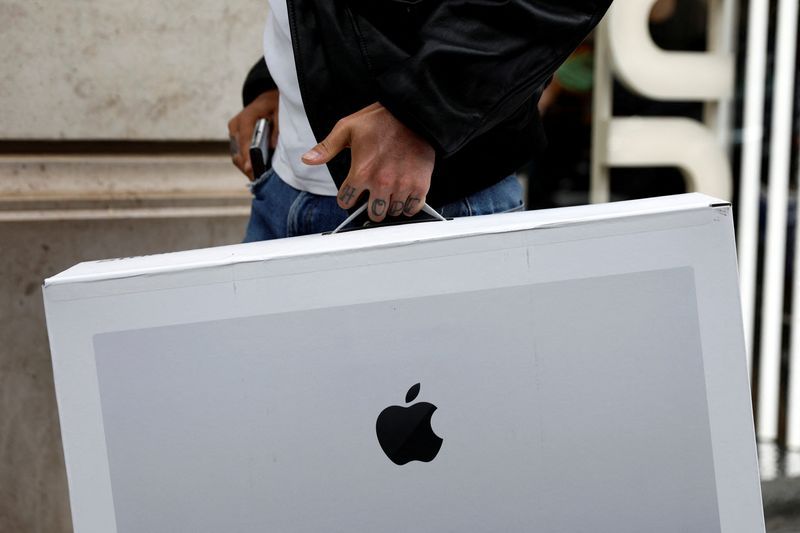
Apple has reclaimed the title of world's most valuable company, surpassing Nvidia with a market valuation of $4.88 trillion as the semiconductor manufacturer slipped to $4.86 trillion following a 3.5% share decline. The change marks a significant reshuffling in the technology sector's hierarchy, reflecting evolving investor sentiment about the trajectory of artificial intelligence development and deployment. Apple's return to the top position represents its first time holding the distinction since April last year, ending Nvidia's reign of nearly twelve months as the world's most valuable enterprise.
The reversal underscores a fundamental shift in how investors are evaluating companies' exposure to the AI opportunity. Rather than concentrating capital in the obvious winners of the artificial intelligence surge, particularly chipmakers supplying the computational infrastructure for AI systems, market participants are now directing attention to companies capable of translating AI capabilities into consumer value and recurring revenue streams. This reallocation reflects growing confidence that the initial wave of AI infrastructure buildout may be approaching a more mature phase, prompting reconsideration of which firms are genuinely positioned to prosper from widespread AI adoption over the medium to long term.
According to Toni Meadows, head of investment at BRI Wealth Management, investor perception regarding Apple's artificial intelligence prospects has undergone substantial revision. Previously dismissed as lagging in the AI competition due to its reluctance to bankroll massive model development initiatives, Apple is now being viewed more favourably by the investment community. Meadows characterised the dynamics at play, noting that Apple operates with lower capital intensity compared to infrastructure-focused competitors and maintains superior positioning to extract economic value from artificial intelligence through its established services ecosystem, proprietary hardware platform lock-in mechanisms, and device upgrade cycles. The rerating of Apple's valuation, according to this analysis, reflects validated confidence in the company's capacity to sustain and grow earnings rather than purely speculative expectations around potential AI breakthroughs.
The milestone carries particular significance given the imminent leadership transition at Apple. Chief Executive Tim Cook is transitioning the company's helm to John Ternus, a veteran hardware executive, in September. The timing of Apple's return to the summit during Cook's final months leading the organisation may influence how his tenure is ultimately appraised by shareholders and commentators. Cook's stewardship will conclude having overseen a period when the company successfully repositioned itself within the fiercely competitive AI landscape despite earlier scepticism about its commitment to the emerging technology paradigm.
Central to Apple's strategic repositioning has been its long-anticipated enhancement of Siri, the company's virtual assistant. Introduced last month, the revamped iteration represents Apple's determined effort to narrow the capability gap separating it from competing technologies developed by major technology firms and ambitious startups. The company is banking on an upgraded Siri experience to demonstrate authentic progress in the artificial intelligence domain, a critical consideration for investors concerned about Apple's historical reticence in this technological frontier.
A compelling strategic advantage that Apple possesses, according to industry analysts, lies in the enormous repository of personal data residing within hundreds of millions of iPhones worldwide. This information, if properly leveraged, could substantially enhance Siri's responses and overall assistant functionality, potentially creating a differentiated offering unavailable to rivals. The fundamental challenge confronting Apple involves reconciling its corporate commitment to data privacy with the technical necessity of accessing device-level information to train and optimise its artificial intelligence systems. Resolving this tension between privacy preservation and AI capability development represents one of the central strategic dilemmas facing the organisation.
However, Nvidia's demotion from the pinnacle should not be interpreted as a permanent or necessarily meaningful alteration in the competitive dynamic. The chipmaker retains its position as a primary beneficiary of global artificial intelligence spending trajectories. Nvidia's graphics processing units continue powering the generative AI infrastructure underpinning the sector's expansion. Depending on how investor sentiment evolves, particularly if enthusiasm for large-scale model development accelerates or infrastructure investment cycles intensify, Nvidia possesses plausible pathways to reclaiming the top valuation position.
Conversely, Apple confronts headwinds of its own. The company has implemented pricing increases intended to compensate for elevated production costs—a tactic that introduces genuine demand risk in an environment characterised by consumer economic sensitivity. This strategic choice could potentially constrain revenue growth or market share expansion if consumer purchasing behaviour proves more elastic than management projections suggest.
Benjamin Hall, vice president of alpha research at Segal Marco Advisors, expressed cautious perspective regarding the meaningfulness of the valuation reversal, emphasizing that Nvidia will likely maintain significance as a major participant in whatever scenarios unfold across the technology landscape. This observation captures an important reality: the artificial intelligence opportunity remains sufficiently expansive that multiple firms can simultaneously prosper and grow enormously valuable, even as relative rankings fluctuate.
The semiconductor enthusiasm has propagated well beyond the market leaders, rewarding memory chipmakers whose products prove essential to artificial intelligence infrastructure development. Micron crossed the $1 trillion market value threshold in May as investors embraced the strategic importance of memory components in supporting AI systems. South Korea's SK Hynix, which listed on the Nasdaq earlier in July, introduces another competitor into the competition for investor capital. Hall remarked that newer entrants to the public markets may fragment investor focus away from the traditional "Magnificent Seven" technology powerhouses, distributing capital across a widened constellation of semiconductor and technology businesses.
The semiconductor sector rallied dramatically through most of 2024 before encountering turbulence in July as market participants began reassessing the sustainability of the artificial intelligence boom. The Philadelphia Semiconductor Exchange Index declined nearly 19% from its historical highs during this revaluation period. Notwithstanding this significant correction, the broader semiconductor index has nonetheless outperformed Nvidia in year-to-date returns, suggesting that investors maintain conviction regarding the sector's fundamental prospects even as they grow more discriminating about valuations and individual company trajectories. For Malaysian investors and technology sector observers, these dynamics underscore how rapidly competitive advantages can shift and how dependent technology valuations remain on sentiment regarding future growth prospects.

