The Arab League's top diplomat delivered an urgent call to the White House this week, signalling deepening concern among regional powers about the trajectory of Middle Eastern geopolitics. Arab League Secretary-General Nabil Fahmy issued a public statement ahead of scheduled talks between US President Donald Trump and Israeli Prime Minister Benjamin Netanyahu in Washington, cautioning that the region stands on the precipice of broader confrontation. His timing underscores the acute anxiety gripping Arab capitals as they watch Washington recalibrate its approach to the longstanding Israeli-Palestinian dispute.
Fahmy framed the current crisis in stark terms, describing the situation as moving toward "a very dangerous point and approaching a moment of explosion on more than one level." This language reflects the multilayered nature of Middle Eastern tensions—the unresolved Palestinian question intertwined with interstate rivalries, sectarian divisions, and great-power competition. The Arab League chief attributed the escalating danger to two converging factors: the political paralysis surrounding Palestinian statehood aspirations and what he characterized as reckless policies pursued by multiple actors during the Gulf tensions. His dual focus acknowledges that regional instability stems from interconnected rather than isolated problems.
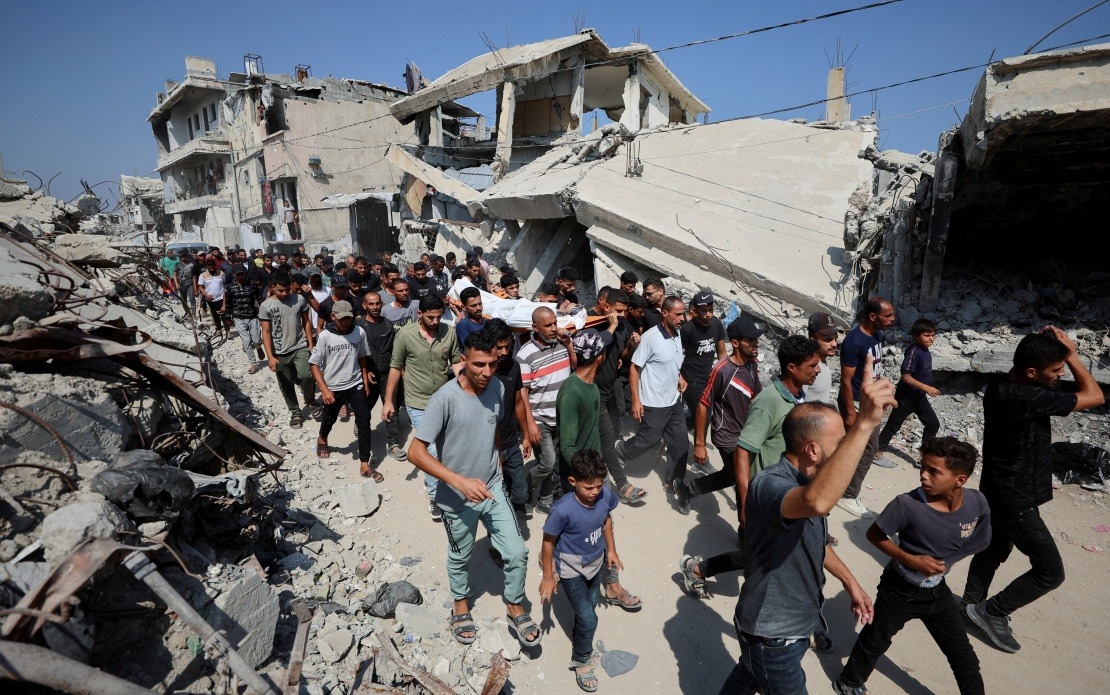
The numerical toll of recent conflict underscores why Arab leaders are sounding alarms. Israeli military operations in Gaza since October 2023 have resulted in more than 73,000 deaths and over 174,000 injuries, according to figures available to regional organizations. Simultaneously, the occupied West Bank has witnessed a surge in Palestinian casualties, with nearly 1,200 killed during the same period, reflecting intensified Israeli military activity across multiple territories. These figures, widely cited in Arab media and diplomatic circles, provide context for growing frustration with what Arab governments view as an asymmetrical security dynamic that privileges Israeli interests while Palestinian grievances remain structurally unaddressed.
The regional security picture extends beyond the Palestinian territories. Israel and the United States conducted joint military operations against Iran in February, prompting Tehran to launch retaliatory strikes targeting American military assets in neighbouring Gulf states. This escalatory cycle has heightened concerns among Arab governments that miscalculation or further escalation could draw them into a broader regional conflict. Fahmy's emphasis on multiple levels of danger reflects these interconnected tensions—not merely the Israeli-Palestinian conflict but the Iran-US-Israel triangle and the vulnerabilities of Arab states caught between these competing interests.
Fahmy directed particular pressure toward the American administration, arguing that the United States bears special responsibility for regional security and stability. This framing invokes Washington's historical role as a security guarantor for Arab states and its capacity to influence Israeli decisions through military aid and diplomatic leverage. The Arab League chief implicitly suggested that Trump, with his emphasis on negotiation and dealmaking, possesses the tools to reshape Israeli strategy if he chooses to deploy them. By highlighting American responsibility, Fahmy sought to activate what Arab capitals view as latent American power over Israeli policy.
Central to Fahmy's appeal was Trump's September 2025 twenty-point Gaza plan, which the Arab League leader referenced approvingly. The proposal envisions a ceasefire, prisoner exchanges, phased Israeli military withdrawal from Gaza, transitional Palestinian governance structures, and comprehensive reconstruction of the devastated territory. Fahmy essentially urged Trump to enforce his own initiative against Israeli resistance, suggesting that without American pressure the plan risks becoming rhetorical rather than substantive. This reflects Arab skepticism about Israeli willingness to implement withdrawals and governance arrangements without explicit American insistence.
The Arab League chief specifically condemned Israeli settlement expansion and displacement policies in occupied territories, accusing the Israeli government of pursuing what he termed "complete elimination of the Palestinian presence." This rhetoric carries significant weight in Arab political discourse, where demographic concerns about Palestinian dispossession resonate deeply. Fahmy's invocation of settlement expansion connects immediate military operations to longer-term structural transformations of Palestinian territories, arguing that Israeli actions threaten Palestinian territorial viability and future statehood prospects regardless of ceasefire arrangements.
Fahmy also raised the question of East Jerusalem, demanding that the Trump administration halt what he described as repeated Israeli violations in that contested territory. East Jerusalem status remains among the most intractable issues in Israeli-Palestinian negotiations, with both sides claiming capital aspirations and historical rights. By elevating this issue, Fahmy signalled Arab insistence that any sustainable settlement must address Jerusalem's political status rather than treating it as peripheral to conflict resolution.
Beyond the Palestinian question, Fahmy called for renewed diplomatic engagement between Washington and Tehran, advocating for resumed negotiations aimed at de-escalating regional tensions. This plea reflects Arab interest in reducing US-Iran confrontation that threatens Gulf stability and security. He emphasized respect for national sovereignty and interests of neighbouring countries, appealing implicitly to principles that Arab states fear are threatened by great-power competition in the region. His mention of ensuring safe passage through strategic waterways—the Gulf and Bab el-Mandeb Strait—highlighted Arab economic interests in maintaining regional peace and freedom of navigation.
The Arab League statement carries particular significance for Southeast Asian observers given regional interest in Middle Eastern stability. Disruption in Middle Eastern energy supplies, regional conflicts drawing external powers into escalation, and sectarian tensions radiating across Muslim-majority regions all carry implications for Southeast Asian countries. Malaysia, as a Muslim-majority nation with economic interests in Middle Eastern stability and diplomatic relations across the region's dividing lines, has stake in whether Arab diplomatic efforts succeed in restraining escalation cycles.
Fahmy's intervention represents traditional Arab diplomacy—public appeals to external powers combined with warnings about regional consequences of continued instability. Whether Trump's upcoming meetings with Netanyahu produce policy shifts remains uncertain, but the Arab League's tone suggests growing desperation among regional actors about their capacity to influence events unfolding in occupied territories. The statement reflects Arab concerns that without decisive external pressure, recent military escalations may harden into permanent structural changes that foreclose future Palestinian statehood possibilities.

