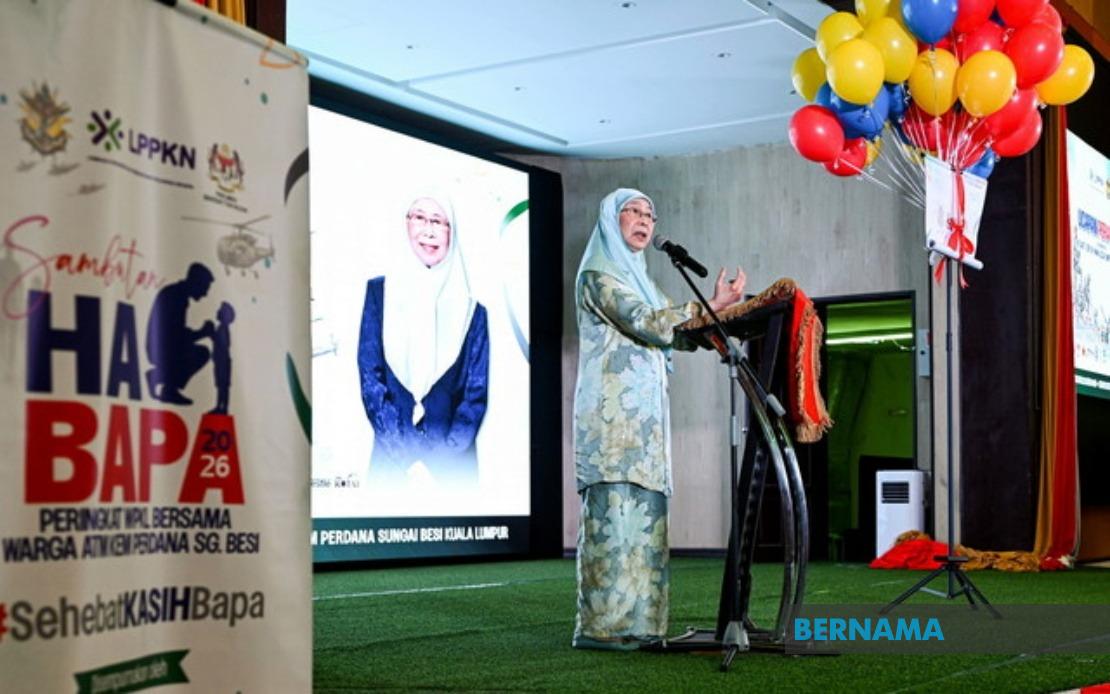
Malaysia's Prime Minister's wife, Datuk Seri Dr Wan Azizah Wan Ismail, has made a compelling case for enhanced support systems targeting fathers within the Malaysian Armed Forces, recognising the unique pressures these servicemen face in reconciling military obligations with family duties. Speaking at the 2026 Federal Territory of Kuala Lumpur Father's Day Celebration held at a gathering of MAF personnel, Dr Wan Azizah underscored that empowerment initiatives must be accompanied by concrete policy backing to ensure military fathers can effectively discharge both their defence responsibilities and domestic roles.
The Bandar Tun Razak Member of Parliament articulated a nuanced perspective on the relationship between male empowerment and family stability. She contended that supporting fathers—particularly those in uniformed services who frequently endure prolonged separation from their children—represents an investment in strengthening the broader family institution. This framing reflects a growing policy recognition across Southeast Asia that paternal wellbeing directly influences household cohesion and children's developmental outcomes, especially in contexts where military deployment regularly fractures family units.
Dr Wan Azizah specifically highlighted the National Family Compassion Policy (DKKN) as an example of targeted intervention designed to address the practical challenges military fathers encounter. This policy framework acknowledges that soldiers cannot simply balance conflicting demands through personal effort alone; rather, institutional mechanisms must exist to facilitate their parental involvement despite geographical and temporal constraints imposed by national defence commitments. For Malaysian readers familiar with the realities of military families, this represents a departure from purely individualistic approaches toward systemic acknowledgment of structural barriers.
A critical dimension of her remarks centred on reframing paternal identity and authority within contemporary Malaysian society. Dr Wan Azizah called for heightened awareness campaigns positioning fathers as primary architects of family structure and values transmission, moving beyond traditional rhetoric to recognise their active leadership role. This messaging carries particular weight in the Malaysian context, where evolving gender dynamics and modernisation have prompted broader questions about masculine identity and domestic engagement.
The celebration itself drew approximately 500 participants, including MAF servicemen, their spouses, children, and government agency representatives. This substantial gathering, organised jointly by the National Population and Family Development Board (LPPKN) of the Federal Territory of Kuala Lumpur and the MAF under the theme 'Sehebat KASIH Bapa' (As Great as Father's Love), provided concrete expression to the policy principles Dr Wan Azizah articulated. The event functioned simultaneously as recognition of military sacrifice and as a platform for showcasing institutional commitment to family-centred military support.
Underlying these initiatives lies profound practical reality: Malaysian Armed Forces personnel routinely face extended deployments, operational commitments, and geographic postings that separate them from their families for extended periods. Unlike civilian professions where remote work or flexible scheduling offers occasional mitigation, military service demands non-negotiable physical presence in operational theatres. The psychological toll on both fathers and their dependents remains substantial, yet historically received limited policy attention. Dr Wan Azizah's emphasis on concrete support mechanisms signals shifting governmental priorities toward addressing this gap.
The LPPKN has already launched several targeted programmes designed to equip military fathers with practical parenting competencies. The Fatherhood Module explicitly addresses parenting skills applicable to long-distance father-child relationships, teaching servicemen strategies for maintaining emotional connection despite physical separation. Complementing this initiative, the Men Empowerment Network (MEN) creates peer support structures among male military personnel, facilitating knowledge-sharing about family management strategies and reducing the isolation many soldiers experience when navigating parental responsibilities alongside operational demands.
These interventions reflect international best practices increasingly adopted across developed militaries worldwide. Nations such as Australia, Canada, and Singapore have integrated family support services into broader military welfare provision, recognising that soldier wellbeing directly correlates with operational readiness and retention. Malaysia's formalised approach through DKKN and LPPKN programming places it within this progressive framework, though the question remains whether implementation reaches sufficient depth and breadth across all service branches and rank structures.
From a regional perspective, Malaysia's emphasis on military family support carries particular significance. Across Southeast Asia, defence establishments frequently struggle with balancing modernisation imperatives, budget constraints, and personnel welfare considerations. Malaysia's willingness to position father empowerment as a defence and family policy priority—articulated at vice-ministerial level—suggests that comprehensive military welfare may constitute competitive advantage in recruitment and retention of quality personnel. As regional security challenges intensify, armed forces that successfully integrate family support into operational planning potentially gain measurable advantages in personnel stability and morale.
Dr Wan Azizah's framing also implicitly addresses gender equity considerations increasingly important in Malaysian policy discourse. By centering male caregiving responsibilities and family contributions, she positions father empowerment not as departing from gender equality commitments but rather as fulfilling them—encouraging men's fuller engagement in domestic spheres traditionally undervalued in policy analysis. This rhetorical move may prove significant in building consensus among constituencies that might otherwise resist family policy innovations.
The sustainability of these initiatives depends heavily on resource allocation and institutional integration. Fatherhood modules and men's networks require dedicated staffing, budget appropriations, and leadership commitment to remain operational beyond initial pilot phases. The challenge facing Malaysian policymakers involves institutionalising these programmes sufficiently that they survive bureaucratic transitions and shifting political priorities, ensuring military fathers receive consistent support across their service careers.
Looking forward, the visible political commitment Dr Wan Azizah expressed suggests momentum for expanding military family support within Malaysia. Future developments might include integration of family support considerations into posting decisions, enhanced leave provisions for significant family events, and improved mental health resources addressing deployment-related family stress. Whether these aspirational possibilities materialise into policy depends on sustained advocacy and resource commitment from both political and military leadership.
For Malaysian military families and the broader defence establishment, Dr Wan Azizah's advocacy represents formal institutional recognition that father empowerment constitutes legitimate defence policy concern. By elevating this conversation beyond individual coping mechanisms toward systematic policy intervention, Malaysia joins progressive militaries worldwide in acknowledging that soldier effectiveness and family stability remain inextricably linked—a principle that promises improved outcomes for servicemen, their families, and ultimately national defence capacity.

