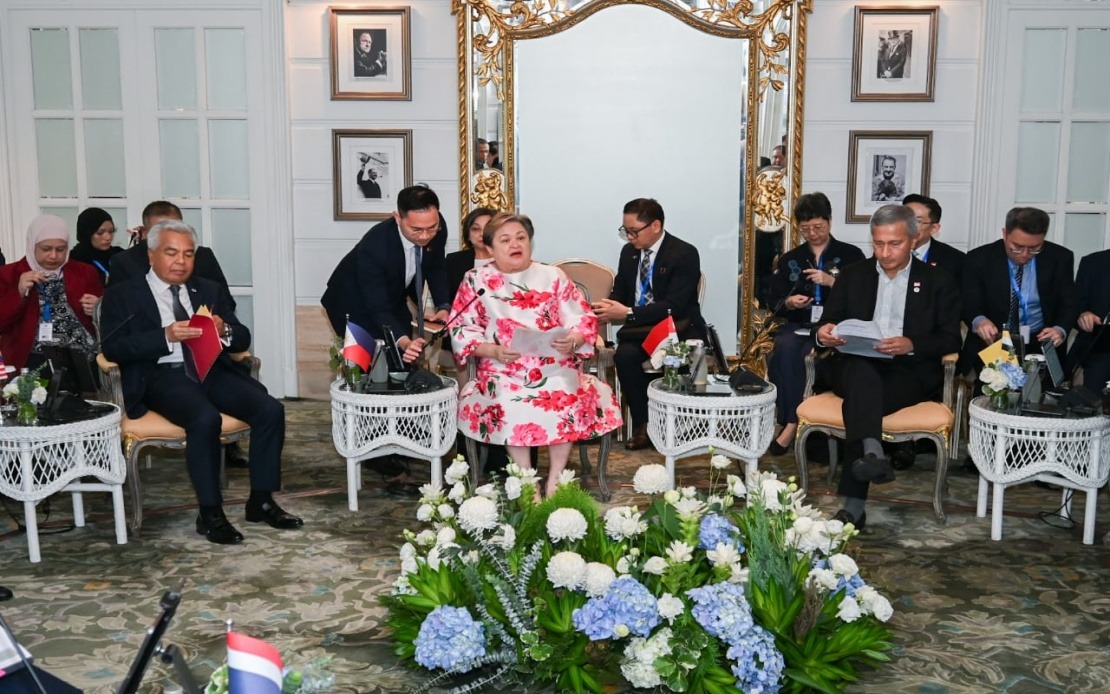
ASEAN member states have made clear their unwavering commitment to the Five-Point Consensus as the cornerstone of their approach to Myanmar's ongoing political turmoil, even as the military regime continues to resist the framework. At a significant gathering of regional foreign ministers in Bangkok on Sunday, ASEAN officials reinforced that the peace plan remains non-negotiable and central to all discussions with Myanmar's government and other stakeholders seeking resolution of the crisis that has gripped the nation since 2021.
Philippine Secretary for Foreign Affairs Maria Theresa Lazaro, serving as special envoy for Myanmar under the current Philippine Chair of ASEAN, stressed that the Five-Point Consensus anchors the regional bloc's entire engagement strategy. She articulated that regardless of whether the junta accepts or rejects the framework, ASEAN will not compromise on this foundational document. Her remarks came during a joint appearance with Thailand's Foreign Minister Sihasak Phuangketkeow, underscoring the coordinated stance across the region's major powers on maintaining diplomatic pressure for change.
The Five-Point Consensus, adopted in April 2021, represents ASEAN's collective prescription for ending Myanmar's descent into chaos. The framework encompasses an immediate cessation of all violence, establishment of inclusive dialogue platforms that bring together the military junta, the ousted government, armed resistance groups, and civil society, sustained humanitarian assistance to affected populations, and the deployment of an ASEAN Special Envoy with mandated access to all relevant parties. This comprehensive approach reflects ASEAN's traditional emphasis on non-interference tempered by pragmatic acknowledgment that Myanmar's instability threatens regional security and cohesion.
The timing of ASEAN's reaffirmation carries particular significance given Myanmar's military-dominated parliament's recent motion explicitly rejecting the peace plan. This rebuff represents the most direct and public dismissal of ASEAN's position, forcing the regional organization to signal that such resistance will not deter its diplomatic efforts. Rather than treating the parliamentary vote as a decisive defeat, ASEAN officials framed it as one obstacle among many in what they anticipate will be a prolonged process of persuasion and pressure.
Lazaro identified three concrete expectations that ASEAN has communicated to Myanmar's junta. First, the regional bloc is pushing for expanded humanitarian assistance, with Thailand's current chairmanship planning a dedicated humanitarian mission to Myanmar to assess needs and identify mechanisms for channelling aid more effectively to vulnerable populations. This emphasis reflects the catastrophic humanitarian toll of the crisis, with hundreds of thousands displaced and countless civilians facing food insecurity and inadequate access to basic services. By making aid delivery a central negotiating point, ASEAN creates leverage while addressing immediate suffering.
Second, ASEAN has demanded tangible reductions in violence directed at civilian populations. The junta's relentless campaigns against armed resistance groups have repeatedly caught civilians in the crossfire, with villages torched, extrajudicial killings documented by international observers, and systematic targeting of healthcare workers and teachers. ASEAN's focus on civilian protection signals to Myanmar's government that indiscriminate violence has concrete diplomatic costs and that the region will not normalize relations with a regime engaged in widespread brutality.
Third, the bloc has pressed for inclusive political dialogue that advances national reconciliation. This encompasses establishing forums where the junta can meaningfully engage with other political actors, creating space for political prisoners' release as a confidence-building measure, and fostering an environment where diverse political viewpoints can be expressed without fear of reprisal. ASEAN recognizes that without genuine political inclusion, any settlement will lack legitimacy and prove unsustainable.
Sihasak's characterization of ASEAN's approach as "calibrated engagement" reflects the organization's delicate balancing act. The term acknowledges that ASEAN cannot abandon Myanmar without fracturing its own unity and surrendering influence, yet simultaneously signals that engagement comes with conditions and consequences. His emphasis that this engagement is reciprocal underscores that ASEAN cannot unilaterally resolve Myanmar's crisis; the junta must actively participate in solutions rather than passively rejecting them. This framing places responsibility squarely on Naypyidaw while protecting ASEAN from accusations of impotent posturing.
The meeting itself represented a significant diplomatic achievement, marking the first in-person encounter between ASEAN foreign ministers and Myanmar's foreign minister since the coup. This direct engagement, despite the junta's parliamentary rejection of ASEAN's peace plan, indicates that channels remain open and that isolation has not become ASEAN's default strategy. The presence of Malaysia's Foreign Ministry Secretary-General Tan Sri Amran Mohamed Zin demonstrated Kuala Lumpur's continued investment in resolving the crisis, though Cambodia's absence raised questions about divisions within the bloc regarding Myanmar policy.
Sihasak indicated that ASEAN will use the upcoming regional summit later this year to assess whether Myanmar has demonstrated progress on the three key expectations. This approach establishes a concrete accountability mechanism while avoiding ultimatums that might alienate the junta entirely. By positioning progress reviews at established ASEAN forums, the organization creates structural opportunities for both pressure and face-saving compromise, essential elements in regional diplomatic culture.
For Malaysia and other Southeast Asian nations, ASEAN's renewed emphasis on the Five-Point Consensus carries strategic implications. Myanmar's instability directly threatens regional security through increased refugee flows, cross-border militant activity, and destabilization of border regions shared with Thailand and Laos. Malaysia, while geographically distant, hosts significant Myanmar refugee populations and maintains economic interests in stability. By maintaining diplomatic pressure through ASEAN's consensus framework, Malaysia benefits from collective action that individual member states lack capacity to undertake alone.
The gap between ASEAN's diplomatic expectations and Myanmar's junta resistance remains vast, yet ASEAN's firmness suggests the organization is preparing for extended engagement rather than expecting rapid breakthroughs. The repeated invocation of the Five-Point Consensus functions both as principle and as diplomatic anchor, preventing ASEAN from drift while maintaining enough flexibility for negotiation. Whether this approach will ultimately compel Myanmar toward reform or whether the junta will continue defiance depends partly on whether ASEAN can sustain unity and partly on external pressures that complement regional diplomacy.

