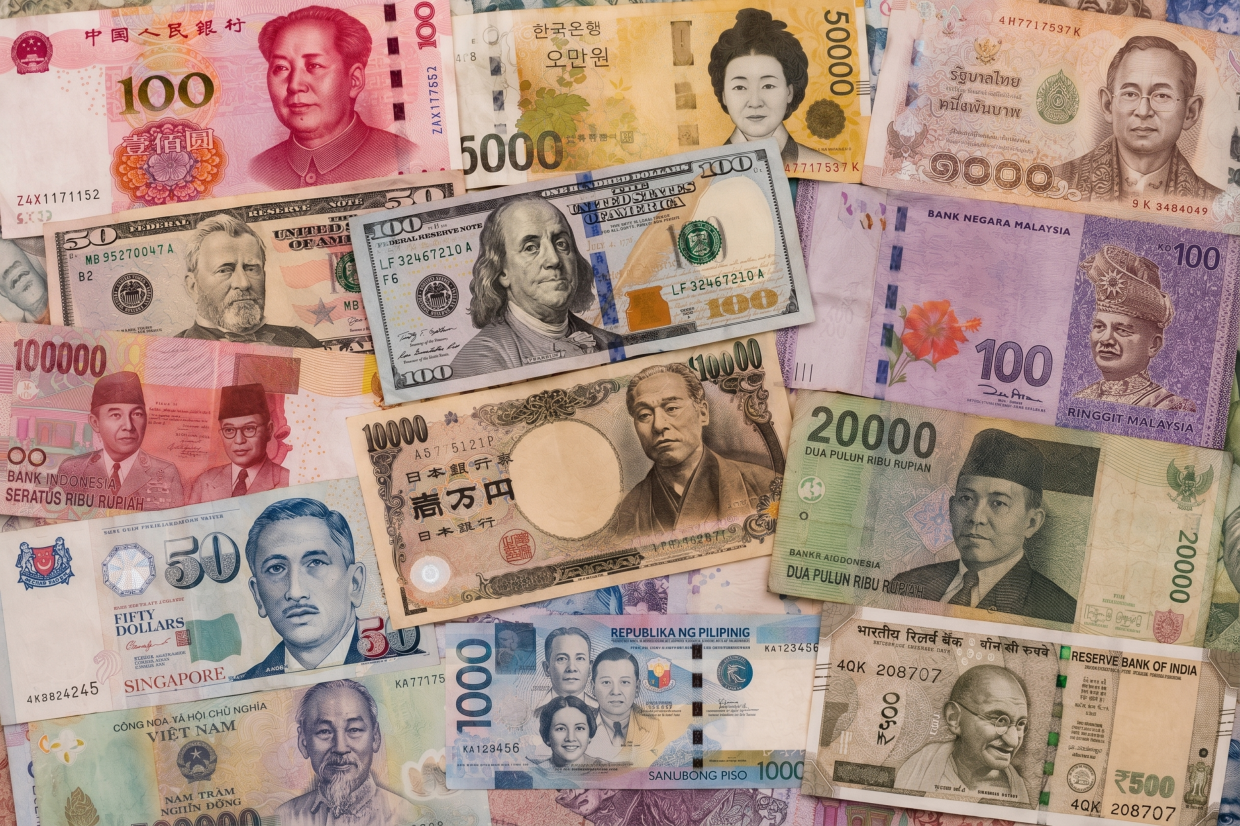
Geopolitical tensions in the Middle East rippled through Asian financial markets on Monday, battering regional currencies and triggering a sharp equity sell-off in South Korea as investors reassessed exposure to inflation-sensitive assets. The escalation in the Gulf region pushed crude oil prices up 4%, strengthening the U.S. dollar across the board and amplifying concerns that central banks may need to maintain or raise interest rates longer than previously expected, a prospect that weighed heavily on emerging market valuations.
The U.S. dollar index firmed against a basket of major currencies as the geopolitical shock reverberated through energy markets. Investors historically view dollar strength as a safe haven during periods of uncertainty, and the combination of Middle East instability and surging energy costs created a toxic environment for emerging Asian assets. The currency movements reflected a classic flight-to-safety dynamic that underscores how quickly regional financial markets can be destabilised by external shocks beyond their immediate control.
The depreciation pressure extended across emerging Asia with particular intensity in currency markets. Indonesia's rupiah weakened to 18,140 against the dollar, marking its lowest level in more than a month and signalling renewed capital outflows from Southeast Asia's largest economy. South Korea's won fared similarly poorly, sliding to 1,507.9 per dollar as foreign investors trimmed exposure to one of Asia's most economically sensitive markets. Malaysia's ringgit weakened to 4.0780 per dollar, though the currency managed to avoid the sharper declines seen in other regional peers.
The South Korean equity market bore the brunt of Monday's turmoil, with the KOSPI benchmark plunging 7.96 percent to touch levels not seen in ten weeks. The sharp move triggered automatic trading halts designed to prevent panic selling, underscoring the intensity of the market downturn. The sell-off was led by SK Hynix, the world's dominant supplier of artificial intelligence memory chips, which nosedived 13 percent as investors locked in substantial gains following the company's blockbuster debut on U.S. markets just days earlier. The magnitude of the decline in the bellwether technology stock reflected broader anxieties about the sustainability of the AI-driven rally that has powered equity markets for much of the year.
Underlying the sharp correction in chipmaking equities are growing questions about whether the exceptional earnings growth in the semiconductor sector can persist. The boom in demand for high-bandwidth memory chips used in artificial intelligence systems has created a rare period of margin expansion for memory manufacturers, but investors increasingly worry that this supercycle may be losing momentum. Concurrently, major artificial intelligence companies and cloud infrastructure operators have become more disciplined in their capital allocation, raising concerns that the insatiable demand picture may not hold up indefinitely. Adding to market fragility, highly leveraged single-stock exchange-traded funds have amplified volatility, turning modest selling pressure into violent downside moves.
Yet South Korea's equity market retains significant resilience when viewed from a longer-term perspective. The KOSPI has nonetheless delivered a robust 63 percent return so far in 2024, making it one of Asia's top-performing stock markets despite having shed approximately 25 percent from its June 22 peak. This underscores the bifurcated nature of Asian market performance—while technology-heavy bourses have shown vulnerability to profit-taking and shifting sentiment around growth narratives, many regional markets have still delivered double-digit gains for the year as a whole.
Malaysia's financial markets present a more mixed picture, reflecting idiosyncratic domestic political developments alongside the regional currency weakness. While the ringgit softened on the day, domestic equities edged higher to reach three-week highs, suggesting that local institutional investors remain constructively positioned. However, the underlying political dynamics carry implications for medium-term asset performance. Prime Minister Anwar Ibrahim's coalition suffered a significant setback in Saturday's Johor state election, with the ruling bloc losing ground to a key partner, raising questions about the durability of the federal government's mandate and the continuity of its economic reform agenda.
Goldman Sachs analysis suggests that the political uncertainty could erode the premium that Malaysian assets have enjoyed from a perception of policy stability and institutional competence. The investment bank noted that while Malaysia's underlying macroeconomic fundamentals remain solid, renewed doubts about coalition cohesion and the longevity of the current government could translate into sustained depreciation pressure on the ringgit and reduced foreign investor appetite for Malaysian equities. Nonetheless, Goldman's analysts pointed out that the Bank Negara Malaysia's measures implemented in June to encourage foreign exchange inflows should provide some structural support for the currency even if political risk premiums persist.
Across the broader region, performance diverged significantly. Philippine equities edged higher while Indonesian shares gained a more modest 0.5 percent, suggesting that smaller markets faced headwinds from both the currency weakness and Middle East jitters. Taiwan's stock market inched lower on the day, while Singapore's benchmark index declined as much as 0.7 percent after notching seven consecutive sessions of record highs. The pullback in Singapore may reflect profit-taking after an extended rally rather than fundamental concerns, but it nonetheless underscored the tentative nature of investor sentiment across developed Asian markets.
Looking ahead, the regional economic calendar carries particular significance given the confluence of geopolitical and monetary policy uncertainties. Singapore's advance second-quarter growth data and Malaysia's inflation reading and output figures will provide crucial snapshots of regional growth momentum at a time when energy price shocks could be feeding through to consumer prices. The Bank of Korea's interest rate decision assumes heightened importance given that South Korean policymakers must balance concerns about sluggish growth against the risk that energy price acceleration could reignite inflation pressures. Meanwhile, the U.S. inflation print will help determine whether the Middle East escalation proves to be a temporary supply shock or the beginning of a more sustained period of elevated price pressures that could derail the anticipated pivot toward rate cuts by major central banks.

