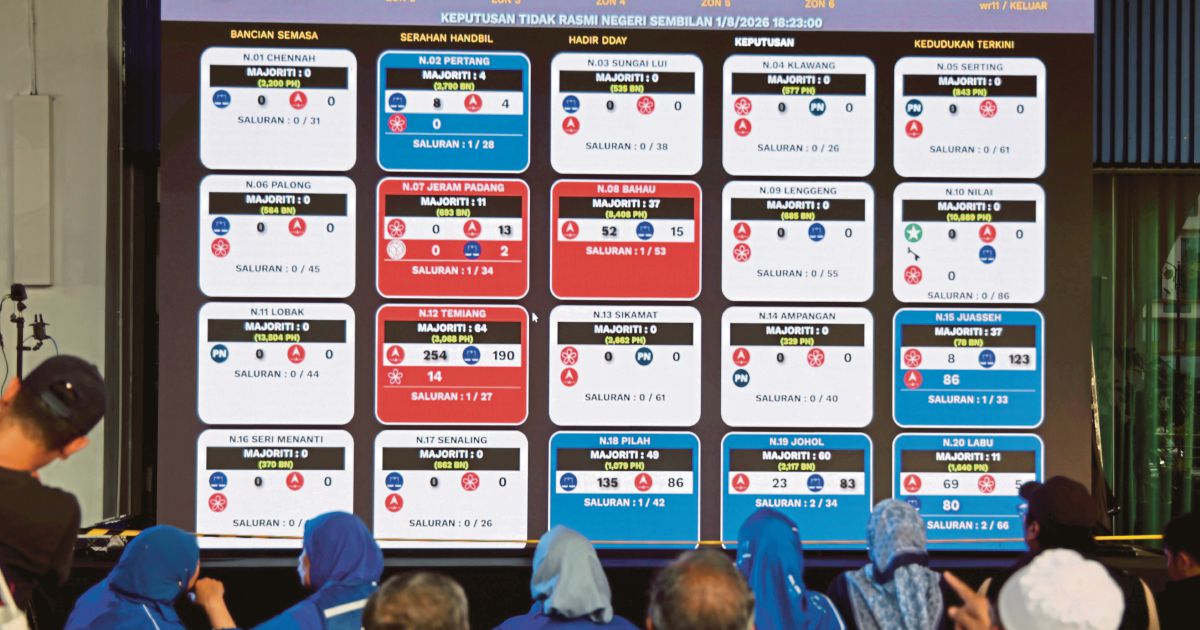
Umno's Datuk Dr Asyraf Wajdi Dusuki has claimed that the Barisan Nasional and Perikatan Nasional coalition has captured sufficient seats to govern Negri Sembilan, asserting they have won 23 of the state assembly seats contested. The assertion comes as results continue to be processed from polling conducted across the state, with the coalition seemingly positioned to lead the state's next administration.
The threshold for commanding a simple majority in the Negri Sembilan state assembly stands at 23 seats out of the 36 total positions up for election. Should the BN-PN alliance's tally hold, they would have precisely the number required to form a government without needing additional support or negotiations with independent candidates. The composition and exact distribution of seats between Barisan Nasional and Perikatan Nasional components has not been fully detailed in the initial announcement.
Negri Sembilan, often considered a bellwether state for broader political movements in Malaysia, has historically swung between the major coalitions. The state's voting patterns frequently reflect shifting national sentiment, making its electoral outcomes significant for understanding the direction of Malaysian politics. A BN-PN victory would represent a notable shift from previous administrations and underscore the changing political landscape in the peninsula's central region.
The election itself reflects the broader realignment occurring within Malaysia's political ecosystem. The collaboration between Barisan Nasional, the historically dominant ruling coalition that includes Umno, and Perikatan Nasional, which consolidated various opposition and dissident elements, represents a significant consolidation of centre-right and conservative political forces. This alignment differs markedly from the fragmentation seen in recent national political cycles, where these blocs competed directly against one another.
Perikatan Nasional's inclusion in this coalition is particularly noteworthy for Malaysian observers tracking the evolution of opposition politics. The bloc, which emerged from the Sheraton Move realignment in 2020 and has included parties such as PAS and Bersatu, has now formally allied with the traditionally dominant Barisan Nasional. This partnership suggests efforts to present a unified alternative to rival coalitions, potentially reshaping expectations for future federal-level politics.
For Negri Sembilan residents, a BN-PN administration would likely bring policy continuity in certain areas while potentially introducing new priorities from Perikatan Nasional-affiliated parties. The state faces ongoing challenges including infrastructure development, small and medium enterprise support, agricultural modernisation, and urban planning issues that any new government must address. The coalition's specific manifesto and legislative agenda for the state have been central to campaigning leading up to polling day.
The preliminary nature of Asyraf Wajdi Dusuki's claim warrants consideration, as final official results remain subject to confirmation by the state election commission. Malaysian state elections typically involve a verification and certification period following polling, during which results are formally tabulated and any irregularities are reviewed. Political claims made during the counting phase, while often accurate, occasionally shift as comprehensive tallies are completed.
Regional observers have been monitoring the Negri Sembilan election closely given its potential implications for larger political calculations. State elections in Malaysia frequently serve as testing grounds for political messaging, coalition viability, and voter sentiment before federal contests. A decisive BN-PN performance here could embolden discussions about similar arrangements at the national level or, conversely, might reveal vulnerabilities in the coalition's broader appeal.
The result, if confirmed, would affect the composition of the Conference of Rulers and the Dewan Negara indirectly, as state electoral performance influences factional strength within respective parties and influences resource allocation within coalitions. For Umno in particular, a strong showing supports arguments about the party's continued relevance and electoral competitiveness despite various internal challenges and controversies the party has faced over recent years.
Beyond state-level governance, the election's outcome carries implications for how Malaysian political parties calibrate their strategies moving forward. The success or otherwise of the BN-PN collaboration in Negri Sembilan will likely inform discussions within both coalitions about future cooperation or competition at federal level. For smaller coalition partners, particularly Perikatan Nasional components, the election provides both legitimacy and leverage in future negotiations over ministerial positions and policy influence.
Kuala Lumpur's political community will be analysing these results carefully as part of the broader effort to understand emerging voting patterns. Whether Negri Sembilan's outcome reflects genuine approval of the BN-PN alliance or primarily reflects local factors specific to the state remains to be unpacked through detailed electoral analysis. Nonetheless, the claimed 23-seat majority, if confirmed, provides the coalition with a clear mandate to lead the state government.

