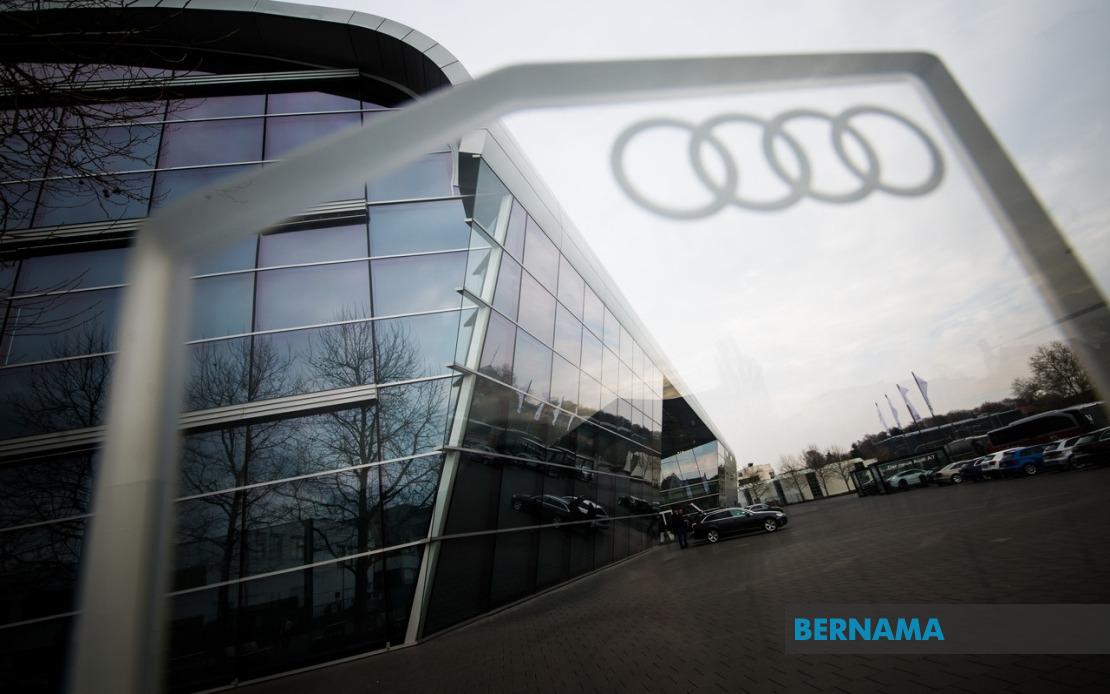
Audi, the Volkswagen Group's premium subsidiary, announced a significant downgrade to its annual financial forecast on Monday, signalling deepening challenges in key markets and a cautious outlook for the remainder of 2024. The Ingolstadt-based carmaker attributed the revision to deteriorating conditions in China, historically one of its most important revenue sources, alongside mounting geopolitical risks emanating from the Middle East. The move underscores growing anxiety within Europe's automotive sector as traditional demand engines sputter and new uncertainties reshape the global competitive landscape.
The company's second-quarter performance painted a sobering picture for investors and industry watchers. After-tax profit contracted by approximately one-fifth to €563 million, equivalent to roughly US$642 million, reflecting margin compression across the business. More significantly, management trimmed its full-year revenue guidance to a range of €58 billion to €63 billion, down substantially from the previous forecast band of €63 billion to €68 billion. This five-billion-euro downward revision signals not merely a temporary slowdown but rather a recalibration of medium-term expectations, with implications extending across Audi's global operations and its sprawling portfolio encompassing luxury marques such as Lamborghini, Bentley, and the Ducati motorcycle brand.
China's deteriorating performance represents the most alarming element of Audi's revised outlook. The world's largest automobile market has become increasingly hostile territory for foreign premium carmakers, as domestic competitors intensify price competition and consumers gravitate toward homegrown brands perceived as offering superior value and technology. Audi's Chinese operations, structured through local joint ventures and therefore classified under financial income rather than core revenue, generated merely €73 million during the first half of 2024—a dramatic collapse representing less than one-quarter of the contribution recorded in the corresponding period last year. This roughly fourfold decline encapsulates the severity of Audi's competitive erosion in a market that once anchored the marque's global expansion ambitions. The Chinese slowdown parallels Audi's acknowledged retreat in the United States, creating a twin-market crisis for a carmaker historically dependent on premium pricing in developed economies.
Geopolitical tension in West Asia adds another layer of uncertainty. While the source material does not specify particular supply chain vulnerabilities or trade route concerns, the escalating regional tensions carry implicit risks for luxury goods manufacturers reliant on complex global logistics and consumer sentiment in affluent Middle Eastern markets. These territories have traditionally absorbed significant volumes of high-specification Audi vehicles, and any prolonged instability threatens both current demand and investor confidence in regional expansion plans. The combination of Chinese market collapse and West Asian uncertainty creates a perfect storm of demand destruction across two critical geographic segments.
Cutthroat pricing dynamics have simultaneously eroded profitability even where sales volumes have held reasonably steady. Chinese competitors, particularly electric vehicle manufacturers unburdened by legacy cost structures, have triggered a race to the bottom that premium foreign marques cannot win without sacrificing margins fatally. Audi's inability to command pricing power in China reflects broader industry transformation whereby technological disruption and emergence of homegrown challengers have fundamentally altered competitive dynamics that Western automakers took for granted for decades. The deterioration in financial returns extends beyond absolute revenue losses to encompass margin compression that threatens long-term investment capacity.
Despite the gloom, Audi's chief financial officer Jürgen Rittersberger expressed cautious optimism regarding potential stabilisation in the second half of 2024. Management anticipates that newly launched vehicle models and continued cost-containment initiatives will generate sufficient momentum to partially offset the first-half decline. The carmaker's executives further noted that the second half of the calendar year traditionally enjoys stronger demand seasonality, particularly in Europe and North America. However, this conventional pattern offers limited reassurance given that even traditional seasonal strength would be insufficient to bridge a guidance gap of such magnitude, suggesting management expectations for genuine operational improvement rather than mere seasonal factors.
Audi's predicament warrants comparison with its parent company Volkswagen Group's own earnings deterioration. Volkswagen's second-quarter profits plummeted by nearly one-third, a steeper decline than Audi's 21 percent drop, indicating that the premium subsidiary has weathered current conditions somewhat better than the mass-market parent. This relative resilience offers minimal comfort, however, given that Audi remains a major profit generator within the wider group and its weakness signals broader portfolio stress.
Loomingover medium-term strategy are reports that Volkswagen Group is contemplating substantial workforce reductions spanning tens of thousands of employees across divisional operations. Audi's manufacturing facility in Neckarsulm, a historic production centre in Baden-Württemberg, stands among four plants under review for potential restructuring or capacity reductions. Such employment decisions, should they proceed, would represent unprecedented action for a group that has historically maintained relatively cooperative labour relations within Germany and would likely trigger fierce resistance from union representatives and political actors defending manufacturing employment.
The implications for Malaysian and Southeast Asian automotive stakeholders deserve consideration. Audi, as a representative player within the premium automotive segment, experiences the same competitive and demand pressures affecting other foreign luxury marques operating in the region. The carmaker's exposure to China's market weakness and its retrenchment from certain geographies may accelerate consolidation within premium automotive distribution networks across Southeast Asia. Local dealers and distributors face potential margin pressure and inventory management challenges should European manufacturers reduce production and marketing investment. Additionally, the strategic pivot by global automotive majors toward Chinese EV manufacturers' technology partnerships may reshape technology transfer and supply chain dynamics affecting the entire region's automotive ecosystem for years ahead.

