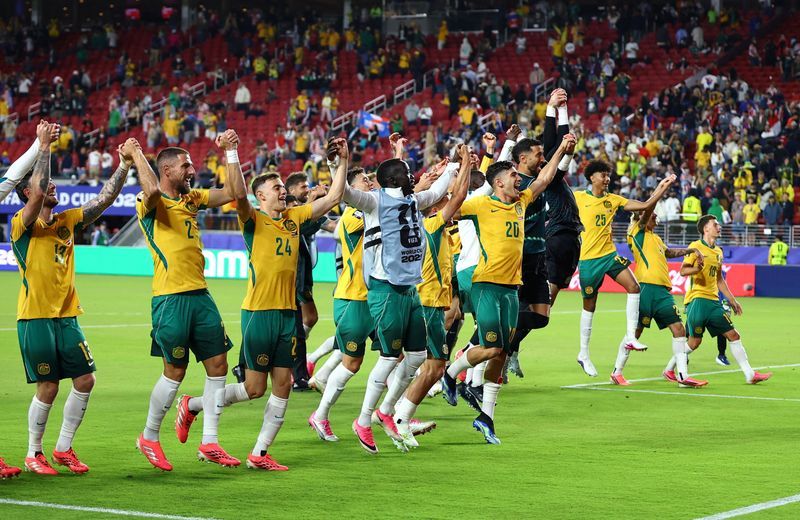
Australia have secured their place in the World Cup's knockout phase for the third time in their tournament history, advancing following a tense goalless encounter with Paraguay at San Francisco Bay Area Stadium on Thursday. The match, contested in the heart of Silicon Valley, proved a tightly-fought affair that showcased Australia's defensive solidity even as the side struggled to convert its attacking opportunities. For Tony Popovic's squad, the result represents a significant milestone—their first knockout appearance since Qatar 2022, when they reached the last 16 four years ago. The achievement comes amid mounting expectations for the Socceroos as they continue to establish themselves as a competitive force on the world stage.
Paraguay, meanwhile, faces an anxious wait to determine their tournament fate. The South American side accumulated four points from their group campaign, which may prove sufficient to advance as one of eight third-placed teams with the strongest records. However, their progression remains uncertain pending the conclusion of other group fixtures scheduled for Friday, when Egypt meet Iran and Belgium face New Zealand. This scenario underscores the unpredictable nature of modern World Cup formats, where third-place finishes can unexpectedly offer pathways to the knockout stages depending on goal difference and goals scored across simultaneous matches.
Popovic demonstrated tactical boldness in his team selection, implementing six changes to the starting eleven from Australia's previous fixture. The inclusion of Nestory Irankunda and Cristian Volpato signalled clear attacking ambitions, with the manager seeking to exploit Paraguay's defensive vulnerabilities through creative play. Jordan Bos was repositioned from his customary left-back berth to the right flank to compensate for the absence of injured defender Jacob Italiano, a switch that reflected the coaching staff's willingness to adapt their formation to circumstances. This proactive approach suggested confidence in the squad's technical capabilities, though the execution would ultimately fall short of the intentions.
Australia dominated possession during the opening period, creating several promising openings down the right wing where Bos's athleticism provided genuine attacking thrust. Volpato's ball-playing ability proved instrumental in constructing opportunities, yet the finishing proved frustratingly wayward. Jackson Irvine received a gilt-edged chance within the opening minutes when Volpato fed him into the penalty area, but the midfielder's angled shot lacked the precision required against goalkeeper Orlando Gill. Similar patterns repeated themselves throughout the first half as Bos and Volpato forced a pair of saves from Gill without ever genuinely stretching the Paraguayan goalkeeper's reflexes.
Paraguay's first-half performance was characterised by defensive compactness and minimal ambition in the attacking third. The South Americans managed only a single shot during the opening 45 minutes, evidence of Gustavo Alfaro's cautious tactical approach. However, the introduction of Mauricio at halftime—a Brazilian-born attacker brought to inject greater penetration into Paraguay's play—changed the dynamic considerably. The substitute promptly tested the Australian rearguard with an audacious long-range effort five minutes after the restart, establishing Paraguay as a more credible attacking threat.
The midfielder Julio Enciso emerged as Paraguay's most dynamic threat as the match progressed, repeatedly carving through Australia's defensive lines with incisive running and technical proficiency. His energy and directness posed persistent problems for the Socceroos' back line, culminating in a genuine scoring opportunity eight minutes from full-time when his low shot whistled agonisingly wide of the left post. This moment represented Paraguay's clearest path to victory and underlined the increasingly competitive nature of the contest as fatigue began affecting Australia's earlier territorial dominance.
Australia's defending, though not always aesthetically pleasing, proved functionally effective throughout. Despite Paraguay's increased pressure in the final stages, Popovic's defenders—marshalled by goalkeeper Thomas Glover—managed to deny the South Americans any clear-cut opportunities. The defensive shape remained organised despite intermittent waves of Paraguayan attacks, suggesting a squad capacity to absorb pressure and maintain structural integrity even when not controlling proceedings.
In the contest's closing moments, both sides created intermittent openings that neither could conclusively finish. Bos provided Australian supporters with a moment of genuine excitement in the 89th minute when he surged forward from right-back, splitting two defenders before sending a shot narrowly beyond the far post. Moments later, Mauricio almost capitalised on a sliver of space at the edge of Australia's penalty area, but his tame effort posed no genuine threat to Glover. These final exchanges typified the encounter's overall character—promising ventures that ultimately yielded no reward.
Australia's progression to the knockout round was secured with pragmatism rather than flair, a trademark of Popovic's managerial philosophy that prioritises results over entertaining football. The Socceroos will now prepare for a clash against the runner-up from Group G, a fixture that remains conditional on Friday's concluding matches. For Malaysian and Southeast Asian followers of Australian football, the qualification represents further evidence of the sport's growing professionalism within the country and the calibre of opposition Australian players now routinely face at the international level.
The draw itself carries significant implications for Paraguay's World Cup adventure. Gustavo Alfaro's side must now hope that other third-placed finishers accumulate fewer points, a scenario that cannot be determined until all group matches conclude. For a squad featuring the technical quality displayed by Enciso and others, a premature exit following an uninspiring group performance would represent considerable disappointment. The coming days will determine whether their defensive approach and point accumulation proves vindicated or represents a missed opportunity.

