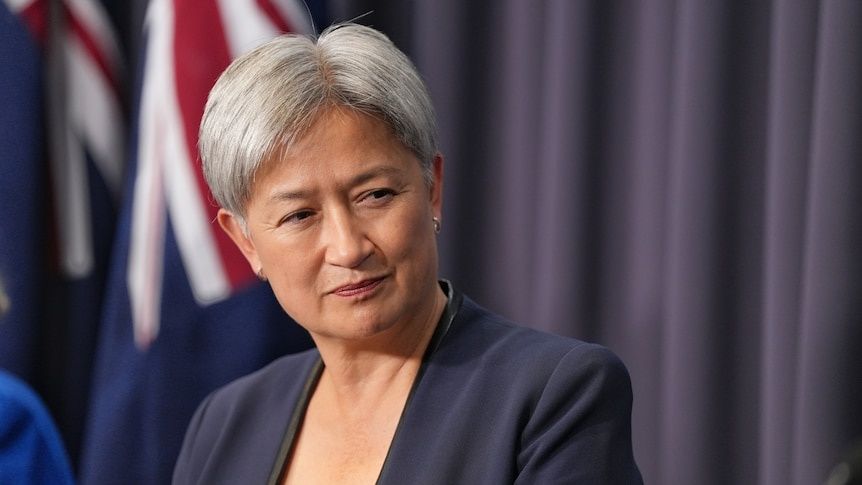
Australia's Foreign Minister Penny Wong is mounting a forceful defence of multiculturalism, characterising it as fundamental to the nation's identity and security interests in a significant political intervention scheduled for Friday. Speaking at the Lowy Institute in Sydney, Wong—herself the first Asian-Australian to reach the cabinet level—will confront the ascendant One Nation party and its leader Pauline Hanson, who have been gaining electoral momentum with appeals for cultural monoculturalism. The timing of Wong's address reflects deepening alarm within Australia's centre-left Labor government about the political trajectory of the country's far-right movement, which recent polling suggests could play a kingmaker role in the 2028 federal election.
Wong's rhetorical framing of multiculturalism as "the only Australia that has ever existed" serves as both historical assertion and political challenge. By anchoring her defence in Australia's demographic reality—half the population was born overseas or has at least one parent born abroad, according to census figures—she positions support for cultural diversity as empirically grounded rather than ideological. This approach contrasts sharply with the romanticised vision of national homogeneity that Hanson's One Nation has been promoting, which the minister characterises as a "melancholic fantasy" that would ultimately weaken rather than strengthen the nation.
The political context animating Wong's intervention cannot be overstated. Hanson, frequently compared internationally to figures like Donald Trump and Marine Le Pen, has been articulating a nationalist platform that explicitly references Australia's now-abandoned White Australia policy—historical legislation that restricted non-white immigration. Her invocation of this discriminatory framework earlier this year provoked widespread condemnation, yet One Nation's electoral support has continued climbing. The party's recent surge to become Australia's most popular political force, as measured by opinion polling, signals a significant shift in the country's political landscape and suggests that traditional two-party politics may no longer dominate Australian electoral discourse.
Wong's argument extends beyond cultural symbolism into strategic calculation. She warns that abandoning multiculturalism would damage Australia's international trade relationships and security partnerships, framing cultural insularity as incompatible with geopolitical resilience. In an increasingly complex regional environment—particularly given Australia's location in the Indo-Pacific and its existing security concerns—Wong suggests that Australia's ability to maintain diverse international connections depends on maintaining a culturally pluralistic domestic society. This framing transforms what might otherwise appear as a social policy debate into a national security matter, elevating the stakes of One Nation's monoculture prescription.
One Nation's policy platform goes considerably further than cultural rhetoric. Hanson has called for Australia to substantially reassess its commitments to international organisations and dramatically reduce foreign aid spending. These positions would represent a significant departure from Australia's postwar foreign policy architecture and would have particular implications for regional neighbours including Malaysia and other Southeast Asian nations that benefit from Australian development assistance and security cooperation. The prospect of One Nation holding meaningful parliamentary power—a scenario that polling suggests is plausible by 2028—thus carries direct consequences for the broader Indo-Pacific region.
The government's acknowledgment of "legitimate concerns" about economic pressures and housing availability suggests an attempt to acknowledge the grievances that have fuelled One Nation's rise without endorsing the party's divisive framing. Prime Minister Anthony Albanese, himself invoking his Italian family heritage to underline his multiculturalist credentials, has indicated that the Labor administration intends to announce immigration policy adjustments. This represents a delicate political balancing act: responding to genuine public anxieties about cost of living and housing affordability while resisting the nativist narratives that far-right parties seek to attach to these concerns.
Wong's intervention is particularly significant given her own biographical narrative as a Malaysian-born politician who achieved senior cabinet rank in a Western democracy. Her presence in Australia's foreign ministry itself constitutes a refutation of the monoculturalist vision, making her the most visible embodiment of the multicultural system that One Nation explicitly rejects. By positioning herself as the articulate defender of diversity against Hanson's insurgent nationalism, Wong is effectively challenging the framing that has allowed far-right movements to dominate recent political discourse in several Western democracies.
The reference to refugee success stories in business and sport in Wong's prepared remarks serves multiple rhetorical functions. It counters the implicit narrative that newcomers represent economic burden by highlighting demonstrable contributions to Australian prosperity and cultural life. It also provides a humanising counterpoint to the abstract debate about national identity, grounding the multiculturalism discussion in concrete examples of individual achievement and social integration. This approach anticipates and attempts to pre-empt One Nation's arguments about economic competition and cultural dilution.
Regionally, Wong's defence of multiculturalism carries particular resonance for Southeast Asia. Australia's relationships with Malaysia, Singapore, and other neighbours have been strengthened by migration flows, business networks, and educational exchanges that depend on cultural openness. An Australian political turn toward restrictionist nationalism, should One Nation eventually gain governing power, could significantly alter the texture of Australia's regional engagement. The business and investment ties that have grown between Australia and Southeast Asia often depend on skilled migration and cultural familiarity, both of which would face headwinds under a One Nation-influenced government.
The government's immigration policy adjustments, while intended partly as political damage control, may inadvertently legitimise One Nation's framing by suggesting that current immigration levels are problematic. However, the distinction Albanese has drawn—between addressing legitimate economic concerns and "vilifying people" or attempting to divide communities—represents an important line that the Labor administration is attempting to maintain. How effectively the government can communicate this distinction while implementing new immigration restrictions will likely determine whether policy adjustments succeed in stabilising support or merely concede rhetorical ground to the far right.
Wong's emphasis on "external and internal forces" seeking to divide Australia appears calibrated to acknowledge both foreign interference concerns (increasingly salient in Australia's strategic thinking) and domestic political actors exploiting divisive issues. This formulation allows her to criticise One Nation's messaging without directly attacking the party in inflammatory language, instead positioning divisive politics as weakening Australia against potential adversaries. The invocation of vulnerability and security weakness as consequences of abandoning multiculturalism reframes cultural diversity not as a luxury or lifestyle choice but as a strategic necessity.
The timing of this intervention, with the 2028 election still several years distant, suggests that the Labor government believes the political moment demands preemptive argument-making rather than waiting for electoral competition to intensify. By establishing clear intellectual and moral ground now, Wong and Albanese are attempting to shape how the multiculturalism question will be debated as electoral competition approaches. Whether this rhetorical strategy can arrest One Nation's momentum or merely document its rise will become clearer as the political cycle progresses toward the next federal election.

