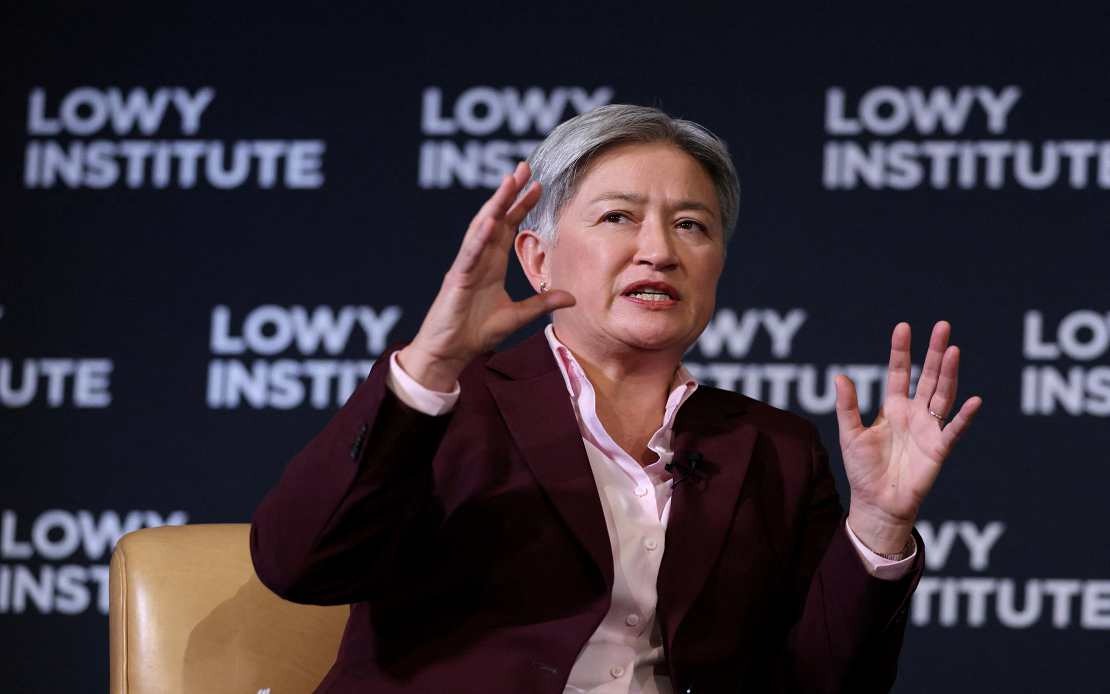
Australia's Foreign Affairs Minister Penny Wong has mounted a forceful defence of multiculturalism, cautioning that ideological pushes toward a monocultural society undermine national strength and economic resilience. Speaking at the Lowy Institute in Sydney on Friday, Wong characterised calls for cultural homogeneity as a counterproductive "melancholic fantasy" that would ultimately isolate Australia from the global community and diminish its standing as a strategic partner in the Indo-Pacific region.
Wong's intervention represents a significant political moment, directly confronting the rising influence of right-wing populist Senator Pauline Hanson, whose One Nation party has repositioned itself as a champion of cultural preservation. In June, Hanson declared that Australia must operate as a monocultural society, a position that has gained considerable traction among portions of the electorate increasingly anxious about demographic change and immigration patterns. The Foreign Minister's rebuke underscores deepening fractures within Australian political discourse over national identity and social cohesion at a critical juncture before the 2028 general election.
The minister articulated a vision of multiculturalism as foundational to Australia's prosperity and security. She argued that abandoning multicultural principles in favour of cultural uniformity would represent a self-imposed strategic retreat, severing economic relationships, diplomatic alliances, and collaborative partnerships essential to Australia's prosperity in an era of regional competition. "The call for a monoculture is a call for Australia to curtail our choices and to cut off our connections. To look inwards, to have no friends to work with, no partners to trade with, and no opportunities to grow from," Wong stated, framing the debate in terms of practical national interest rather than abstract principle.
One Nation's electoral momentum has become impossible to ignore. Recent YouGov Australia polling from July reveals that 26 per cent of Australians now intend to vote for One Nation at the next election, a dramatic rise from the 6.4 per cent of votes the party secured in the 2025 ballot. This four-fold increase within a single electoral cycle signals a profound shift in voter sentiment and represents a significant challenge to the established major parties. The party has pledged an aggressive policy agenda including strict immigration curbs, slashed foreign aid expenditure, and withdrawal from multilateral institutions should it attain power—positions that directly contradict Wong's articulated vision of Australia's role in the world.
The polling data reveals broader erosion of support for Australia's traditional political establishments. The governing Labour Party has declined from 34.5 per cent support at the 2025 election to 28 per cent in current polling, while the conservative Coalition has fallen even more sharply from 31.8 per cent to 20 per cent. This fragmentation suggests that neither major party currently commands the confidence of a substantial plurality of voters, creating space for alternative political movements. The deterioration of Coalition support is particularly noteworthy given its historical role as the centre-right governing alternative, indicating potential longer-term realignment in Australian politics.
Public attitudes toward immigration have hardened measurably across the population. The Lowy Institute's annual 2026 poll, released in June, documented that 55 per cent of Australians believe the immigration intake is too high, up from 53 per cent in 2025 and 48 per cent in 2024. This steady annual increase suggests that concerns about migration levels have become embedded in public consciousness and represent a structural challenge for policymakers regardless of party affiliation. The trend indicates that immigration policy will likely dominate electoral discourse leading into 2028 and that any government must address voter anxiety about population change as a priority.
For Malaysian and Southeast Asian observers, Australia's political turbulence holds particular significance. Australia remains a critical security partner and trading relationship for the region, and any shift toward isolationist policies or withdrawal from multilateral engagement would have direct implications for regional stability and economic cooperation. The potential strengthening of One Nation's parliamentary representation could complicate bilateral relationships and alter Australia's participation in organisations such as ASEAN Regional Forum and the East Asia Summit, in which Australia has played an increasingly active diplomatic role.
The ideological conflict now consuming Australian politics reflects broader Western tensions between liberal internationalism and populist nationalism. Wong's defence of multiculturalism draws on arguments about economic dynamism and security partnership, positioning openness as pragmatic rather than merely progressive. Her warning that cultural homogeneity would produce vulnerability aligns with globalisation-era arguments that diversity drives innovation and resilience. This framing attempts to reorient debate away from cultural identity alone toward national competitiveness and security.
However, the electoral trajectory suggests that Wong's arguments have yet to gain decisive traction with ordinary voters. The sustained rise in One Nation support despite sustained criticism from political and intellectual establishments indicates that sections of the Australian electorate perceive existing frameworks as failing to address their concerns about rapid social change, wage pressure, housing affordability, and community cohesion. One Nation has positioned itself as a voice for constituencies feeling left behind by globalisation—a political positioning that transcends purely cultural objections to immigration.
The 2028 election will serve as a critical test of whether Wong's vision of enlightened internationalism and multicultural cohesion can arrest the momentum of populist challengers or whether One Nation and similar movements will consolidate their influence. The result will reverberate across the Indo-Pacific, potentially reshaping Australia's strategic orientation and its commitment to regional institutions and partnerships. For now, the trajectory remains uncertain, with the Foreign Minister's warnings representing an opening salvo in what promises to be a defining electoral contest over Australia's identity and global role.

