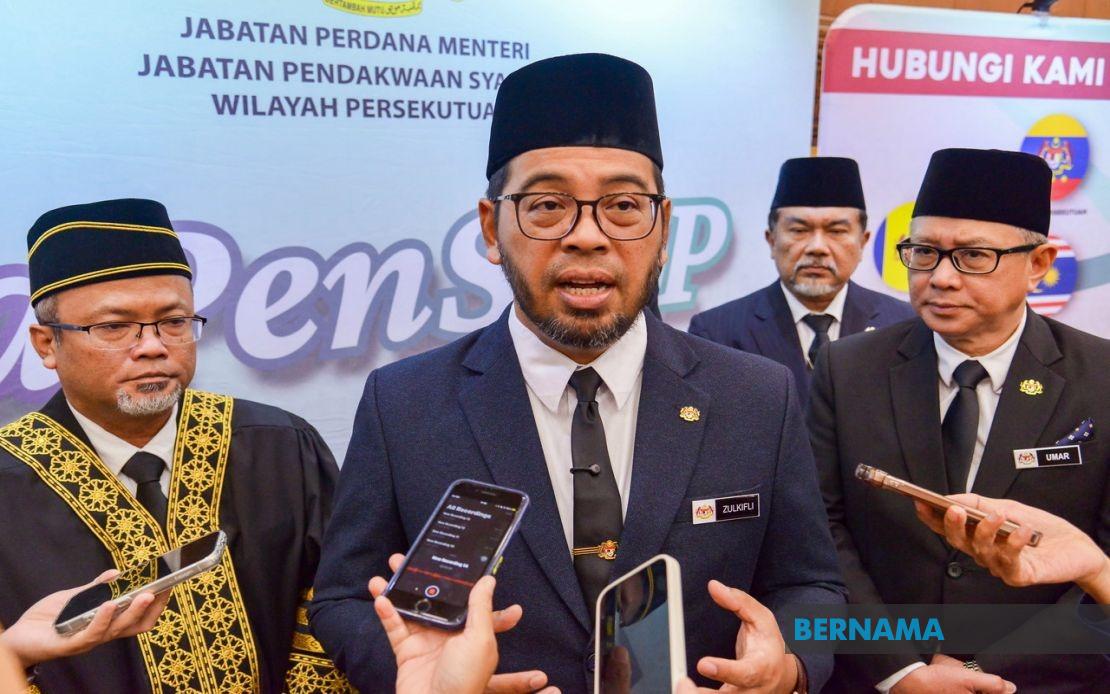
The Prime Minister's Department handling religious affairs has initiated an investigation into allegations that a Department of Islamic Development Malaysia (JAKIM) reference number was inappropriately used to lend legitimacy to marriage declaration letters purportedly issued by the Malaysia Rohingya Ulama Council. Minister Dr Zulkifli Hasan disclosed the probe following a public event in Putrajaya on July 15, acknowledging that his office had not yet assembled comprehensive information necessary to evaluate the validity of the contentious claims now circulating across social media platforms.
The controversy emerged after marriage declaration letters displaying the JAKIM reference number "JAKIM.PERH/LN.800-7(5)" began spreading virally online, prompting widespread concern and confusion about whether the documents carried official government endorsement. This apparent misuse of a government agency's reference number triggered immediate scrutiny from religious authorities, particularly those at state level, who questioned both the legitimacy of the letters and their potential legal implications for the Rohingya community seeking formal marriage recognition within Malaysia's religious and civil framework.
State-level religious authorities have moved swiftly to distance themselves from these documents. The Perak Islamic Religious Department (JAIPk) publicly stated that it does not recognise the marriage declaration letters as legally valid instruments, clarifying that the department cannot process or register marriages involving members of the Rohingya community. Officials explained that this restriction stems from policy considerations currently under review by various state religious bodies, suggesting the issue involves broader jurisdictional and administrative questions rather than straightforward document authentication.
The marriage registration difficulties encountered by the Rohingya community within Malaysia reflect the complex intersection of humanitarian concerns, administrative regulation, and religious law enforcement. Since the Rohingya population in Malaysia comprises stateless refugees and asylum seekers without citizenship status, their ability to formalise personal relationships through government channels remains significantly constrained. The emergence of alternative marriage documentation systems, whether legitimate or questionable, underscores the practical difficulties facing a marginalised community attempting to navigate Malaysia's formal institutions.
Beyond the immediate marriage document controversy, Dr Zulkifli highlighted another pressing concern occupying the attention of his department: the proliferation of religious lectures and teachings delivered via social media platforms without proper accreditation. This issue has gained prominence as digital platforms democratise religious instruction, enabling individuals to reach large audiences without necessarily possessing recognised qualifications or official approval from religious authorities. The minister acknowledged that addressing unaccredited religious teaching online presents significant enforcement and coordination challenges across Malaysia's federal and state jurisdictional boundaries.
Responsibility for regulating religious instruction ultimately rests with individual state governments, according to Dr Zulkifli, as these authorities hold constitutional power over Islamic affairs within their territories. This decentralisation of enforcement authority creates complications for addressing online religious content, which transcends state boundaries and operates in digital spaces beyond traditional regulatory oversight. The minister indicated that his department is currently formulating a comprehensive approach to managing unaccredited religious teaching online, taking into account the complex legal and constitutional dimensions involved in regulating digital religious speech.
At the departmental level, Dr Zulkifli assured that screening mechanisms exist to verify the accreditation status of religious figures invited to appear on government-sanctioned platforms or broadcast channels. However, enforcing comparable standards across the broader social media ecosystem, where independent content creators and uncertified religious teachers operate with minimal oversight, presents substantially greater difficulties for regulatory authorities. The challenge intensifies when considering the borderless nature of digital platforms and the comparative ease with which individuals can establish online audiences regardless of formal qualifications.
The broader modernisation of Syariah law enforcement featured prominently in Dr Zulkifli's remarks during the second Malaysian Syariah Prosecutors Conference (PePSSM) 2026. He emphasised that Malaysia's religious legal framework must evolve to address emerging categories of offences, particularly those involving cyber-related crimes, digital fraud, and online violations of Islamic principles. This recognition that Syariah law must adapt to technological change reflects a pragmatic understanding that traditional enforcement approaches prove insufficient when dealing with crimes committed through digital channels and internet-based platforms.
Effective prosecution of cyber-related religious offences requires unprecedented coordination between multiple government agencies operating across different jurisdictional and technical domains. Dr Zulkifli stressed the necessity of strengthening cooperative frameworks between JAKIM, the Malaysian Communications and Multimedia Commission (MCMC), the Royal Malaysian Police (PDRM), and the Attorney General's Chambers. This multi-agency coordination approach recognises that prosecuting digital crimes demands expertise spanning Islamic jurisprudence, telecommunications regulation, criminal investigation, and courtroom advocacy.
The minister called upon Syariah prosecutors to substantially enhance their professional capabilities in areas including digital forensics, data analysis, and information technology systems. Prosecutors handling religious cases increasingly encounter evidence derived from digital devices, cloud storage systems, and online communications, requiring technical sophistication previously unnecessary in traditional Syariah litigation. Building this capacity represents a significant professional development undertaking, as legal professionals must acquire specialised knowledge typically associated with cybercrime investigation and digital evidence handling.
These interconnected issues—the questionable marriage documents, unaccredited religious instruction online, and evolving cyber-related offences—collectively illustrate the complex challenges confronting Malaysia's religious governance structures as society becomes increasingly digitised. The Rohingya marriage document controversy serves as a particular flashpoint, highlighting how vulnerable populations may become victims of fraudulent documentation schemes or may resort to unrecognised alternative systems when formal channels prove inaccessible. Addressing these challenges requires not only investigation and enforcement but also deeper policy examination regarding how Malaysia's religious institutions can adapt to serve diverse populations while maintaining integrity and public trust in official processes.

