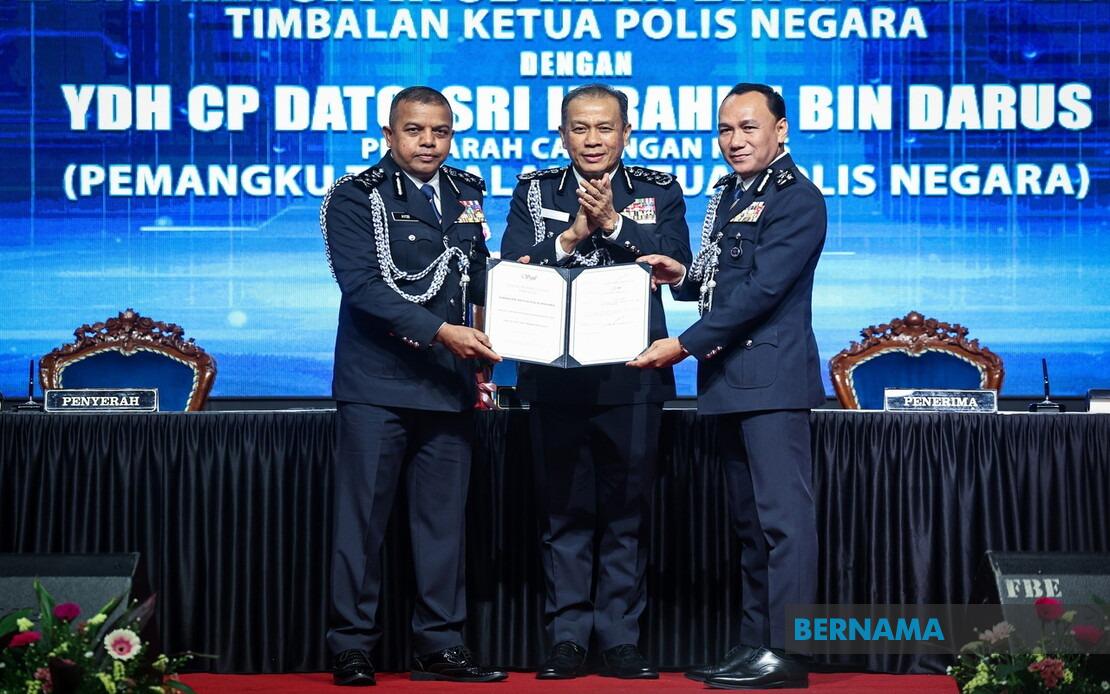
The Royal Malaysian Police marked a significant leadership transition on July 26 as Tan Sri Ayob Khan Mydin Pitchay stepped down from his position as Deputy Inspector-General of Police following more than 35 years of distinguished service. At a handover ceremony held in Kuala Lumpur, Inspector-General Tan Sri Mohd Khalid Ismail delivered a wide-ranging tribute to the outgoing deputy, characterising him as an exemplar of steadfast principles and unwavering dedication to the force's core values. The passing of the baton represents a moment of reflection on institutional continuity within Malaysia's premier law enforcement agency, even as the police force navigates evolving security challenges across the region.
Mohd Khalid's remarks painted a portrait of leadership grounded in personal conviction rather than expediency. He described Ayob Khan as someone whose tenure had been defined by commitment to fundamental principles, particularly the maintenance of the rule of law—a quality the IGP suggested should serve as a benchmark for the broader police hierarchy. The language employed underscored the significance of the transition, with Mohd Khalid framing Ayob Khan's departure not merely as a routine retirement but as the conclusion of a formative chapter in the PDRM's modern institutional history. This characterisation carries particular weight given the police force's prominence in Malaysia's political and social governance structures, where law enforcement leadership decisions frequently intersect with national policy debates.
Ayob Khan's career arc reflects the traditional advancement pathway within PDRM's hierarchy, though his progression through diverse and sensitive portfolios suggests a leader entrusted with complex operational responsibilities. Beginning from his foundation as a university graduate from Universiti Kebangsaan Malaysia, he progressed through the special intelligence apparatus before assuming command of the Johor Contingent—a major state-level deployment. His subsequent postings at the Narcotics Criminal Investigation Department and the Criminal Investigation Department positioned him at the centre of PDRM's drug enforcement and serious crime operations, two areas that have consistently demanded sophisticated investigative capability and strategic acumen. By the time of his elevation to the Deputy Inspector-General role in June 2023, Ayob Khan had accumulated extensive operational experience across the breadth of police specialisations, from counterterrorism to narcotics interdiction.
The decision to appoint Datuk Seri Ibrahim Darus as Acting Deputy Inspector-General brings the director of the Bukit Aman Special Branch into the second-highest position within the police hierarchy. Ibrahim's background in intelligence and counterintelligence operations signals continuity in the strategic posture of PDRM's senior command, particularly regarding internal security matters and the coordination of intelligence resources. The Special Branch directorate, being the primary vehicle through which the police coordinate intelligence and internal security operations, represents a sensitive portfolio. Ibrahim's elevation suggests the police leadership intends to maintain focus on counterintelligence and threat assessment as core institutional priorities moving forward.
Mohd Khalid's public endorsement of Ibrahim carries implicit weight beyond mere courtesy. The IGP explicitly stated his confidence that Ibrahim would shoulder the responsibilities of acting deputy with "full dedication," an assurance directed both at the broader police establishment and potentially at political stakeholders who influence senior police appointments. The succession dynamics within PDRM have occasionally become objects of political attention in Malaysia, reflecting the force's role in national security architecture. By framing Ibrahim's appointment as a straightforward continuation of institutional excellence, Mohd Khalid sought to signal stability and the absence of any disruption to operational effectiveness during the interim period.
Ayob Khan's emphasis on combating militant elements and safeguarding institutional integrity, as highlighted by Mohd Khalid, reflects concerns that have preoccupied Malaysian security planners for more than a decade. The rise of transnational extremist networks, the emergence of domestic militant cells, and the persistent threat posed by foreign terrorist organisations operating across Southeast Asia have placed counterterrorism and counterradicalisation at the forefront of PDRM's strategic agenda. The IGP's specific mention of Ayob Khan's contributions in this domain suggests that intelligence and counterterrorism operations constitute a defining element of his legacy—areas where principled decision-making and institutional integrity prove especially consequential.
The handover ceremony itself, though formal in nature, serves multiple institutional functions within the police hierarchy. Such ceremonies reinforce the legitimacy of succession processes, demonstrate continuity of command, and provide senior leadership with an opportunity to articulate institutional values to the broader force. By publicly celebrating Ayob Khan's principled approach to law enforcement and his resistance to pressures that might compromise institutional standards, Mohd Khalid effectively communicated expectations to the police hierarchy regarding what the force's leadership considers exemplary conduct. This dimension proves significant in contexts where institutional independence and integrity occasionally face external or internal pressures.
For Malaysia's broader security and governance landscape, the transition in the deputy inspector-general position carries implications extending beyond routine personnel management. The Deputy IGP coordinates major operational divisions, serves as the IGP's principal deputy in strategic decision-making, and often functions as the de facto operational commander for substantial enforcement initiatives. The continuity provided by Ibrahim's appointment, combined with the institutional acknowledgment of Ayob Khan's principled leadership, signals that Malaysia's police hierarchy remains committed to maintaining operational effectiveness and institutional standards even as external security pressures mount across the region. Southeast Asian governments have increasingly grappled with transnational criminal networks, maritime security challenges, and the coordination of counterterrorism operations across borders—domains where PDRM plays a central coordinating role.
Ayob Khan's 35-year tenure encompasses periods of significant institutional evolution within PDRM, from technological modernisation of investigative capabilities to the integration of specialised counterterrorism units and the expansion of intelligence coordination mechanisms. His progression through these transformative periods, and the IGP's attribution to him of unwavering commitment to principled policing, suggests a leader who navigated institutional change while maintaining fidelity to core values. This balance between adaptation and principle constitutes a recurring challenge for law enforcement agencies operating in rapidly evolving security environments, where technological advances, political pressures, and transnational criminal innovation constantly test institutional frameworks and individual leadership.
The explicit reference by Mohd Khalid to Ayob Khan's status as both "senior assistant" and "loyal comrade" illuminates aspects of senior police culture that shape institutional dynamics beyond formal organisational charts. Police leadership at the deputy inspector-general level operates within networks of professional relationships, institutional loyalty, and personal regard that substantially influence decision-making processes. Mohd Khalid's characterisation of Ayob Khan suggested someone who had earned the respect of his colleagues through consistent demonstration of principled conduct, institutional commitment, and the willingness to defend the force's integrity during challenging circumstances. Such relationships, built over decades of shared experience, substantially shape how police institutions navigate crises and maintain operational coherence during periods of stress.
Moving forward, the Malaysian police force faces evolving challenges that will require the sustained commitment to integrity and principled decision-making that Mohd Khalid attributed to Ayob Khan. Regional counterterrorism operations, transnational criminal investigations, cybercrime and digital forensics, and the maintenance of public confidence in police institutions all demand leadership approaches grounded in institutional values rather than expediency. Ibrahim's appointment as Acting Deputy IGP provides an opportunity to sustain and build upon the institutional standards that the retiring deputy embodied throughout his career. The ceremonial acknowledgment of Ayob Khan's legacy thus serves not merely as a formal farewell but as a reinforcement of institutional expectations for the police hierarchy that will guide PDRM's strategic direction in coming years.

