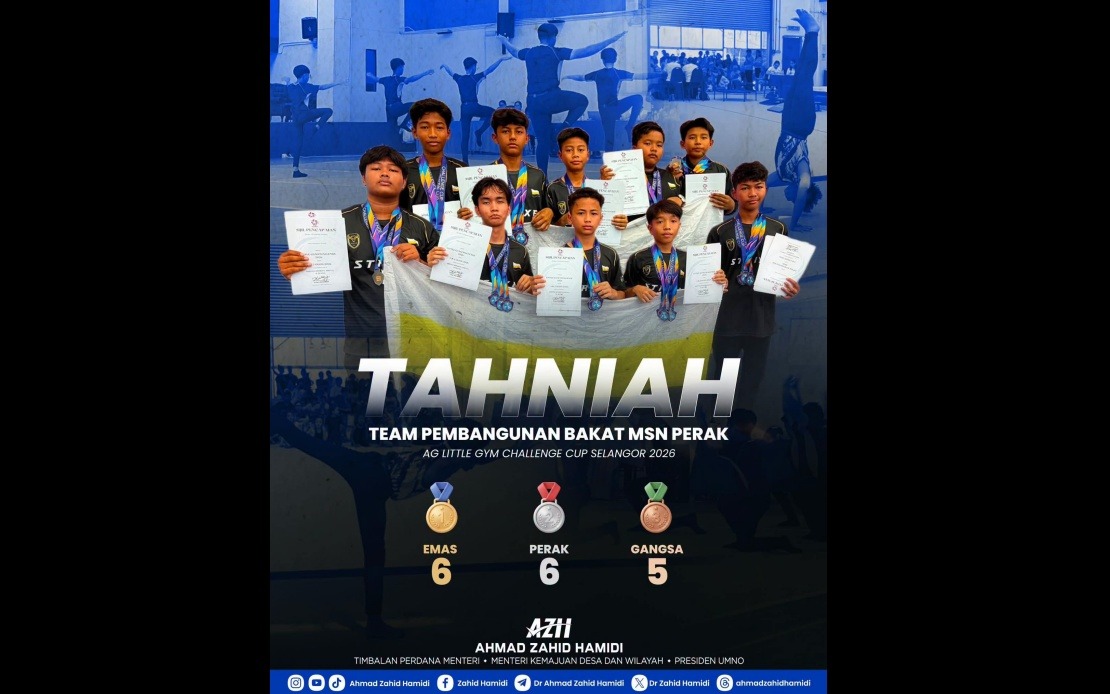
Young athletes from Bagan Datuk have scripted a remarkable chapter in the district's sporting annals by capturing six gold medals at the AG Little Gym Challenge Cup Selangor 2026, a major gymnastics championship held in Kajang on August 1. The delegation's success extended beyond the top podium position, with the team also securing six silver medals and five bronze medals across the competition, demonstrating both depth and consistency in their performances. This comprehensive medal haul represents a watershed moment for grassroots gymnastics in Perak's parliamentary constituency, which has historically been better known for its political prominence than its sporting achievements.
Deputy Prime Minister Datuk Seri Dr Ahmad Zahid Hamidi, who represents Bagan Datuk as Member of Parliament, took to social media to celebrate the accomplishment, framing the victory as validation of the young athletes' capabilities across multiple domains. In his remarks, he highlighted that the medalists have dispelled any notion that excellence in one arena necessarily limits achievement in another, emphasising that academic prowess and sporting prowess can coexist when conditions are favourable. His public acknowledgment carries significance beyond mere ceremonial support, signalling political backing for youth development initiatives in his constituency and potentially encouraging sustained investment in sports infrastructure and coaching at the grassroots level.
The deputy premier's statement underscored a fundamental principle often overlooked in Malaysian discourse: that comprehensive youth development requires simultaneous cultivation of intellectual and physical capabilities. By drawing explicit attention to the fact that Bagan Datuk's young people excel academically whilst also triumphing in competitive sports, Dr Ahmad Zahid has articulated a vision of holistic human development that extends beyond examination performance. This messaging resonates particularly in Malaysian society, where the pressure to achieve academic credentials frequently crowds out space for athletic pursuits among younger generations, potentially compromising their overall wellbeing and creating narrow definitions of success.
In his congratulatory remarks, the Deputy Prime Minister recognised the ecosystem that enabled such achievement, specifically acknowledging the contributions of coaches, parents, and supporting stakeholders whose behind-the-scenes labour proved instrumental to the team's success. This recognition reflects an understanding that athletic medals represent not merely individual effort but the convergence of multiple supporting factors including quality instruction, parental encouragement, appropriate facilities, and sustained training regimens. For Malaysian readers and policymakers, this framing offers an important reminder that sporting excellence cannot emerge spontaneously but requires deliberate cultivation through institutional and familial support structures.
The Bagan Datuk Generasi Muda Gymnastics Club, the organisation directly overseeing these athletes, released their own statement characterising the medals as milestones rather than endpoints in a developmental journey. Their post, circulated through social media platforms, emphasised that the achievements were harvested through disciplined training, perseverance, and psychological resilience—qualities that extend far beyond the gymnasium and into broader life competencies. This perspective, whilst potentially familiar in sporting circles, warrants emphasis in the Malaysian context, where competitive results are sometimes interpreted as final judgments rather than snapshots within longer trajectories of continuous improvement.
The club's explicit commitment to intensifying preparation for future competitions signals ambitions that transcend a single successful tournament. Such declarations typically indicate that the organisation possesses sufficient infrastructure, financial backing, and coaching expertise to sustain competitive momentum—a notable achievement for a district-level club in Malaysia's provincial gymnastics ecosystem. The willingness to adopt such a forward-looking stance, rather than resting on current laurels, suggests institutional maturity and strategic thinking that may distinguish this club from other similar organisations.
For Southeast Asian gymnastics enthusiasts, Bagan Datuk's emergence as a regional competitor carries broader implications. Malaysia has historically lagged behind countries such as Thailand and Vietnam in developing comprehensive gymnastics programmes, particularly at the youth level. The success of this particular club may catalyse increased attention to gymnastics infrastructure across Perak and neighbouring states, potentially elevating the sport's profile and encouraging investment by state governments and private sponsors. Young Malaysians observing these achievements may find inspiration to pursue gymnastics seriously, expanding the talent pool available for national team selection in future years.
The geographical location of the championship in Kajang, within Selangor state, places Bagan Datuk's success in direct comparison with competitors from Malaysia's most developed state, arguably increasing the impressiveness of their medal haul. Bagan Datuk, whilst politically significant as a parliamentary constituency, remains economically dependent upon smaller-scale manufacturing, agriculture, and trade rather than the industrial and technology sectors that dominate Selangor's economy. That young athletes from a relatively less economically developed district outperformed their counterparts from wealthier regions underscores the determination and quality of coaching that characterises the Generasi Muda club's approach.
The medalists' achievement also carries implications for gender equity in Malaysian sports. Gymnastics, particularly at youth levels, has traditionally attracted higher female participation rates than certain other sports, potentially offering pathways for young women to develop athletic excellence, earn recognition, and access opportunities that broaden their horizons beyond conventional limitations. The prominence of young gymnasts from Bagan Datuk may therefore represent an implicit expansion of athletic possibilities for female youth in Perak, an outcome with social ramifications extending well beyond competition results.
Sustaining this momentum will require deliberate action from multiple stakeholders. State and federal sports authorities might consider channelling additional resources toward facilities and coaching development in the Bagan Datuk region, leveraging this recent success as justification for investment. Corporate sponsors and philanthropic organisations may perceive commercial or reputational value in supporting young athletes from provincial districts, broadening their base of community engagement. Parents and school administrators, observing these achievements, may become more receptive to gymnastics programmes and facility development in local educational institutions.
The human dimension underlying these medals—the countless hours of training, the financial commitments made by families, the expertise imparted by coaches—deserves equal recognition alongside the objective results. Each medal represents not only athletic skill but also commitment to excellence, willingness to undergo rigorous discipline, and cultivation of mental toughness that proves valuable throughout life. For Malaysian youth, particularly those in districts that have not traditionally produced elite athletes, these young gymnasts demonstrate that geographic location and resource constraints need not determine destiny.
The Bagan Datuk gymnasts' success at the AG Little Gym Challenge Cup Selangor 2026 thus transcends the immediate context of a single competition. It represents validation of grassroots sporting development, affirmation that Malaysian youth possess competitive capabilities on par with international standards, and encouragement for sustained investment in comprehensive youth development. As this team looks toward future competitions with stated determination to excel further, Malaysian sports administrators and stakeholders would be prudent to recognise that similar success stories could be replicated across the country with appropriate support, investment, and institutional commitment to athlete development from the ground up.

