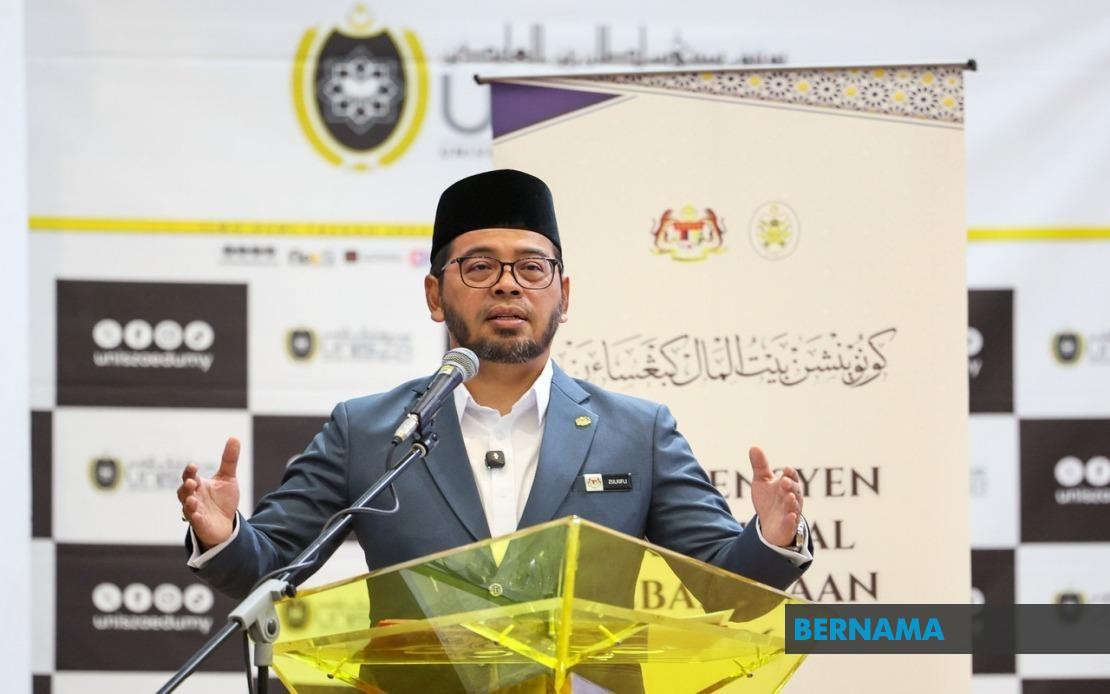
The conventional model of Baitulmal as a charitable institution focused on collecting and distributing alms requires fundamental restructuring to meet the complex socio-economic needs of modern Muslim communities, according to Dr Zulkifli Hasan, the Minister in the Prime Minister's Department (Religious Affairs). Speaking at the National Baitulmal Convention (KBK) 2026 launch held at Al-Muktafi Billah Shah Hall of Universiti Sultan Zainal Abidin in Kuala Nerus, the minister articulated a vision that positions Baitulmal not merely as a poverty-relief mechanism but as a catalytic institution capable of generating lasting economic transformation across Malaysia's Muslim population.
The distinction between poverty alleviation and poverty elimination has long preoccupied development economists, and Dr Zulkifli invoked the late Royal Professor Ungku Aziz's seminal observation that deprivation extends beyond inadequate income to encompass limited access to mechanisms for self-improvement. This conceptual shift carries particular significance for the Malaysian context, where Baitulmal institutions operate across federal and state levels with combined resources that remain substantially underutilized for productive purposes. The minister's argument suggests that current disbursement patterns, whilst providing immediate relief, fail to address structural inequality and systemic barriers that perpetuate dependence on welfare assistance across generations.
Dr Zulkifli outlined a three-pronged transformation strategy centring on the integration of Islamic social finance instruments as the foundation for economic empowerment. Rather than allocating Baitulmal funds exclusively towards subsistence grants, the proposed framework envisions capital deployment through profit-and-loss sharing mechanisms (Mudaraba and Musharaka structures), microfinance schemes, and Islamic venture capital instruments that enable beneficiaries to establish viable enterprises. This reorientation aligns with broader regional trends across Southeast Asia, where Islamic finance authorities increasingly emphasize productive investment over consumptive distribution, recognizing that sustainable development demands engagement with entrepreneurial ecosystems rather than perpetuation of aid dependency.
The second pillar of reform addresses operational transparency and systemic efficiency through comprehensive digital infrastructure. The minister emphasized that modern financial technology, artificial intelligence, and blockchain-based management systems can fundamentally restructure how Baitulmal resources flow through institutional networks. By establishing interconnected data platforms across state religious authorities, federal agencies, and civil society organizations, the proposed "Cross-Platform Social Exchange" concept would eliminate duplicate assistance, prevent fraudulent claims, and generate real-time visibility into resource allocation. Such technological integration carries implications extending beyond administrative convenience; it represents a democratic accountability mechanism that strengthens public confidence in religious institutions entrusted with managing substantial community assets.
Dr Zulkifli presented concrete evidence that digital transformation strategies already demonstrate measurable results within Malaysia's existing Baitulmal ecosystem. Collections have increased by 10 per cent following the implementation of accessible digital payment channels, with 40 per cent of total collection now occurring through online platforms and QR code-enabled transactions. These figures illustrate a fundamental principle of modern development finance: when institutions lower friction costs and enhance user accessibility, participation and contribution rates increase organically. The implication for Malaysia's religious authorities is straightforward—technological sophistication need not conflict with traditional charitable principles; instead, modern systems enhance the capacity of communities to engage with Islamic social welfare frameworks more effectively.
The third strategic element involves leveraging corporate instruments and Environmental, Social and Governance (ESG) frameworks to channel private sector resources toward Baitulmal objectives. This approach represents a significant departure from the conventional philanthropic model that relies primarily on individual zakat contributions and government allocations. By positioning Baitulmal institutions as vehicles through which corporations can fulfil ESG commitments, Malaysia's religious authorities can access substantially larger capital pools whilst aligning private investment with social development outcomes. This convergence of Islamic finance principles with contemporary global sustainability standards reflects Malaysia's positioning as a sophisticated Islamic financial hub capable of translating theological concepts into modern investment mechanisms.
The broader strategic context for Baitulmal reform extends beyond institutional rearrangement to encompass Malaysia's competitive positioning within regional Islamic finance markets. As Indonesia, Saudi Arabia, and the United Arab Emirates invest heavily in Islamic financial infrastructure, Malaysia's ability to demonstrate innovative approaches to charitable capital deployment becomes strategically significant. The proposed transformation of Baitulmal from traditional welfare institutions into dynamic wealth-creation platforms could enhance Malaysia's reputation as a jurisdiction where Islamic finance encompasses not only commercial banking but also sophisticated social finance mechanisms designed to address persistent inequality whilst generating sustainable livelihoods.
For Malaysian entrepreneurs and small business operators from disadvantaged communities, the shift toward Baitulmal-funded productive ventures offers tangible opportunities that currently remain largely unavailable. Traditional microfinance institutions operate within commercial parameters that frequently exclude individuals without established credit histories or collateral. By contrast, Baitulmal-administered Islamic financing instruments, grounded in principles of social welfare and community benefit, can accommodate risk profiles unsuitable for conventional lending whilst maintaining financial discipline through profit-sharing arrangements. This distinction carries particular relevance for rural communities, marginalized urban populations, and first-generation entrepreneurs seeking capital to establish viable enterprises.
The ministry's emphasis on integrated data systems and blockchain-based transparency addresses a persistent challenge within Malaysia's charitable and religious institutional landscape: public skepticism regarding resource utilization and administrative costs. By establishing technological systems that permit instantaneous auditing of fund movements, Baitulmal institutions can demonstrate that contributions directly translate into productive investment rather than administrative overhead. This transparency imperative extends beyond building public confidence; it creates institutional accountability mechanisms that discourage corruption and inefficiency whilst establishing performance metrics against which institutional leaders can be evaluated objectively.
Dr Zulkifli's remarks also signal the government's intent to harmonize Malaysia's Islamic social finance frameworks with international standards. The 2024 introduction of Accounting Standards for Islamic charitable institutions represents an important institutional development, positioning Malaysia's religious authorities alongside global best practices in financial governance. For foreign investors and development partners considering collaboration with Malaysian Baitulmal institutions, standardized accounting protocols reduce transaction costs and expand opportunities for structured partnerships that leverage international development finance alongside local charitable resources.
The success of this transformation agenda depends substantially on institutional capacity development and regulatory clarity. State Baitulmal authorities, which administer parallel systems across Malaysia's 13 states, require coordinated guidance regarding implementation of digital infrastructure, Islamic finance product development, and ESG framework integration. The proposed convention mechanism provides institutional forums for sharing best practices and addressing implementation challenges collaboratively. However, translating ministerial policy vision into sustained institutional practice requires sustained investment in staff training, technology infrastructure, and inter-institutional governance arrangements that remain under development.
Looking forward, Malaysia's Baitulmal institutions stand at an inflection point where strategic choices regarding operational models will determine their relevance for addressing Muslim community development across subsequent decades. The minister's articulated vision acknowledges that traditional poverty relief, whilst morally necessary, proves insufficient for addressing the complex economic challenges confronting contemporary Muslim societies. By positioning Baitulmal institutions as engines of wealth creation integrated with modern financial technologies and aligned with global sustainability standards, Malaysia's religious authorities signal their capacity to evolve Islamic charitable principles toward contemporary development challenges. The degree to which this transformation agenda translates into institutional practice will substantially influence Malaysia's credibility within regional Islamic finance markets and its ability to demonstrate the practical relevance of Islamic social finance for addressing twenty-first-century inequality.

