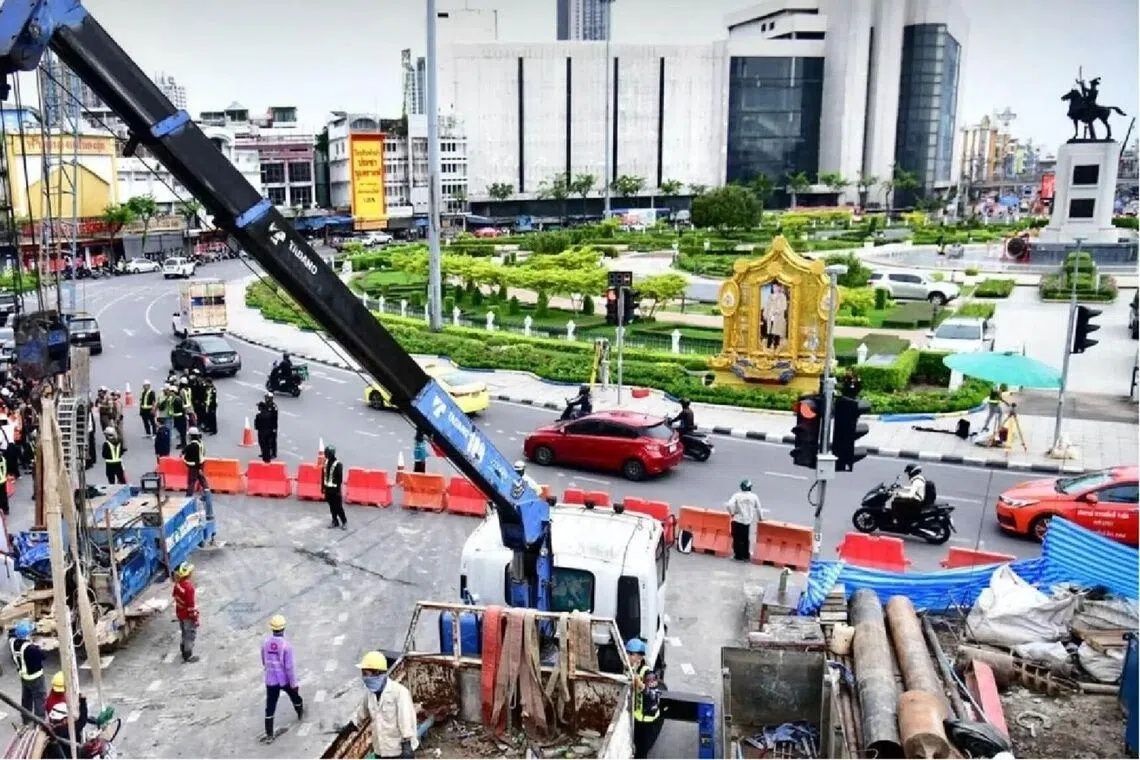
Bangkok has launched emergency evacuation procedures affecting some 60 people from three commercial buildings situated within 30 metres of a dangerous subsidence zone that opened up near Wongwian Yai following structural failure at an underground construction site. The incident underscores the mounting challenges facing Southeast Asia's rapidly expanding metro systems as they push deeper underground in densely populated urban areas, where ground instability can have cascading effects on surface infrastructure and communities above.
The crisis stemmed from water seepage that penetrated a drainage sump at the lowest point of the southern Purple Line tunnel construction. This water intrusion set off a chain of geological problems: surrounding soil gradually flowed into the underground structure, destabilising the ground above and causing both the road surface and nearby terrain to subside. The situation immediately triggered concerns about structural integrity in neighbouring buildings, prompting swift official action to protect residents and property.
Bangkok governor Chadchart Sittipunt, accompanied by deputy governor Wisanu Subsompon and deputy permanent secretary Kanokwan Iamlim, visited the affected site on July 9 to assess conditions firsthand. Initial reports indicated that water levels and the rate of subsidence had begun stabilising by the time of the inspection, though authorities emphasised that round-the-clock surveillance would persist until engineers confirmed the area's safety. This multi-level official involvement reflects the seriousness with which municipal and national authorities are treating the incident.
The Bangkok Metropolitan Administration and the project contractor initiated the evacuation of residents from the three buildings, transferring them to temporary accommodation including hotels for an anticipated one-week stay. The Mass Rapid Transit Authority of Thailand's contractor accepted financial responsibility for lodging, compensation and all related expenses, a significant commitment that underscores corporate liability in infrastructure projects. Officials have not yet permitted residents to return, stating that comprehensive stability assessments of both buildings and surrounding infrastructure must be completed before restrictions can be lifted.
To maintain real-time oversight of structural conditions, the Department of Disaster Prevention and Mitigation deployed two Rescue Guardian monitoring units on buildings close to the damage zone. These sophisticated sensors continuously measure tilting and structural movement, transmitting data instantly to a centralised monitoring system that triggers immediate warnings should abnormal displacement occur. The sensors were positioned within 30 metres of visible cracks in the road surface, creating a sensitive perimeter around the subsidence point.
Engineers from Thailand's national Urban Search and Rescue team joined the inspection operation, conducting detailed evaluations of surrounding structures to ensure that emergency response measures met both engineering standards and public safety requirements. The Department of Disaster Prevention and Mitigation mobilised generators, lighting systems and specialised machinery to support overnight operations, while rescue foundations and volunteer groups were positioned on standby should emergency medical assistance become necessary. This comprehensive deployment illustrates the scale of coordination required for subsurface infrastructure failures in urban settings.
Authorities implemented traffic restrictions spanning approximately 200 metres along Prajadhipok Road between Ban Khaek intersection and Wongwian Yai, closing all outbound lanes to reduce vibration that might further destabilise soil or compromise nearby building foundations. Two inbound lanes were converted temporarily to handle outbound traffic, with motorists from Memorial Bridge and Phra Pok Klao Bridge directed to use alternative routes including Itsaraphap, Lat Ya and Somdet Chao Phraya roads. This area functions as a major traffic bottleneck serving large educational institutions including Suankularb Wittayalai School and Suksanari School, complicating both mobility and logistics for thousands of daily commuters.
The immediate engineering priority centres on sealing the water leak and preventing additional soil from being drawn into the tunnel system. Engineers are deploying continuous monitoring instruments to track road surface conditions, soil movement, water seepage rates and the structural health of nearby buildings. This layered surveillance approach reflects recognition that subsurface failures can trigger unpredictable secondary collapses if not actively managed during repair and stabilisation operations.
This incident represents the second significant subsidence event along the southern Purple Line alignment, following an earlier road collapse near Vajira Hospital. However, the current situation involves a different construction contractor, suggesting that the problems may reflect broader challenges in tunnel excavation and drainage management rather than isolated contractor negligence. The recurrence of such events raises important questions about oversight mechanisms, design standards and contingency planning for Bangkok's ambitious transit expansion programme.
Governor Chadchart indicated that Bangkok may implement measures previously deployed following the Vajira Hospital subsidence, potentially including additional school shuttle services designed to reduce vehicular traffic in the area during the closure period. These adaptive management strategies attempt to mitigate broader economic and social disruption beyond the immediate evacuation zone. Authorities stated that traffic arrangements and closure duration would be announced only after engineers confirmed that buildings, roads and surrounding infrastructure met safety standards, meaning the roadblock could extend well beyond the initially estimated one-week timeline depending on repair complexity.
The incident carries implications for Malaysia and other Southeast Asian nations undertaking major metro construction projects. Bangkok's experience demonstrates how subsurface infrastructure failures can rapidly escalate into multi-agency crises affecting hundreds of residents and disrupting critical urban transport corridors. As countries in the region pursue deep tunnel projects to increase transit capacity in congested cities, they would benefit from studying Bangkok's emergency response protocols, monitoring technologies and contractor oversight mechanisms to prevent similar incidents.

