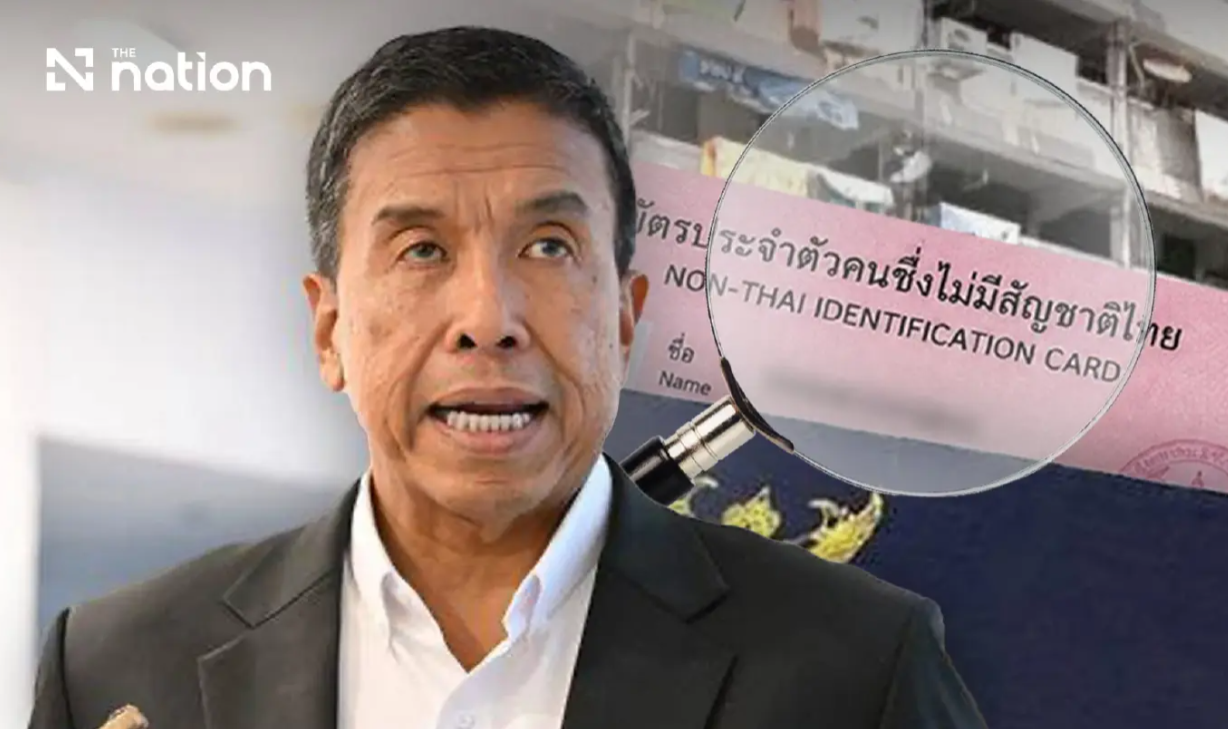
Bangkok Governor Chadchart Sittipunt has ordered a comprehensive examination of household-registration records spanning the past decade after authorities uncovered suspected systematic fraud involving pink cards—identification documents issued to individuals without Thai nationality. The sweeping review, which encompasses all 50 district offices in the capital, represents one of the city's most significant civil-administration investigations in recent years and highlights serious vulnerabilities in Thailand's identity-verification systems that could have implications for the broader Southeast Asian region as migration and cross-border populations continue to grow.
The investigation focuses on suspected irregularities where non-Thai nationals were improperly transferred into household registrations, enabling them to obtain documentation that could support pink-card applications. Each district office was directed to submit preliminary findings by August 21, with the review examining a period dating back to 2017. The scope and scale of the audit underscore the depth of concern among Bangkok administrators about potential exploitation of administrative processes that, if left unchecked, could undermine the integrity of the city's civil records and create security vulnerabilities.
Investigators have identified several fraudulent methods that appear to have been used in these schemes. One approach allegedly involved birth certificates belonging to children of foreign nationals born in Thailand who subsequently returned to their parents' home countries. These certificates remained within Thailand's system and were then allegedly repurposed to transfer other individuals into household registrations under the children's identities, effectively creating fictitious family relationships on official records. Such exploitation of legitimate documents demonstrates how criminals have managed to work within existing administrative frameworks to commit fraud at scale.
Additional irregularities involved transferring names from central household registers into standard household registrations or fabricating artificial parent-child relationships—colloquially referred to as "phantom child" and "phantom father" arrangements. These deceptive practices allowed unrelated individuals to appear as family members within a single residence, facilitating coordinated fraud operations. The sophistication of these methods suggests that such activities were not merely isolated incidents but rather part of a deliberate, organized scheme that exploited systemic weaknesses.
The investigation first surfaced definitively in Din Daeng district, where authorities discovered alarming concentrations of individuals listed at single addresses. One property measuring approximately 40 square metres held registrations for between 40 and 45 people—a figure that immediately raised red flags among administrators. Subsequent reviews of Din Daeng household transfers during 2024 alone identified more than 2,000 apparently suspicious address relocations, suggesting that the problem extends well beyond a handful of isolated cases and may represent a broader pattern requiring urgent systemic correction.
The Bangkok Metropolitan Administration has already taken disciplinary action, temporarily removing four administrative employees from their positions pending formal inquiries. These administrative suspensions are procedural steps rather than determinations of guilt, and separate police investigations continue independently. The involvement of government employees raises serious questions about potential complicity or negligence in approving fraudulent registrations, compelling authorities to examine whether systematic oversight failures created opportunities for abuse or whether individual officers were deliberately facilitating the fraud.
Governor Chadchart acknowledged that preliminary estimates suggested approximately 3,000 questionable registrations, though this figure remains unconfirmed pending detailed analysis. Rather than being concentrated at single properties, these problematic registrations may be distributed across multiple locations throughout the city, which would necessitate a more labour-intensive investigation approach. To manage the initial screening phase, the BMA will prioritize properties with at least 15 registered residents, with the threshold potentially lowered later to permit wider random audits of individual households.
The probe's scope has expanded to examine possible financial connections between suspected brokers and government officials. Governor Chadchart indicated that the BMA would coordinate closely with police to investigate money flows and determine whether payments occurred between brokers and administrators, acknowledging that civil authorities lack the investigative powers to compel cooperation from external parties or examine financial transactions. This collaborative approach recognizes the limitations of administrative investigation and the necessity of law-enforcement expertise to establish potential criminal conduct.
An investigative committee will be established to examine the records thoroughly and assess the conduct of involved personnel. Chadchart stated that the inquiry would pursue evidence wherever it leads, including toward retired senior officials, with any resulting action dependent on findings and applicable legal provisions. This commitment to accountability regardless of an individual's current position or seniority signals determination to address the issue comprehensively rather than limiting scrutiny to lower-ranking employees.
Beyond immediate investigation, the BMA is implementing structural reforms designed to prevent recurrence of such fraud. New procedures will distribute registration-approval authority among district directors and section heads rather than concentrating it within individual employees, thereby strengthening institutional oversight and reducing the risk of individual-officer abuse. Officials working in sensitive registration positions will undergo periodic rotation to disrupt potentially entrenched relationships that might facilitate corruption or negligence.
The administration plans to expand existing anti-corruption policies with enhanced emphasis on civil-registration procedures and administrative transparency. These systemic improvements reflect recognition that effective fraud prevention requires not merely investigating past wrongdoing but fundamentally restructuring processes to eliminate vulnerabilities. The challenge will be implementing these safeguards while ensuring that legitimate applicants—particularly the many foreign residents of Bangkok—are not unfairly burdened by investigation-related delays or overly restrictive new requirements.
For Malaysia and other Southeast Asian nations, Bangkok's pink-card fraud investigation carries important lessons. As populations become increasingly mobile and cross-border residence more common throughout the region, the civil-registration vulnerabilities exposed in Thailand could exist in other countries' systems. Malaysia's own approach to managing household registrations and identification for foreign residents merits examination to ensure similar exploitations cannot occur domestically, particularly as the country hosts substantial migrant populations and processes substantial numbers of temporary and permanent resident applications annually.

