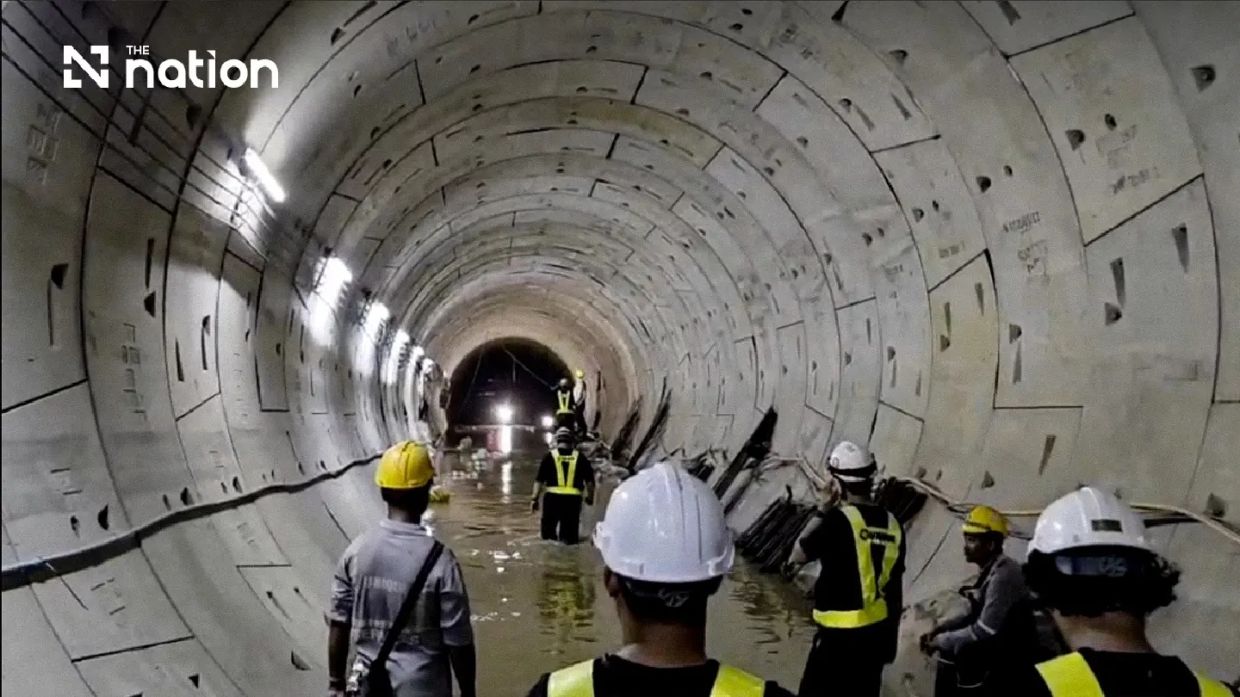
A significant water intrusion at Bangkok's Purple Line extension has triggered an urgent response from Thailand's highest-ranking transport officials, with Prime Minister Anutin Charnvirakul making a late-night inspection of the affected construction site near Wongwian Yai following heavy monsoon rainfall on July 8. The incident underscores mounting pressure on infrastructure planners to demonstrate rigorous oversight of the capital's expanding mass transit network, particularly after a catastrophic tunnel collapse near Vajira Hospital shook public confidence in project management protocols just months earlier.
Water penetrated the construction shaft serving the Tao Poon–Rat Burana section of the Purple Line's southern extension, specifically within the Saphan Phut–Dao Khanong corridor. The breach occurred as relentless rainfall saturated Bangkok throughout the day, with water levels accumulating steadily inside the active worksite. Unique Engineering and Construction Public Company Limited, the contractor responsible for this segment valued at 14.982 billion baht (US$447.3 million), has been conducting tunnel excavation and reinforced wall construction in this critical underground corridor. The timing of the leak, coinciding with Bangkok's peak monsoon season, highlights the vulnerability of ongoing subway construction to severe weather events that climate projections suggest will intensify.
Anutin arrived at the scene shortly after midnight, joining Deputy Prime Minister and Transport Minister Phiphat Ratchakitprakarn, along with multiple deputy ministers and senior officials from the Mass Rapid Transit Authority of Thailand. This mobilization of cabinet-level personnel reflects both the seriousness with which government regards infrastructure incidents and the political sensitivity surrounding the Purple Line project following earlier setbacks. The convoy's presence sent a clear signal that any compromise to public safety or project timeline would face immediate executive scrutiny.
The immediate response focused on stabilizing the situation and establishing baseline technical assessments. Phattharaphong Phatraprasit, one of the deputy transport ministers on site, ordered a comprehensive engineering review to identify the precise origin of the leak and directed contractors to implement corrective measures without delay. Critical to the inspection was determining whether the water breach reflected localized seepage or systemic structural compromise that could jeopardize the tunnel's integrity. Officials simultaneously installed sophisticated monitoring equipment throughout the surrounding district to detect any ground movement or subsidence in nearby residential and commercial structures—a precautionary measure directly informed by the Vajira Hospital collapse, where tunnel failure precipitated dramatic surface deformation.
Anutin distinguished the Wongwian Yai incident from the earlier Vajira Hospital disaster, emphasizing that in this case authorities had detected and begun addressing the leak proactively rather than discovering structural failure only after catastrophic surface collapse. The prime minister's framing sought to reassure the public that lessons from the September 2025 collapse had fundamentally altered official protocols, enabling earlier intervention and more controlled crisis management. He reported that water levels inside the construction shaft remained stable at the time of inspection and that no abnormal movement had been detected in adjacent buildings, though he acknowledged that continuous monitoring would persist throughout repair operations.
The political dimensions of this incident extend beyond immediate technical concerns. Thailand's major infrastructure projects operate under intense public scrutiny, particularly subway systems that directly affect daily life for millions of Bangkok residents and commuters. The Purple Line represents a significant multi-billion-baht investment critical to reducing Bangkok's notorious traffic congestion, yet repeated setbacks—including the Vajira Hospital collapse—have created persistent anxiety about project management competence. Anutin's rapid appearance at the site functioned partly as political theater, demonstrating ministerial responsiveness and willingness to engage directly with crises, but it also reflected genuine apprehension that another major incident could generate public backlash demanding fundamental changes to project oversight.
The broader Southeast Asian context makes Bangkok's underground transit development particularly consequential. As regional capitals compete to modernize their mass transit infrastructure, Thailand's experiences—both successes and failures—shape perceptions of construction quality and public safety in the region. Malaysian planners monitoring the Purple Line's development may draw conclusions about contractor reliability, geological assessment adequacy, and weather resilience in tropical urban environments. The incident thus carries implications beyond Thailand's borders, potentially influencing investment confidence and technical standards across Southeast Asia's rapidly expanding subway network.
Anutin acknowledged that the scale of ministerial response might appear disproportionate but defended it as consistent with the administration's commitment to preventive governance. He noted that information about the crisis had circulated through informal government channels, resulting in multiple officials converging on the site independently rather than through formal mobilization orders. This explanation revealed the organic nature of high-level crisis response in Thailand's centralized governance structure, where personal networks and immediate communication often supersede bureaucratic protocols. Whether such ad hoc coordination ultimately enhances or complicates crisis management remains contested among public administration specialists.
The technical requirements for resolving the leak involve multiple concurrent processes: rapid water extraction and management, comprehensive structural assessment of the tunnel lining and adjacent geological formations, and implementation of long-term waterproofing measures to prevent recurrence. Heavy excavation near underground structures in monsoon climates requires exacting precision, as excessive water removal can destabilize surrounding soil while insufficient extraction risks further infiltration. The contractor has mobilized specialized pumping equipment and is coordinating closely with consulting engineers to balance these competing imperatives while maintaining the construction schedule for this crucial transit segment.
Official statements emphasized that the Purple Line project remains fundamentally sound and that this isolated incident, while serious, does not indicate systemic failure. Anutin and his fellow ministers presented a unified message reassuring the public that authorities possess both technical capacity and political will to manage such challenges effectively. However, the incident inevitably revived questions about whether Thailand's rapid infrastructure expansion adequately prioritizes preventive maintenance and rigorous environmental assessment. For Malaysian observers and regional infrastructure investors, the Purple Line's trajectory—marked by genuine innovation alongside episodic crises—offers instructive lessons about the complexities of executing mega-projects in tropical, densely urbanized environments vulnerable to intensifying climate impacts.

