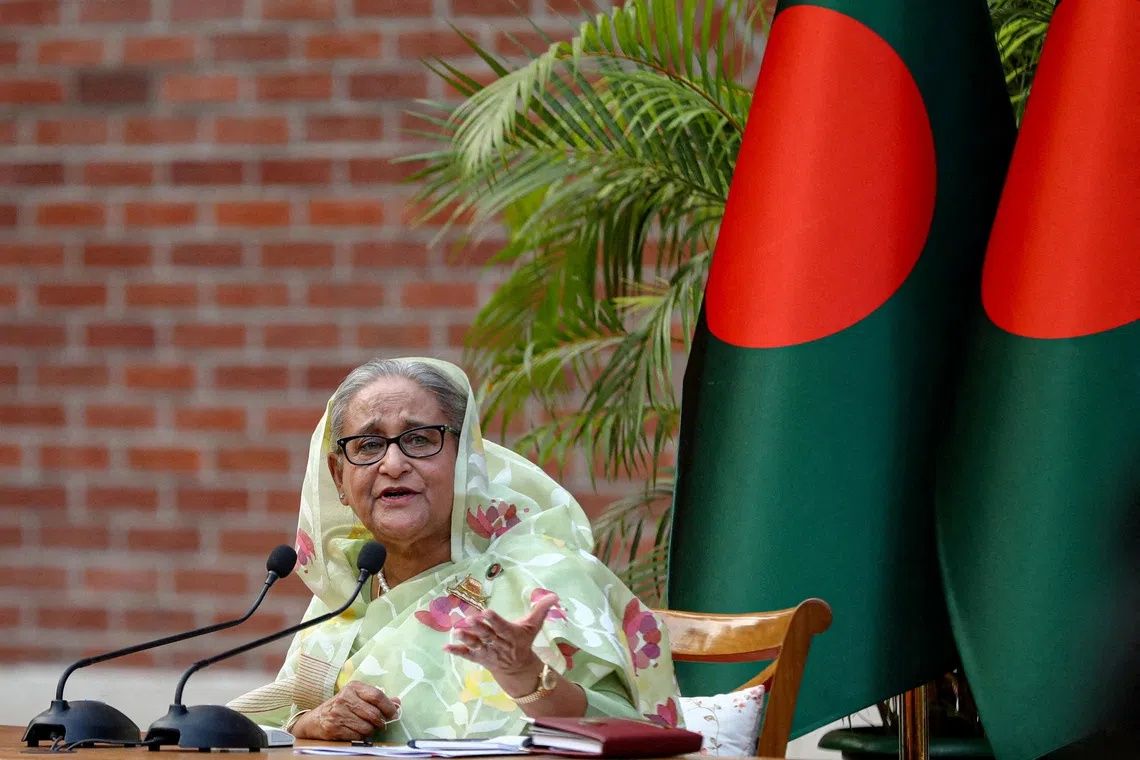
Bangladesh has formally requested clarification from India regarding exiled former Prime Minister Sheikh Hasina's intention to deliver a virtual address from New Delhi at an event marking the second anniversary of the student-led uprising that toppled her government in August 2024. The intervention by Dhaka represents the first official response to the planned appearance, which is scheduled to take place on August 5 at a gathering hosted by the Foreign Correspondents' Club of South Asia. Hasina, who fled to India following the collapse of her administration, has remained in the country since that tumultuous period, and her plans to speak publicly from Indian soil have now become a diplomatic flashpoint between the two neighbours.
State Minister for Foreign Affairs Shama Obaed Islam articulated Bangladesh's concerns at a media briefing late Monday, emphasizing that New Delhi must communicate a clear position on the matter. Islam stated that Dhaka's government is committed to advancing ties with India through a future-oriented framework, but expressed worry that permitting such activities could undermine the progress both nations have made in rebuilding relations. The minister's carefully calibrated language suggested that while Bangladesh does not necessarily blame the Indian government directly, the country remains deeply sensitive to any platform that might allow Hasina or other Awami League figures to conduct political activities from Indian territory.
The dispute emerges against a backdrop of continued Bangladeshi efforts to secure Hasina's extradition. Since her departure, Dhaka has faced considerable domestic pressure to prosecute the former premier, with multiple criminal cases filed against her. In 2025, a Bangladeshi court convicted Hasina in absentia and imposed a death sentence for crimes against humanity, citing her government's 2024 crackdown on pro-democracy protesters that the United Nations estimated resulted in up to 1,400 deaths. Hasina has dismissed the verdict as legally invalid, and in a recent Reuters interview declared her intention to return to Bangladesh by December despite the legal jeopardy she faces upon arrival.
The Foreign Correspondents' Club of South Asia confirmed that Hasina, who is 78 years old, will participate in the August 5 event through video link along with her son Sajeeb Wazed Joy and other speakers. The organization, however, has not yet provided a substantive response to Bangladesh's diplomatic objections regarding the planned participation. This silence has only intensified concerns in Dhaka, which worries that inaction might be interpreted as tacit approval for the event. The timing of the speech—coinciding with the anniversary of the uprising—carries particular symbolic weight, as it will directly commemorate an event widely viewed within Bangladesh as a liberation moment from Hasina's rule.
Islam emphasized that Bangladesh has communicated its position to India on multiple occasions, repeatedly stressing that Dhaka does not wish to see Hasina or other Awami League leaders making political pronouncements from Indian soil. She explicitly stated that Bangladesh wants to prevent India-Bangladesh relations from being damaged by statements emanating from fugitive individuals accused of serious crimes. Islam also noted that India had previously indicated to Bangladesh that it does not expect fugitives to engage in political activities from its territory, suggesting that New Delhi's own stated policy should preclude such events. However, Islam acknowledged that while the August 5 gathering is not being organized by the Indian government, Dhaka stands ready to raise the matter through formal diplomatic channels if necessary.
The Indian foreign ministry has not yet issued any public response to Bangladesh's concerns, leaving considerable ambiguity about New Delhi's actual position. This silence is notable given India's longstanding diplomatic engagement with Bangladesh and the recent warming of relations following the February elections that brought Tarique Rahman's government to power. The lack of immediate clarification has prompted speculation in regional diplomatic circles about whether India intends to allow the event to proceed or whether behind-the-scenes negotiations might yet alter the arrangement.
Bilateral relations between the two neighbours have endured significant strain since Hasina's ouster, though both governments have recently signalled a commitment to reconciliation and deepened cooperation. The new Bangladesh administration under Rahman has prioritized rebuilding ties with India as part of its broader foreign policy realignment. However, the Hasina speech controversy reveals the persistent friction points that continue to complicate the relationship, particularly regarding how India manages its status as a haven for prominent Bangladeshi political figures. For many Bangladeshis, India's willingness to provide refuge to individuals convicted of mass violence represents a troubling inconsistency in New Delhi's democratic credentials.
The episode also underscores the precarious position in which Hasina finds herself, operating from exile while maintaining defiant public statements about her intention to return. Her assertion that she will come back to Bangladesh by December appears strategically designed to position herself as unwilling to remain indefinitely in exile, yet the death sentence and numerous other charges make such a return extraordinarily risky. The planned New Delhi address represents one of her most prominent public acts since fleeing Bangladesh, suggesting that despite her legal predicament, Hasina remains determined to maintain a political presence and continue advocating for her position.
For Malaysia and other Southeast Asian nations observing this dispute, the Bangladesh-India tension offers important lessons about managing extradition requests, the treatment of political exiles, and the balance between humanitarian asylum principles and the legal obligations states owe to one another. The case exemplifies the complex dynamics that arise when major regional powers must navigate between friendship with incumbent governments and responsibility for individuals who claim political persecution. How India ultimately responds to Bangladesh's diplomatic pressure will likely influence regional expectations about the treatment of fugitive political leaders across Southeast Asia.

