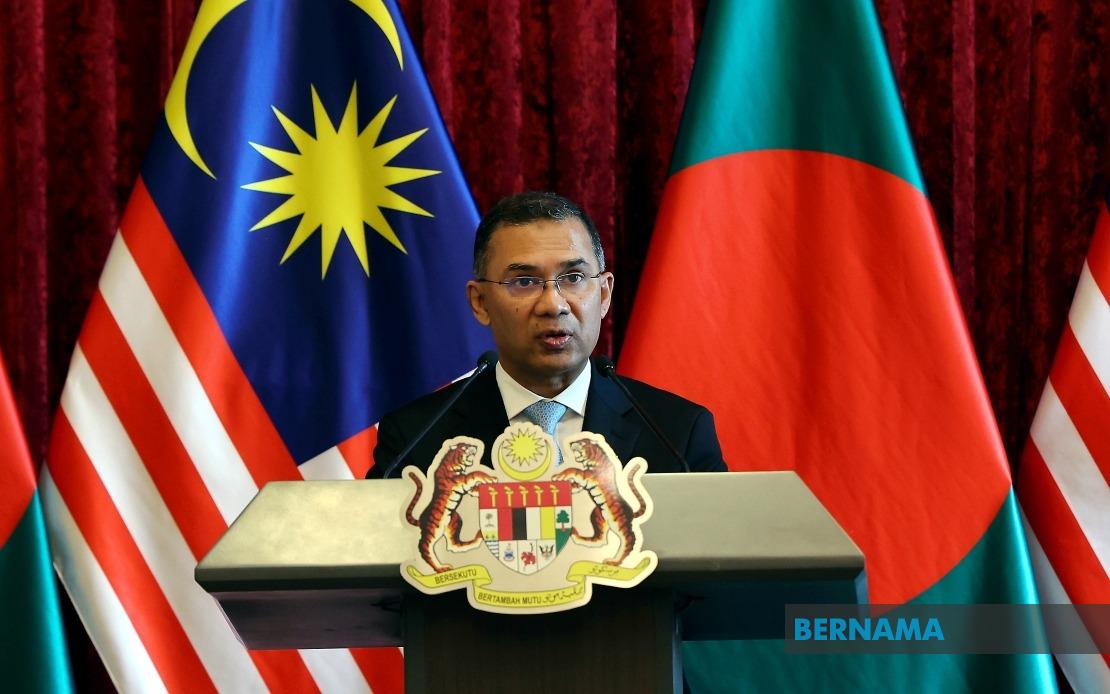
Bangladesh Prime Minister Tarique Rahman arrived in Putrajaya on Monday to underscore his government's determination to expand cooperation with Malaysia across multiple domains, from security and trade to diplomatic coordination at the international stage. During a joint press conference with Prime Minister Datuk Seri Anwar Ibrahim, Rahman emphasized that both nations had renewed their commitment to leveraging established institutional frameworks to drive closer engagement on pressing regional and global matters.
The bilateral engagement between the two South Asian and Southeast Asian neighbours reflects a strategic priority for Rahman's administration, particularly as he seeks to establish Bangladesh's foreign policy direction following his assumption of office earlier this year. This two-day official visit, undertaken at Anwar's invitation, carries symbolic significance as Rahman's inaugural bilateral journey abroad in his new capacity as premier, signalling the importance Dhaka places on its relationship with Kuala Lumpur.
Both leaders witnessed the formal signing of three substantive agreements designed to deepen institutional ties. A Memorandum of Understanding on Cultural Cooperation establishes a framework for exchanging knowledge, artistic expression, and heritage preservation initiatives between the two nations. Two Exchanges of Notes were also finalized, one focusing on counter-terrorism research and another addressing investment promotion and facilitation. These instruments reflect the multifaceted nature of modern bilateral relations, extending well beyond traditional diplomatic courtesies into concrete collaborative mechanisms.
A particularly noteworthy element of the discussions centred on Malaysia's backing for Bangladesh's candidacy for the presidency of the 81st session of the United Nations General Assembly. This public endorsement carries weight in the competitive international arena where regional support proves instrumental in securing high-profile UN positions. Rahman's acknowledgment of Malaysia's backing underscores how bilateral friendship translates into tangible support on the global stage, benefiting both nations' strategic interests within multilateral institutions.
The leaders also engaged in substantive dialogue regarding regional security challenges, with particular attention to developments in West Asia. This shared concern with geopolitical events beyond South and Southeast Asia demonstrates how contemporary bilateral relationships increasingly revolve around coordinating positions on matters affecting global stability. Both governments reaffirmed their intention to collaborate within the United Nations and other international bodies on issues of mutual concern, suggesting alignment on key foreign policy priorities.
Commercially, the relationship has flourished considerably. During 2025, bilateral trade between Malaysia and Bangladesh reached RM12.18 billion, with Malaysian exports comprising RM10.08 billion, predominantly petroleum products that supply Bangladesh's energy needs and industrial sectors. Bangladesh shipped RM2.10 billion worth of goods to Malaysia, primarily textiles, apparel, and footwear—sectors where the South Asian nation maintains competitive advantages. This trade composition reveals complementary economic structures, with Malaysia serving as a significant energy supplier while Bangladesh leverages its labour-intensive manufacturing capabilities.
Bangladesh's standing in Malaysia's trade hierarchy underscores the partnership's commercial significance. Ranking as Malaysia's 28th largest trading partner globally and second only to India within South Asia, Bangladesh represents a strategically important economic engagement for both countries. For Malaysia, Bangladesh offers access to a massive consumer market of over 170 million people and serves as a manufacturing hub for labour-intensive products. For Bangladesh, Malaysia provides essential energy security and investment opportunities in petrochemicals and downstream industries.
The textile and apparel trade flows merit particular attention given Bangladesh's status as a global manufacturing powerhouse in these sectors. Malaysian importers rely on Bangladesh for competitive-priced garments and finished textiles, reflecting the efficiency and cost-effectiveness that have made Bangladesh a preferred sourcing destination for retailers worldwide. This trade relationship extends beyond simple commercial exchange to encompassing deeper supply chain integration, with Malaysian businesses maintaining significant operations and partnerships within Bangladesh's industrial zones.
The diplomatic momentum generated during Rahman's visit carries broader implications for stability and prosperity across South and Southeast Asia. As both nations navigate the complex geopolitical landscape of the region, strengthened institutional mechanisms promise more coordinated responses to transnational challenges ranging from terrorism financing to maritime security. The counter-terrorism research collaboration specifically addresses a shared security concern, as both nations contend with radical extremist groups that operate across borders and exploit transnational networks.
Cultural cooperation agreements possess significance beyond their ceremonial character. They facilitate people-to-people exchanges, educational collaborations, and tourism initiatives that build enduring ties among ordinary citizens. Young Bangladeshis studying in Malaysian universities and Malaysian investors operating in Bangladesh benefit from formal frameworks that recognize and support these cross-border human interactions. Such initiatives help construct durable relationships that withstand political fluctuations and economic cycles.
For Malaysian policymakers, Bangladesh represents an increasingly consequential partner as regional architecture evolves. Bangladesh's strategic location at the juncture of South Asia and Southeast Asia, its growing economic influence, and its sizeable diaspora in Malaysia combine to make the relationship worthy of sustained high-level attention. Rahman's maiden bilateral visit abroad sends a clear signal that his government views Malaysia as a priority relationship deserving of early diplomatic engagement.
Looking forward, both governments have signalled their commitment to expanding cooperation through enhanced bilateral consultations between foreign ministers and regular joint commission meetings. These institutional mechanisms provide structured forums for addressing contentious issues, resolving disputes, and identifying fresh opportunities for collaboration. The emphasis on dialogue and engagement suggests both leaders recognize that in an increasingly multipolar regional environment, strong bilateral relationships serve as anchors for stability and prosperity.
The visit ultimately demonstrates how neighbouring nations separated by the Andaman Sea and Indian Ocean can forge increasingly sophisticated partnerships that transcend trade and encompass security coordination, cultural exchange, and diplomatic alignment on international questions. As both countries navigate the complexities of a rapidly changing global order, their commitment to strengthening ties offers a model of constructive bilateral engagement focused on shared prosperity and mutual benefit.