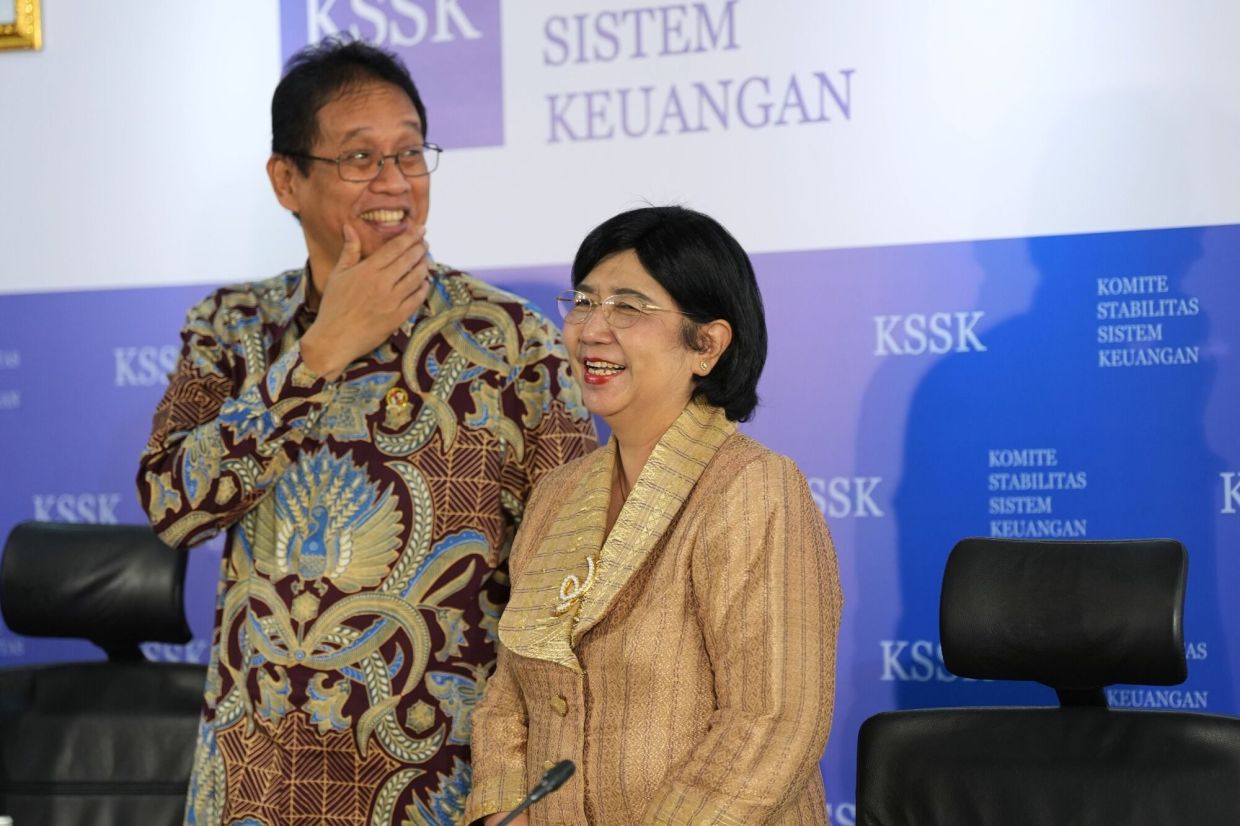
Destry Damayanti stepped into one of Southeast Asia's most delicate leadership positions when she assumed Indonesia's acting central bank governorship two weeks ago. Her first official day revealed much about her strategic priorities: before meeting President Prabowo Subianto at the presidential palace, she made a deliberate stop at the Finance Ministry to sit down with Finance Minister Purbaya Yudhi Sadewa. The timing and sequence of those appointments communicated a clear message about her willingness to forge a collaborative relationship with the government on monetary and fiscal coordination. Within days, the two appeared together at a public press briefing, exchanging handshakes and warm smiles that contrasted sharply with the more formal dynamics of her predecessor's tenure.
The contrast with outgoing Bank Indonesia Governor Perry Warjiyo is striking and deliberate. Warjiyo's interactions with the finance minister typically occurred in formal, broader settings at the presidential palace or through regulatory committees rather than as direct bilateral engagements. The only publicly documented one-on-one meeting between Warjiyo and Purbaya took place at the central bank's offices in September 2025, suggesting a relationship conducted largely at arm's length. President Prabowo has now formally nominated Destry as the sole candidate for the governor position, seeking to achieve what appears to be a carefully calibrated balance: a market-oriented economic technician aligned with his administration's policy objectives while maintaining enough credibility to reassure international investors.
At the core of Destry's challenge lies a fundamental tension in Indonesian economic governance. Prabowo has set an explicit target of lifting growth toward 8% by 2029, an ambition that requires expansionary policy support and business-friendly measures. Yet the international investment community remains anxious about Indonesia's policy direction after a year of populist initiatives that have unsettled markets, including free school meal programmes and expanded state control over commodities. The rupiah has deteriorated roughly 6% against the dollar this year, making it the worst-performing currency in Asia, while both Fitch Ratings and Moody's have placed Indonesia's sovereign debt on negative watch, citing concerns about policy uncertainty.
Economists monitoring the central bank transition have expressed cautious optimism about Destry's appointment, suggesting that her deep familiarity with Bank Indonesia's operations—she has served as deputy governor since 2019—should provide policy continuity and preserve the institutional focus on currency stability that markets value. Her stronger rapport with the finance minister is widely interpreted as likely to produce improved coordination between monetary and fiscal authorities, though some analysts worry this could tilt the central bank's stance in a more accommodative direction. When her nomination was announced on Monday, financial markets responded positively, with the rupiah extending gains to its strongest level in a month and outperforming most comparable Asian currencies, though her appointment still requires parliamentary approval to take effect.
The technical track record that Bank Indonesia established under Warjiyo will weigh heavily on investor assessments of Destry's performance. The previous governor deployed a sophisticated combination of policy tools to navigate competing objectives: three rate increases since May, foreign exchange market interventions to support the rupiah, and selective use of non-rate instruments to nurture credit expansion and growth. The question now is whether this balanced approach will continue or whether the new governor, with her demonstrated openness to closer government cooperation, will gradually shift toward more accommodative settings. Irman Faiz, chief economist at PT Bank Danamon, emphasizes that investors will scrutinize whether the central bank maintains its willingness to raise rates when inflation or currency pressures warrant such action, and whether liquidity management remains grounded in technical assessments of financial stability rather than growth preferences.
Destry's credentials suggest she possesses both the intellectual capability and relevant experience to handle the dual pressures ahead. She holds an economics degree from the University of Indonesia and a master's degree in regional science from Cornell University. Before joining the central bank, she worked as chief economist at PT Bank Mandiri and served as a commissioner at the Indonesia Deposit Insurance Corporation, an agency that was previously headed by Finance Minister Purbaya. Her history of regular engagement with Indonesia's investor and analyst communities suggests comfort with transparent communication about monetary policy objectives, a quality that investors value highly when evaluating central bank credibility.
However, the operating environment for Indonesia's monetary authority has grown considerably more complex. Global interest rates remain elevated and the dollar continues to strengthen, both factors that exert persistent downward pressure on the rupiah despite relatively modest domestic inflation. These external headwinds will make it progressively harder for the central bank to simultaneously support the president's growth acceleration while maintaining the currency stability that investors and multinational firms require. The rupiah's weakness has become a particular concern for President Prabowo's economic team, as it complicates efforts to attract foreign investment and may eventually feed into domestically-tradable goods prices.
Citigroup economist Helmi Arman has suggested that improved communication between the central bank and government could materially strengthen Indonesia's policy framework going forward, but he cautioned that the broader institutional credibility environment remains uncertain and subject to significant political-economic dynamics. The distinction that Faiz emphasizes appears critical here: effective coordination between monetary and fiscal authorities is necessary and beneficial, but the subordination of monetary policy to political objectives would represent a dangerous erosion of the central bank's independence. The reputation Bank Indonesia has built for professional management of inflation and currency stability over recent years would become difficult or impossible to recover if it were compromised.
Looking beyond the immediate policy cycle, Fakhrul Fulvian, chief economist at PT Trimegah Sekuritas Indonesia, argues that the central bank's next phase must transcend mere preservation of recent achievements. The technical accomplishment of stabilizing inflation and the rupiah, while valuable, is only a foundation. The more demanding task will be translating that stability into functionally normalized liquidity conditions, a yield curve that reflects genuine market expectations rather than policy distortions, more reliable transmission of monetary signals to the real economy, and a restoration of private-sector confidence in both the government's policy framework and the central bank's commitment to sound money principles. For Destry Damayanti, success will ultimately be measured not by her ability to maintain harmonious relations with the finance minister, but by whether she can deliver on that broader economic promise while preserving the institutional independence that makes such delivery credible.

