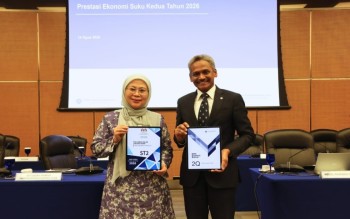
Bank Negara Malaysia has maintained its 2026 gross domestic product growth forecast of 5.0 per cent, with Governor Datuk Seri Abdul Rasheed Ghaffour signalling no immediate need for downward revision despite evolving global uncertainties. Speaking after the release of Malaysia's second-quarter economic data, the central bank chief expressed continued optimism about the trajectory of the national economy, noting that economic fundamentals remain sound and growth drivers are still firmly in place. The decision to hold the forecast reflects confidence that the country's expansionary momentum will persist through the remainder of the year, even as external headwinds warrant monitoring.
Malaysia's economy outperformed expectations in the second quarter of 2026, expanding by 6.0 per cent compared to the Department of Statistics Malaysia's preliminary estimate of 5.8 per cent. This third consecutive quarter of growth above forecasts has reinforced central bank confidence in the economy's resilience and capacity to absorb potential shocks. The stronger-than-anticipated performance underscores the breadth of expansion, with support coming from multiple sectors rather than concentrated in a single area. This diversification provides a buffer against sector-specific vulnerabilities and suggests the economic recovery has taken root across the productive base.
According to Rasheed, the primary engine of growth continues to be domestic demand, particularly household consumption, which registered 4.8 per cent expansion in the second quarter. This resilience in consumer spending reflects multiple reinforcing factors, with rising incomes providing the foundation for increased expenditure. Household savings have also played a supporting role, enabling families to maintain purchasing power even as external conditions evolve. Government policy initiatives, including targeted support measures and spending programmes, have added further impetus to consumption patterns. Notably, the governor clarified that household borrowing remains a marginal contributor to consumption growth, indicating that the rebound is underpinned by genuine income expansion rather than debt-fuelled spending, a critical distinction for assessing the sustainability of the recovery.
The external sector has delivered meaningful support to overall growth, particularly through export performance. The governor highlighted that export expansion has been diversified rather than concentrated, with both electrical and electronics shipments and non-E&E products recording gains. This diversification across export categories reduces Malaysia's vulnerability to sector-specific downturns and reflects the economy's growing structural resilience. Beyond traditional manufactured goods, the information and communications technology services sector has emerged as an additional growth contributor, signalling Malaysia's progress in shifting towards higher-value-added economic activities. This sectoral broadening is particularly significant for Southeast Asian peers examining Malaysia's development trajectory and potential models for economic transition.
Investment activity remains a third pillar of growth, though the governor's remarks suggest this component merits continued attention. The presence of consistent investment inflows, whether domestic or foreign, would typically underpin the projected 5.0 per cent medium-term growth trajectory. For Malaysian policymakers and regional observers, the composition and sustainability of investment flows warrant scrutiny, particularly as global capital allocation patterns shift in response to geopolitical considerations and technology sector dynamics. The central bank's confidence in the investment outlook appears anchored in expectations that Malaysia's competitive positioning in regional trade networks and its role in global supply chains will continue attracting capital deployment.
Bank Negara has acknowledged that the global environment presents emerging risks capable of moderating growth if circumstances deteriorate. Specifically, geopolitical tensions and uncertainties surrounding the international economy could weigh on Malaysia's outward-oriented sectors, particularly trade and tourism. The governor's measured tone—maintaining the forecast while cautioning against complacency—reflects a pragmatic assessment of downside scenarios. For Malaysian businesses and investors, this messaging suggests the central bank anticipates the need for potential forecast adjustments should external conditions materially shift, though the current momentum does not yet warrant such revisions. Such fiscal and monetary forecasting typically undergoes comprehensive review during the annual budget announcement, providing a natural checkpoint for policy calibration.
Climate-related challenges, particularly the impacts of El Niño weather patterns, present an additional layer of risk to Malaysia's economic outlook. The governor indicated that agricultural sectors would likely face the most acute effects, with economic damage largely concentrated in rural production segments. However, he emphasised the importance of proactive business and household adaptation, suggesting that preparedness and resilience-building measures could mitigate potential disruptions. For a nation where agriculture remains culturally and economically significant despite the economy's diversification into services and manufacturing, El Niño contingency planning represents a prudent policy consideration. The agricultural sector's relative share of GDP has diminished, but disruptions could nonetheless cascade through rural communities and affect food security metrics.
The resilience of household consumption at 4.8 per cent growth merits closer examination when considering medium-term growth sustainability. Income growth appears to be the primary driver, suggesting that employment conditions remain favourable and wage pressures are translating into household purchasing power. This contrasts with scenarios where consumption rebounds through credit expansion or depleted savings, patterns often associated with less durable recoveries. Malaysian policymakers have benefited from structurally sound employment markets in recent quarters, though global slowdown risks could eventually reach labour demand. The contribution of government policy support indicates that fiscal transfers and targeted assistance programmes continue providing stimulus, a factor that could face budgetary constraints if revenue shortfalls materialise.
For regional observers and foreign investors monitoring Malaysia's economic trajectory, Bank Negara's reaffirmed 5.0 per cent forecast projects a growth rate positioned between the stronger expansions of Southeast Asia's higher-growth economies and the moderate rates of mature developed peers. This positioning reflects Malaysia's intermediate development status and the economy's transition from purely manufacturing-dependent growth to a more balanced, services-inclusive model. The central bank's emphasis on broad-based growth and sectoral diversification aligns with long-standing development objectives and suggests that Malaysia's recent outperformance reflects structural improvements rather than cyclical windfalls. Investors considering regional allocations can interpret the forecast maintenance as indicating central bank confidence in Malaysia's medium-term prospects, though geopolitical and climate risks remain forces requiring vigilant monitoring through the remainder of 2026 and into subsequent years.

