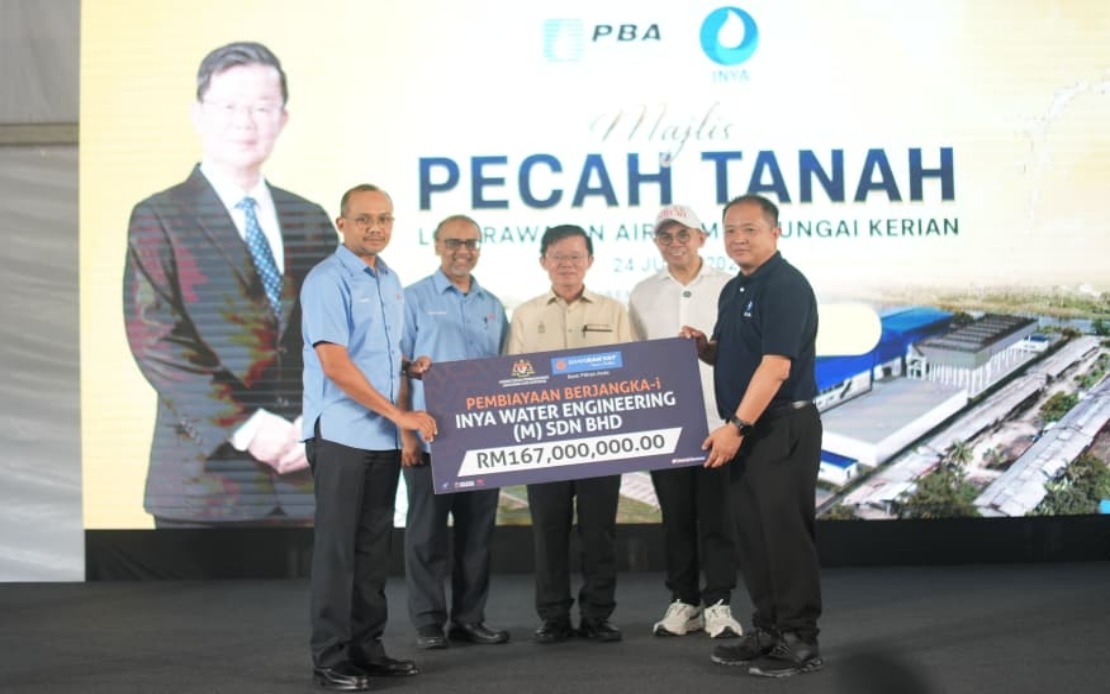
Bank Rakyat has committed RM167 million in financing for the Sungai Kerian Water Treatment Plant in Seberang Perai Selatan, Penang, underscoring the institution's expanding role beyond traditional lending to micro and small enterprises into critical infrastructure development. The amount represents 80 per cent of the total RM209 million project cost, with the remaining investment secured through other channels. This financing arrangement reflects a strategic pivot by Malaysia's development financial institution to strengthen water security infrastructure in states facing growing demand from industrial and residential sectors.
Entrepreneur and Cooperatives Development Minister Steven Sim characterised the investment as emblematic of Bank Rakyat's dual mandate—supporting economic actors while simultaneously investing in foundational systems that underpin long-term prosperity. Speaking on the financing commitment, Sim emphasised that such capital deployment addresses multiple national objectives simultaneously: stabilising water availability, enabling industrial expansion, and creating broader economic opportunities across the Penang region. The minister's framing suggests that development finance institutions are increasingly expected to assume direct roles in infrastructure financing rather than functioning solely as credit providers to smaller enterprises.
The Sungai Kerian facility represents a departure from conventional public water infrastructure financing models in Penang. Rather than utilising traditional government bonds or public financing, the 80 million litres-per-day capacity plant operates under a 30-year Build-Operate-Transfer arrangement, with Inya Water Engineering undertaking construction and operations before transferring assets to the Penang Water Supply Corporation upon contract expiry. Bank Rakyat will provide financing over 15 years, with an additional two-year grace period during the initial construction phase—a structure designed to reduce financial strain during the non-revenue generating period.
Penang Chief Minister Chow Kon Yeow, who presided over the ground-breaking ceremony, underscored the project's significance for regional water security. The plant will serve approximately 223,000 residents across Seberang Perai Selatan and Seberang Perai Tengah districts, with operational commencement scheduled for mid-2027. This timeframe reflects the complexity of constructing large-scale treatment facilities while maintaining rigorous environmental and safety standards throughout the Penang region.
The adoption of the BOT model represents the inaugural instance of this financing structure for Penang's water infrastructure, marking institutional innovation within the Penang Water Supply Corporation's development strategy. Under this arrangement, PBAPP avoids direct capital expenditure while securing treated water at a negotiated rate of RM0.98 per cubic metre from 2027 onwards. The pricing framework includes quinquennial review mechanisms, permitting rate adjustments according to mutually agreed parameters outlined in the concession agreement. This contractual structure protects both parties: PBAPP gains cost certainty while Inya retains provisions for cost recovery in response to inflation and operational variations.
Chow stressed that the additional capacity contributes modestly to PBAPP's total water supply infrastructure, constituting merely 6.6 per cent of the organisation's 1,208 million litres daily production as recorded in the preceding year. This relatively modest expansion underscores the ongoing challenge of meeting accelerating water demand across the northern region, particularly as Seberang Perai continues attracting manufacturing and semiconductor industries. The incremental nature of the addition suggests that state planners anticipate multiple such projects will be required to adequately meet demand trajectories through the coming decade.
A critical concern for Penang residents involves potential tariff implications. Chow provided reassurance that the project's operational commencement would not precipitate water tariff increases during 2027 and 2028, a significant political commitment given the sensitivity surrounding utility pricing in Malaysian households. The Penang Water Supply Corporation intends to absorb acquisition costs for the treated water within its operating budget during the initial two-year period, effectively subsidising the transition to the new capacity through internal cost management and efficiency improvements elsewhere within the organisation's operations.
The financing structure reflects broader patterns within Malaysian development finance, where institutions like Bank Rakyat increasingly participate in large-scale infrastructure projects alongside traditional commercial banking entities. The 15-year financing tenor aligns with the recovery period for such capital-intensive facilities, ensuring debt serviceability through operational revenues. The two-year grace period acknowledges construction timelines and the necessity of achieving operational stability before revenue generation commences, reducing default risk during the critical ramp-up phase.
For Malaysian policymakers and regional observers, the Sungai Kerian project illustrates viable pathways for financing essential infrastructure through structured public-private partnerships without straining government budgets or relying entirely upon foreign capital sources. The involvement of a domestic development finance institution provides continuity and ensures decision-making authority remains within national institutional frameworks. This approach holds relevance for other Malaysian states contemplating infrastructure expansion, particularly in water security, where climate variability and population growth create mounting pressures.
The timing of this financing commitment carries significance within Penang's broader economic development agenda. The northern corridor remains integral to Malaysia's semiconductor and electrical and electronics manufacturing sectors, and reliable water supply represents a critical competitive advantage in attracting and retaining such capital-intensive industries. By securing additional treated water capacity before demand constraints emerge, Penang positions itself to capitalise on industrial opportunities without experiencing the supply bottlenecks that have periodically constrained growth in other regions.
The BOT model's operational flexibility extends beyond simple financing considerations. Inya Water Engineering assumes responsibility for maintaining service quality throughout the 30-year operating period, aligning operational incentives with consumer interests. The eventual transfer of assets to PBAPP ensures that public ownership is ultimately restored while permitting private sector expertise and capital to address the immediate infrastructure gap. This hybrid approach attempts to combine public interest protection with private sector efficiency and risk management, addressing perennial tensions within infrastructure development across Southeast Asia.
Moving forward, the project's success may establish a template for addressing water security challenges across multiple Malaysian jurisdictions. As climate change intensifies variability in monsoon rainfall patterns and urban populations continue expanding, securing reliable treated water supply becomes increasingly critical for economic competitiveness and public welfare. The Sungai Kerian facility demonstrates that innovative financing structures, when coupled with appropriate regulatory oversight and long-term contractual certainty, can mobilise capital efficiently while maintaining public accountability and protecting consumer interests.

