Malaysia's financial sector is fundamentally reshaping how corporations approach sustainability, with banks and lending institutions now treating environmental, social and governance reports as essential documentation in loan applications. This shift represents a critical inflection point for the country's business landscape, particularly as global capital markets increasingly embed sustainability considerations into their investment and financing decisions. According to Prathab V, principal consultant at Malaysian consulting firm ESGright Sdn Bhd, this transition is occurring because financial institutions recognise that a company's sustainability performance directly correlates with its long-term viability and risk profile, making ESG reporting a standard prerequisite rather than an optional corporate nicety.
The practical implications are substantial for Malaysian enterprises across the size spectrum. While listed companies on Bursa Malaysia face mandatory sustainability disclosure requirements, unlisted firms and small-to-medium enterprises have traditionally operated without such obligations. However, the emergence of sustainability-focused lending criteria has effectively made ESG reporting a de facto requirement even for businesses without public market access. Companies that develop robust sustainability reporting frameworks gain measurable advantages in capital access, attracting investors who now prioritise ESG metrics alongside traditional financial indicators. Conversely, businesses that neglect this area risk progressive competitive disadvantage as their rivals capture what Prathab describes as "smart capital"—investment capital that flows towards demonstrably sustainable enterprises.
The Malaysian government has actively encouraged this transition through regulatory bodies and industry guidelines that champion sustainability reporting adoption. This support reflects a broader recognition that strengthening professional capacity in ESG reporting enhances the nation's competitiveness in regional and global markets. Malaysia has already developed considerable expertise in this domain; the country now hosts one of ASEAN's highest concentrations of Global Reporting Initiative certified professionals, underscoring institutional commitment to building this capability. Recent appointments, including ESGright becoming Malaysia's first approved education partner for the International Financial Reporting Standards Foundation's sustainability credentials, demonstrate how quickly the country's infrastructure is evolving to support this transition.
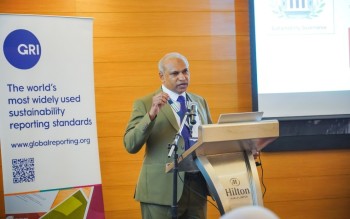
Recent dialogue among Malaysia's top corporate sustainability leaders highlighted the scale of stakeholder engagement occurring around this agenda. A meeting organised by ESGright and the Global Reporting Initiative brought together approximately 40 senior corporate figures whose combined market capitalisation exceeds RM380 billion. This concentration of capital and decision-making power illustrates that sustainability reporting is no longer a peripheral concern confined to environmental committees but has moved squarely into mainstream corporate boardrooms where capital allocation decisions happen. The breadth of participation suggests that the trend is not driven by regulatory mandate alone but reflects genuine recognition among Malaysia's business elite that sustainability integration is fundamental to future viability.
Small and medium enterprises face particularly acute challenges navigating this new landscape. These businesses typically operate with constrained resources and limited capacity for specialised compliance functions that larger corporations maintain. Robin Hodess, Global Reporting Initiative chief executive officer, emphasises that SMEs require scaled sustainability frameworks that acknowledge their operational constraints while still providing meaningful disclosure. Rather than imposing the same comprehensive reporting burdens that multinational corporations shoulder, appropriately calibrated frameworks allow SMEs to demonstrate sustainability commitment proportionate to their scale and sector. This calibrated approach proves especially critical given that many SMEs function as suppliers within larger corporate value chains; adopting basic sustainability reporting practices gives these firms access to supply chain opportunities that increasingly require proof of sustainable operations.
The complexity of modern ESG reporting architecture presents another significant challenge. Multiple international reporting standards, domestic regulatory requirements, and investor expectations create a labyrinthine compliance environment where companies struggle to identify which frameworks apply to their particular circumstances. ESG reporting has fragmented across numerous standards—the Global Reporting Initiative, International Sustainability Standards Board standards, and sector-specific frameworks—forcing corporate teams to invest time and resources in navigating overlapping disclosure requirements. This proliferation can trigger what Prathab identifies as "compliance fatigue," where companies become overwhelmed by competing obligations and lose sight of substantive sustainability improvement in favour of mechanical compliance.
Malaysia's listed companies have already demonstrated considerable sophistication in adopting global ESG practices. Many major Malaysian corporations began integrating Global Reporting Initiative standards well before Bursa Malaysia mandated sustainability disclosures, recognising that international markets increasingly prioritise ESG credentials for export competitiveness. This forward-looking posture reflects these companies' understanding that embedding sustainability into operations facilitates international business expansion and strengthens relationships with multinational customers who increasingly conduct ESG due diligence on supply partners. The precedent these early adopters establish provides valuable guidance for smaller businesses beginning their sustainability journey.
A counterintuitive insight emerging from industry discussions is that perfect, comprehensive ESG reporting across all dimensions may be strategically suboptimal for many companies. Prathab advocates for what might be termed "focused sustainability strategy," where companies identify their most material environmental, social, and governance challenges, then concentrate on achieving genuine excellence in those specific areas rather than attempting incremental improvement across every possible dimension. This approach recognises that meaningful sustainability impact derives from deep commitment to particular areas—whether environmental restoration, workforce development, or governance reform—rather than superficial compliance across all fronts. Companies that adopt this focus create more substantial sustainability impact while managing resource constraints more effectively.
The financial system's increasing demand for ESG reporting also reflects evolving investor sophistication and risk perception. Modern capital allocation increasingly recognises that companies ignoring climate change, labour practices, or governance standards face material financial risks: regulatory penalties, supply chain disruption, reputational damage, and customer defection. From a lender's perspective, robust sustainability practices signal management competence, forward-thinking strategy, and reduced long-term risk. Banks therefore treat ESG reports not as charitable corporate responsibility documents but as material risk assessment tools that inform lending decisions, pricing, and covenant requirements.
For Malaysian SMEs and unlisted firms, this transition creates both challenge and opportunity. The challenge involves acquiring new capabilities, developing reporting systems, and dedicating resources to an area previously considered peripheral to core business operations. The opportunity, however, is substantial: businesses that move expeditiously to establish credible sustainability reporting gain competitive advantage against slower-moving rivals. Supply chain opportunities, particularly with multinational corporations operating in Malaysia, increasingly flow towards suppliers demonstrating verified sustainability credentials. Export markets in developed economies increasingly apply ESG screening criteria to trading partners, making sustainability reporting an implicit qualification for market participation.
The trajectory appears irreversible. Government support through regulatory guidance and educational infrastructure, combined with financial sector demand driven by global investment trends, creates reinforcing momentum toward universal adoption of ESG reporting practices. Malaysia's strategic positioning as a financial centre within ASEAN enhances the nation's opportunity to establish regional leadership in sustainability reporting standards and practice. Companies that view this transition as an inconvenient compliance burden risk strategic blindness; those recognising sustainability reporting as a competitive imperative and opportunity for differentiation position themselves advantageously for the economy's future configuration.

