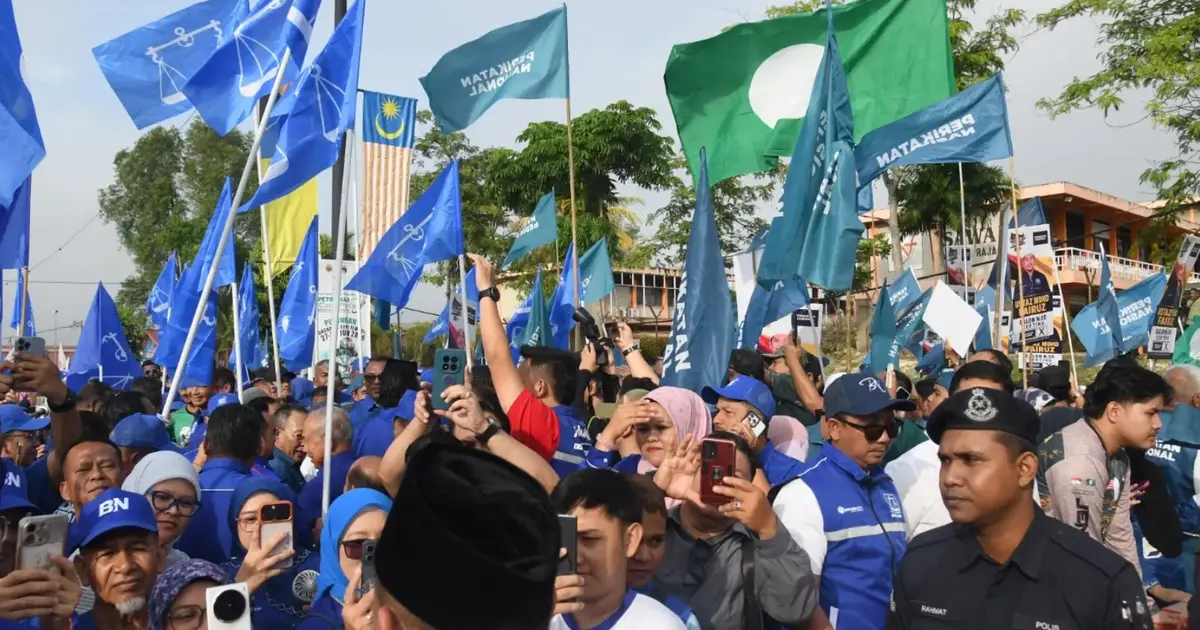
Selangor's political landscape continues to evolve as coalition dynamics shift, but according to analyst Azmi Hassan, the absence of Bersatu from a strengthened Barisan Nasional partnership presents a fundamental challenge for PAS's ambitions to seize control of Malaysia's most developed state. Hassan's assessment highlights how the fracturing of the Perikatan Nasional alliance has created a vacuum that conventional power-sharing arrangements may struggle to fill, raising questions about whether established parties possess the agility to replicate the electoral breakthroughs achieved by newer political movements.
The analyst's observation reflects deeper structural realities within Malaysian politics, where voter coalitions are built on more than traditional party machinery. During the previous Selangor state election, Bersatu functioned as a bridge between the Islamic-oriented appeal of PAS and the broader electorate's willingness to consider alternatives to Pakatan Harapan's incumbency. Bersatu's relative newness as a political force, combined with its positioning as neither purely establishment nor radically alternative, created a unique electoral advantage that proved difficult for existing parties to counter or replicate. The party's subsequent internal fracturing and the imprisonment of its former chairperson have fundamentally altered the political equation.
Barisan Nasional's track record in recent state elections demonstrates the coalition's declining capacity to mobilise voter bases independent of its traditional strongholds. The coalition has faced persistent challenges in translating its historical dominance into contemporary electoral success, particularly among younger voters and in urbanised constituencies where swing voters concentrate. In Selangor specifically, BN's presence has been progressively marginalised as three-cornered contests have favoured either Pakatan or Perikatan challengers. The coalition's attempts to reclaim relevance have often relied on negative messaging against opposing coalitions rather than forward-looking platforms that attract swing voters across demographic lines.
The mechanics of how Bersatu contributed to Perikatan's previous electoral performance in Selangor operated through several complementary channels. The party's ability to field candidates in constituencies where PAS faced organisational limitations proved invaluable, particularly in areas with mixed Muslim and non-Muslim populations where PAS's religious positioning created electoral sensitivity. Furthermore, Bersatu's younger cadre and more flexible ideological presentation allowed Perikatan to broaden its appeal beyond the conservative religious vote that constitutes PAS's core constituency. These roles cannot be automatically transferred to Barisan Nasional, whose institutional structure and public perception remain tethered to decades of establishment governance.
For Selangor's electorate, the implications of a weakened Perikatan challenge centred on PAS without Bersatu support could meaningfully reshape the state's political trajectory. The presence of a credible opposition coalition has historically constrained Pakatan's policymaking decisions and forced the ruling coalition to remain responsive to constituent concerns. Without Bersatu functioning as a bridge between PAS and broader voter blocs, the opposition's penetration into swing constituencies and suburban areas where Selangor's decisive battles are won may diminish considerably. This could result in either a strengthened Pakatan government with reduced electoral accountability or a more contentious political environment if voters perceive the opposition as offering only narrow ideological appeals.
Barisan Nasional's structural position within Malaysian politics further complicates its utility as a replacement mechanism for Bersatu's previous contributions. The coalition comprises component parties with divergent interests, each protecting fiefdoms within their respective communities. Unlike Bersatu's leadership structure, which operated with centralised strategic direction, BN's decision-making processes involve numerous stakeholders whose interests do not always align. This makes rapid repositioning in response to electoral opportunities considerably more difficult, and coordination across constituencies becomes complex when component parties prioritise their own survival within the coalition framework.
The territorial considerations within Selangor add another layer of complexity to Hassan's assessment. Selangor remains a racially and religiously diverse state where electoral success requires nuanced messaging and candidate selection that reflects local demographic realities. Bersatu's previous success partly derived from its capacity to field candidates who resonated within specific communities without triggering the kind of polarisation that occasionally accompanies PAS-led campaigns in non-Malay majority areas. Barisan Nasional, bound by long-established communal party networks and predictable messaging patterns, may find it harder to innovate its approach in ways that simultaneously broaden opposition appeal while maintaining internal coalition coherence.
Looking at regional political trends, Selangor's electoral dynamics possess implications that extend beyond state boundaries. As Southeast Asia's most urbanised state and the economic engine of Malaysia, Selangor's political direction influences investor confidence and national policy frameworks. A reconfigured opposition that proves less effective at challenging Pakatan could consolidate Kuala Lumpur's position as a single-coalition stronghold, reducing competitive pressures that typically drive government responsiveness. Alternatively, should Barisan Nasional find unexpected ways to compensate for Bersatu's absence, the resulting political configuration could reshape national coalition possibilities and redefine how Malaysian politics organises itself beyond the current three-bloc structure.
Hassan's conclusion ultimately underscores the unpredictability inherent in Malaysian electoral politics following the Sheraton Move and subsequent realignments that dismantled stable coalition frameworks. Political parties continue adjusting to new realities, and while Barisan Nasional possesses substantial institutional resources, the specific electoral functions that Bersatu performed cannot be automatically inherited. The implications for Selangor's governance, opposition effectiveness, and broader national politics depend critically on whether any coalition can successfully reconstruct the voter coalitions that determined previous election outcomes.

