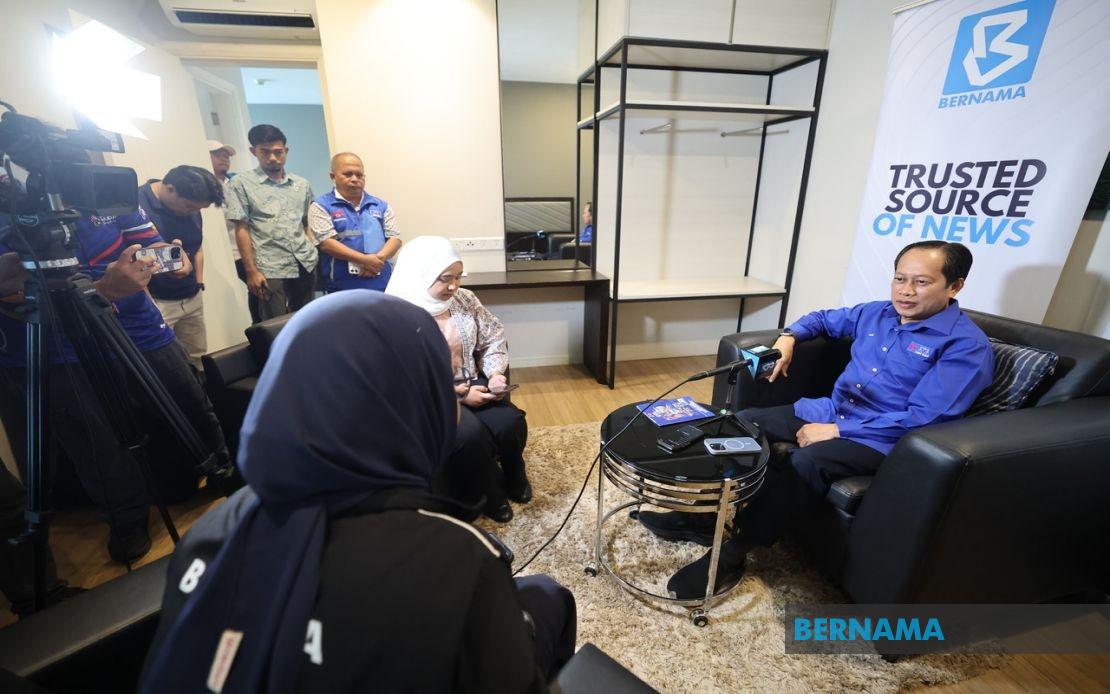
The Barisan Nasional coalition is projecting strong momentum heading into the Johor state election scheduled for July 11, with senior party figures publicly expressing optimism about retaining control of the state government. Datuk Seri Dr Ahmad Maslan, the Johor UMNO deputy liaison committee chairman, articulated the coalition's confidence in an interview, emphasising that preliminary indicators suggest BN is positioned to secure substantially more than the 40 seats it is targeting out of the 56 available in the State Legislative Assembly. Such declarations of confidence from mid-level leadership serve as both internal morale-boosting statements and public relations messaging designed to shape voter perception heading into the final campaign stretch.
Ahmad's assessment draws from extensive ground-level exposure, having personally observed campaign activities across 25 of Johor's 26 parliamentary constituencies. This direct engagement provides him with a perspective beyond polling data or media coverage—what party strategists often characterise as "ground feel." The reliance on such subjective assessments reflects a broader pattern in Malaysian electoral politics where party machinery evaluations and informal networks offer grassroots intelligence that candidates and officials believe supplements or even supersedes scientific polling. For Malaysian observers monitoring the Johor race, such insider optimism from active campaign participants carries weight, though the accuracy of these assessments remains dependent on whether local machinery assessments align with actual voter sentiment when ballots are cast.
The confidence expressed by Ahmad rests on several observable campaign dynamics. He highlighted the consistent activation of Barisan Nasional's party machinery, noting that district-level polling centres functioning as campaign command hubs have maintained intensive operations extending from morning through evening hours. This 24-hour campaign presence encompasses door-to-door voter outreach, data analysis of registered voters, campaign simulation exercises to refine messaging, and coordination of field operations. Such detailed campaign infrastructure reflects the institutional depth and organisational capacity that Barisan Nasional has cultivated over decades of governing Malaysia and multiple state governments.
The deployment of inter-state reinforcement teams represents an increasingly sophisticated element of Malaysian electoral strategy. Barisan Nasional has positioned operatives from other states—most notably including Pahang's Menteri Besar—to bolster campaign operations in targeted constituencies. Ahmad particularly emphasised this development in the Pontian parliamentary constituency, where the Pahang contingent is simultaneously supporting four state-level seats including Pulai Sebatang, Benut, Kukup and Pekan Nanas. The coalition's rationale for these cross-state deployments reflects a philosophy that external perspectives and campaign techniques developed in different electoral contexts can refresh local approaches and provide tactical advantages unavailable through purely internal operations.
This inter-state coordination model carries particular significance for understanding how Malaysia's major coalitions now operate during state elections. Rather than treating state contests as isolated battles, the approach demonstrates how Barisan Nasional operates as a coordinated national machine capable of directing resources, personnel, and strategic input across state boundaries. For Johor specifically, this represents a substantial commitment of senior leadership bandwidth and human resources to ensure state-level victory. The fact that Ahmad could detail specific examples—such as the Pahang Menteri Besar's involvement in particular constituencies—suggests these reinforcement deployments are operationally substantive rather than symbolic.
The morale benefits Ahmad attributed to external campaign teams deserve scrutiny beyond his stated observations. He noted that the Pahang delegation brought "perspectives that differ from the usual approach" and "fresh input and views based on experiences beyond our usual way of thinking." Such language suggests that campaign fatigue, localised tactical assumptions, or entrenched methodologies within Johor's BN machinery may have created openness to external intervention. This dynamic points to a tension in maintaining intensive campaign operations—the longer a campaign proceeds, the greater the potential for established approaches to become less effective, making regular injection of new personnel, ideas, and energy strategically rational.
Ahmad's emphasis on the responsiveness of voters and the performance of individual candidates in campaign settings represents a second pillar of BN's confidence. He characterised voter response as "encouraging" and praised candidates' campaign performance without quantifying either metric. In Malaysian electoral discourse, such positive characterisations of voter reception are standard optimistic rhetoric, yet the fact that they are offered at all suggests BN believes it has avoided major gaffes or unforced errors during the initial campaign phase. Whether such assessments reflect genuine voter enthusiasm or normalised positive feedback within hierarchical campaign structures remains a question voters will ultimately answer through their ballot choices.
The targeting of over 40 seats out of 56 represents a two-thirds supermajority if achieved. This threshold carries significance beyond simple governance—it provides Johor's state government with sufficient legislative strength to pass state constitutional amendments, a power that gives a supermajority government substantial long-term institutional advantages. For Barisan Nasional, securing such a margin would effectively consolidate its position in Johor beyond a single election cycle and constrain opposition parties' capacity to advance constitutional reforms or amendments during the subsequent state government term.
Johor's electoral significance extends beyond the state itself. As Malaysia's second-largest state by population and a historically reliable Barisan Nasional stronghold, the outcome carries symbolic weight for the coalition's overall viability and electoral prospects nationally. A comprehensive Johor victory would reinforce narratives of BN resurgence and organisational effectiveness that the coalition has been cultivating since its return to federal government. Conversely, any failure to achieve the stated 40-seat threshold would invite questions about whether the coalition's machinery has genuinely recovered to pre-2018 effectiveness levels or whether it remains susceptible to electoral surprises.
For voters in Johor and observers across Malaysia and Southeast Asia monitoring Malaysian politics, Ahmad's statements provide insight into how major political actors assess their own electoral prospects internally. The specificity of the 40-seat target, the detailed description of campaign machinery operations, and the characterisation of reinforcement teams as strategically valuable all suggest Barisan Nasional has conducted serious internal assessments rather than merely offering generic optimistic commentary. Whether these assessments prove prescient or overly optimistic will become clear when Johor votes on July 11, with results carrying implications for Malaysia's broader political trajectory in the months ahead.
The campaign dynamics Ahmad described—intensive ground operations, cross-state coordination, emphasis on voter data analysis and simulation exercises—reflect how Malaysian electoral competition has evolved to incorporate technology-enabled voter targeting alongside traditional door-to-door engagement. This hybrid approach characterises contemporary Malaysian politics, where sophisticated data analytics and digital campaigning complement rather than replace labour-intensive personal voter contact. For Johor specifically, this suggests a competitive environment in which victory margins may ultimately depend on execution efficiency and organisational discipline as much as underlying voter sentiment.

