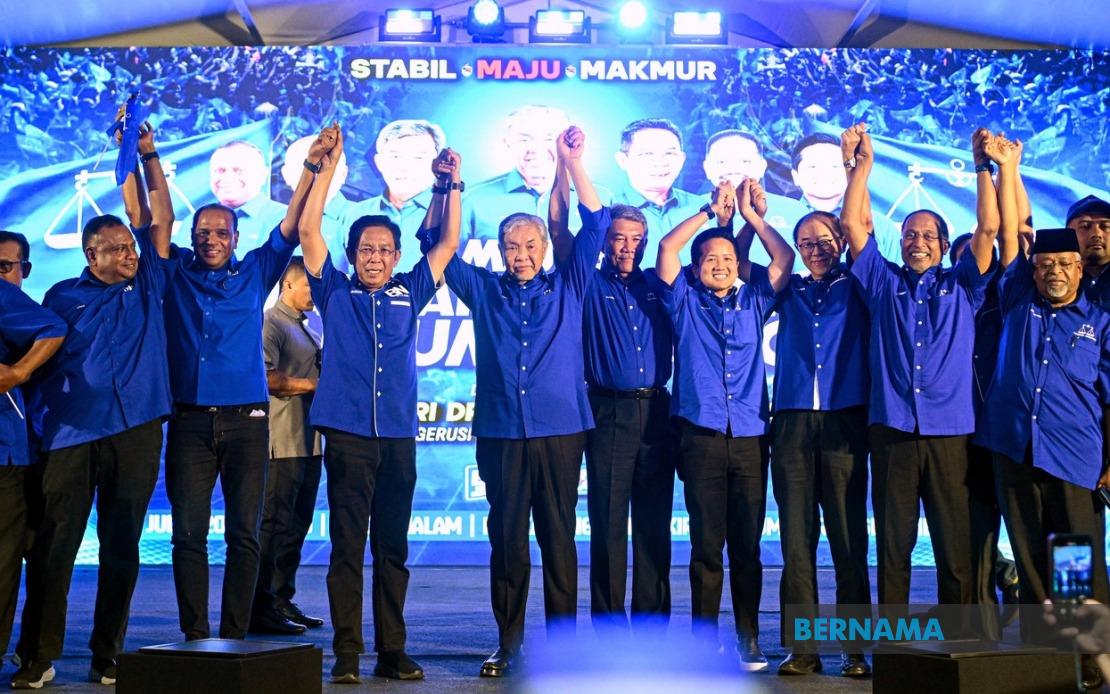
Barisan Nasional has formally announced its full slate of 25 candidates for the 16th Negeri Sembilan state election, cementing the coalition's approach of blending established political veterans with fresh recruits in its push to maintain control of the central state. The lineup was unveiled at Tuanku Abdul Rahman Stadium in Paroi during a gathering that also marked the launch of BN's campaign machinery for the contest.
At the heart of BN's strategy in Negeri Sembilan stands the retention of Datuk Seri Mohamad Hasan, the state coalition's chairman and the incumbent representative for Rantau. Mohamad, who has held the seat consecutively since 2004, secured explicit backing from UMNO president Datuk Seri Dr Ahmad Zahid Hamidi to contest once more. His position as both a state-level and national party figure—he serves as BN deputy chairman—underscores the significance the coalition places on the Rantau constituency, which has remained a BN stronghold for two decades. The decision to keep him signals confidence that he retains sufficient ground support to fend off opposition advances.
Equally crucial to BN's election mathematics is the decision to retain Datuk Seri Jalaluddin Alias in the Pertang seat, which he has represented since 2013. Jalaluddin, who chairs the Negeri Sembilan UMNO Liaison Committee and serves as the Member of Parliament for Jelebu, brings cross-level political experience that bridges state and federal representation. His continued candidacy suggests the coalition views Pertang as another seat where incumbency and established networks can prove decisive in fending off opposition challenges.
The candidate announcement also confirmed the retention of several other sitting representatives. Datuk Mohd Faizal Ramli will seek to hold onto Linggi, while Datuk Mustapha Nagoor will contest for another term in Palong. These decisions reflect a broader conservative approach within BN's Negeri Sembilan branch, prioritising proven track records and established voter relationships. In state elections where margins can be tight and individual performance directly influences outcomes, retaining candidates who have demonstrated electoral appeal offers a straightforward risk mitigation strategy.
Despite the announcement of 25 candidates, a significant portion of the state assembly constituencies remain without confirmed BN representatives. Eleven seats—Klawang, Serting, Lobak, Sikamat, Ampangan, Bukit Kepayang, Mambau, Paroi, Lukut, Bagan Pinang, and Gemas—have not yet been finalised according to the candidate list circulated to media outlets. This delay, whether tactical or logistical, leaves room for last-minute adjustments and potentially reflects ongoing negotiations among UMNO, MCA, and MIC over seat allocations within the BN framework.
The incomplete candidate roster carries implications for BN's preparedness relative to opposition coalitions, which may have already finalised their full lineups. A delayed finalisation could suggest internal coalition tensions over seat distribution or difficulties in recruiting quality candidates for certain constituencies. Conversely, BN may be deliberately holding back final decisions to maintain negotiating leverage with component parties or to assess ground sentiment before making final commitments.
Negeri Sembilan's electoral landscape has shifted considerably in recent election cycles, with opposition parties—particularly PKR and DAP—making inroads into traditionally BN-held constituencies. The state's 36 assembly seats remain competitive, and turnout patterns have become less predictable. BN's strategy of retaining senior figures in prominent seats appears designed to anchor the coalition's campaign narrative around stability and continuity, presenting voters with recognisable faces and established governance records.
The announcement at a major stadium gathering also served to energise BN's ground machinery and reinforce internal party morale at a moment when Malaysia's political landscape continues to shift. For Negeri Sembilan specifically, the election represents a crucial test of whether BN can maintain its traditional hold on the state or whether opposition momentum—particularly from Pakatan Harapan—has consolidated sufficiently to challenge the coalition's dominance. The prominence given to retaining Mohamad Hasan and Jalaluddin suggests the coalition believes these figures can serve as anchors around which to build victory.
The decision to rely heavily on incumbent candidates also reflects broader trends in Malaysian electoral politics, where sitting representatives command inherent advantages in terms of name recognition, established service networks, and demonstrated ability to channel development funds to constituencies. However, this approach carries its own risks. If incumbents face credibility challenges or if voter sentiment has shifted dramatically against the BN brand nationally, even established figures may struggle.
For the 11 unfinalised seats, the coming weeks will prove critical. The finalisation process will likely involve negotiations between BN component parties, assessments of opposition strength in specific constituencies, and evaluation of available candidate quality. Some of these seats may have been problematic for BN in previous contests, requiring either fresh approaches or reinforced candidacy from stronger figures. The delay in announcing these candidates may also reflect genuine difficulty in recruiting competitive candidates willing to stand in seats where opposition has momentum.
Mohamad Hasan's explicit acknowledgment of backing from the UMNO president also signals that Negeri Sembilan remains a priority state for UMNO's national leadership. With federal politics in flux and BN's status as the governing coalition facing periodic challenges, maintaining control of significant state governments provides crucial leverage and resources. Negeri Sembilan's central location and strategic importance in regional politics make it particularly valuable for the coalition's broader political positioning.
As the state election campaign unfolds, the composition of BN's candidate slate will shape perceptions of the coalition's confidence and preparedness. The retention of experienced figures paired with what appears to be selective introduction of new blood suggests a measured approach—neither entirely defensive nor aggressively expansionist. The eventual completion of the candidate list and the campaign dynamics that follow will determine whether this strategy proves sufficient to maintain BN's control in Negeri Sembilan or whether opposition forces have fundamentally altered the state's electoral math.

