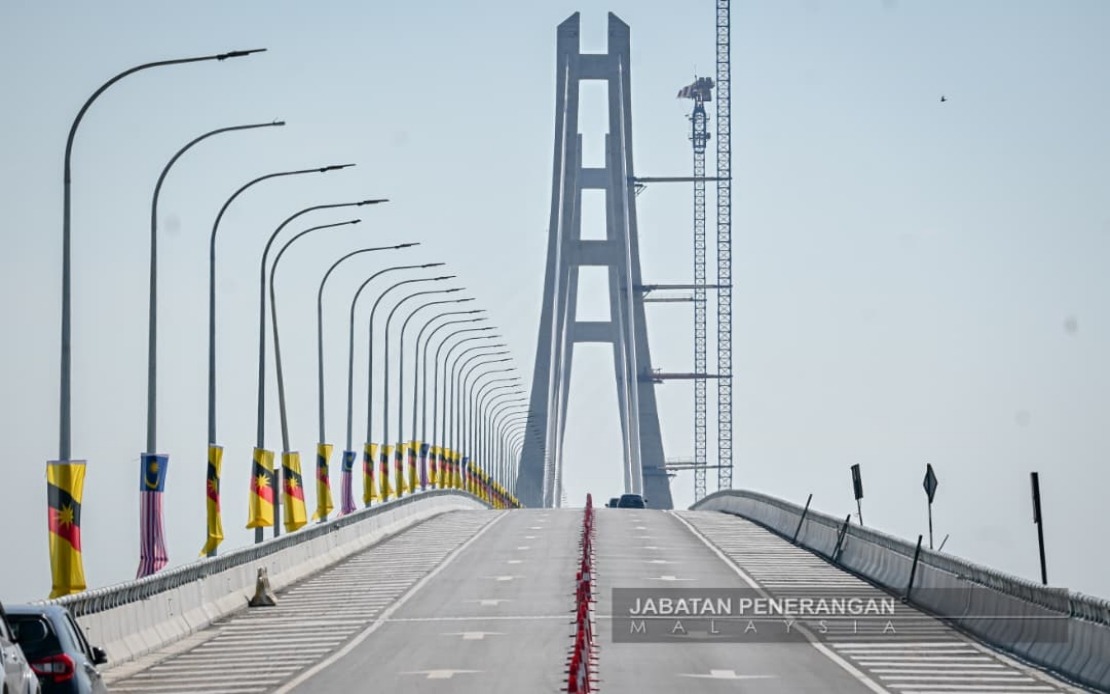
Sarawak has crossed a pivotal threshold with the official opening of the Batang Lupar 1 Bridge, a transformative infrastructure project that Premier Tan Sri Abang Johari Tun Openg describes as a watershed moment for the state's development trajectory. The 4.844-kilometre crossing, constructed at a cost of RM848.75 million, carries symbolic weight beyond its engineering credentials—it represents the culmination of persistent community advocacy and marks the end of an era defined by hazardous ferry services that have long constrained regional movement and commerce.
The bridge's strategic importance lies in its role as a cornerstone of the broader Sarawak Second Trunk Road initiative, an ambitious RM3.21 billion coastal connectivity project designed to reshape how people and goods flow across the state's shoreline. By eliminating the need for the Sebuyau-Triso ferry service, which previously required crossings that could extend beyond an hour under normal conditions, the bridge fundamentally alters accessibility patterns. Deputy Premier Datuk Amar Douglas Uggah Embas, who oversees infrastructure development, characterised the project as ending a long chapter of isolation, particularly for residents and businesses in Sebuyau, Betong, Sri Aman and Samarahan districts who have historically endured operational disruptions caused by adverse weather conditions along the Batang Lupar River mouth.
Beyond immediate convenience, the bridge unlocks significant economic implications for Sarawak's development agenda. The newly connected coastal corridor creates pathways for agricultural producers in interior regions to access markets more efficiently, potentially reshaping supply chains and reducing logistics costs. Sarawak's agricultural sector, historically constrained by transportation bottlenecks, stands to benefit from improved market access and reduced transit times. Similarly, investors considering projects in these coastal districts now operate with greater certainty regarding accessibility and operational continuity, removing a longstanding friction point that deterred regional development.
The reduction in travel distance between Kuching and Sibu from 396 kilometres to 252 kilometres—a saving of 144 kilometres—represents more than a numerical convenience. This compression of travel time will have cascading effects on tourism, commerce and inter-regional business operations across northern Sarawak. Goods transported along this corridor will reach markets faster and at lower cost, while business professionals and government officials conducting cross-district coordination will operate with enhanced efficiency. For Malaysia's broader regional competitiveness, the modernisation of Sarawak's coastal infrastructure signals the state's commitment to positioning itself as a functional economic node rather than remaining dependent on fragmented transportation networks.
The engineering achievement itself warrants consideration. Recognition by the Malaysia Book of Records as Malaysia's longest river-spanning bridge adds prestige to Sarawak's infrastructure narrative and demonstrates the state's capacity to execute large-scale projects. This recognition, while ceremonial, carries practical implications for investment confidence and the state's ability to attract engineering talent and technological expertise for future projects. The bridge's successful completion also provides a template for addressing similar infrastructure gaps elsewhere in Southeast Asia, where river crossings remain persistent development challenges.
Historically, the Batang Lupar crossing's hazards were not merely inconveniences but genuine safety threats. The Deputy Premier's reference to tragic incidents caused by strong waves and winds underscores that the ferry service carried real human cost, particularly during monsoon seasons. Communities living in affected areas experienced not just economic hardship but genuine vulnerability. The bridge's opening therefore resolves both tangible and intangible dimensions of regional wellbeing, restoring predictability to daily movement patterns and reducing exposure to weather-dependent operational disruptions.
The broader Sarawak Coastal Road network, scheduled for complete implementation by 2030, represents a multi-decade commitment to transforming the state's development geometry. Rather than maintaining the historical focus on interior riverine networks, this initiative privileges the coastal corridor, reflecting strategic recognition that maritime access and littoral development hold increasing importance in regional economies. The phased completion approach allows for staged economic activation, with earlier phases like the Batang Lupar 1 Bridge generating economic momentum that can sustain and justify investment in subsequent segments.
For Malaysian policymakers monitoring regional development, Sarawak's investment trajectory offers insights into how infrastructure spending can catalyse structural economic transformation. The willingness to commit substantial resources—RM848.75 million for a single bridge segment—reflects state-level confidence in coastal development returns. This contrasts with historical development patterns where inland and riverine projects dominated. The strategic pivot toward coastal connectivity positions Sarawak to participate more effectively in maritime regional networks and strengthen integration with neighbouring states and Southeast Asian economies.
The communities directly affected by this infrastructure change face both opportunities and adjustment challenges. Enhanced accessibility will attract external investment and talent inflow, potentially transforming economic structures in districts like Sebuyau and Betong from primarily subsistence and small-scale agricultural activities toward more diversified economic bases. Agricultural producers gain access to larger markets, potentially enabling value-chain integration and export orientation. However, such transitions inevitably generate social friction as traditional economic patterns shift, and local authorities will need to manage this transition thoughtfully to ensure existing communities benefit rather than experience displacement.
From a Southeast Asian perspective, Sarawak's infrastructure trajectory contributes to ASEAN's broader connectivity agenda, particularly the Master Plan on ASEAN Connectivity frameworks. Improved internal road networks enhance Sarawak's capacity to participate in cross-border economic initiatives and maritime regional integration. The bridge specifically facilitates north-south movement along Malaysia's most geographically extensive state, creating economic corridor effects that extend beyond Sarawak's borders into regional supply chain networks.
The political dimension merits attention as well. Premier Abang Johari's emphasis on responsiveness to community requests—noting that construction was driven by persistent local advocacy—reflects calculated political communication around infrastructure delivery. This framing positions the state government as responsive to constituent needs and capable of translating community demands into tangible outcomes. In Malaysian political contexts where infrastructure becomes a proxy for government effectiveness, such messaging carries significance for electoral dynamics and state legitimacy.
Looking forward, the Batang Lupar 1 Bridge represents not merely a completed project but an opening act in Sarawak's long-term spatial reorganisation. The scheduled 2030 completion of the full Sarawak Coastal Road network suggests that subsequent phases will generate complementary economic effects, with each segment activating new economic opportunities. Investors considering regional operations in northern Sarawak now operate with enhanced visibility regarding future connectivity, potentially accelerating project initiation and capital deployment.
Ultimately, the bridge's significance transcends its physical dimensions. It embodies the state's shift toward modern infrastructure-driven development, marks the resolution of a persistent safety and accessibility challenge, and establishes momentum for broader coastal economic activation. For Malaysian readers and regional observers, the project illustrates how targeted infrastructure investment, when aligned with geographic opportunity and community need, can serve as a catalyst for structural economic transformation across entire regions.

