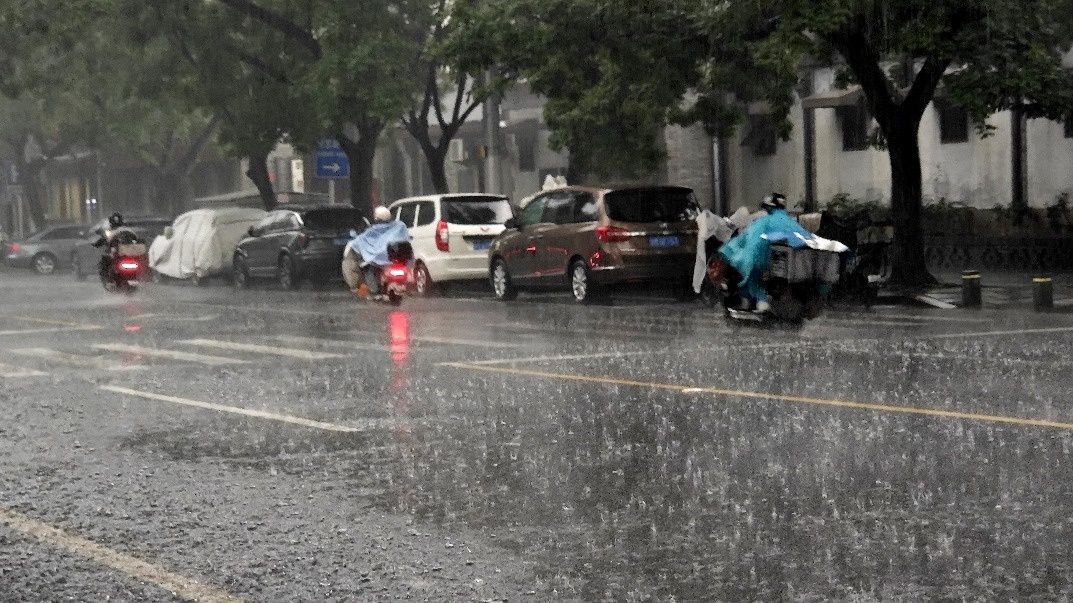
Beijing has activated its second-highest weather alert level following an orange-level rainstorm warning issued by the city's meteorological observatory on Thursday afternoon. The warning, the first of such severity since the flood season commenced, indicates that the capital faces a significant rainfall event over the coming weekend, with authorities coordinating a comprehensive response across multiple sectors including transport, education and public safety.
The alert was issued at 1:30 pm Thursday, prompting the Beijing flood control office to simultaneously activate a Level-II flood control emergency response. This coordinated escalation reflects the serious nature of the meteorological threat, as the city's emergency management structures prepare residents and institutions for the anticipated deluge. The timing of the alert underscores how quickly conditions can deteriorate during peak flood season, when atmospheric moisture and weather systems combine to produce severe precipitation events.
Forecasters predict that from 2:00 pm Friday through 8:00 am Sunday, the city will experience persistent heavy rainfall concentrated across several vulnerable districts. The mountainous and hilly areas of Huairou and Miyun face particular concern, as do the more developed urban districts of Shunyi and Fangshan. Pinggu, located in Beijing's eastern sector, rounds out the list of districts expected to receive the heaviest precipitation. This geographic distribution reflects how the city's topography channels moisture-laden weather systems, with elevated terrain amplifying rainfall while lower-lying urban areas face flooding risks from accumulated runoff.
Precipitation intensity poses the most immediate hazard. Hourly rainfall rates in some locations are forecast to exceed 70 millimetres, a volume that overwhelms standard drainage infrastructure and rapidly generates flash flooding in susceptible areas. Over the full weekend period, cumulative rainfall could accumulate beyond 150 millimetres in the worst-affected zones—equivalent to a month's worth of normal precipitation falling within roughly 40 hours. Such concentration of moisture creates compound risks: saturated soils become unstable on slopes, underground spaces fill with water, and surface drainage systems become gridlocked with runoff.
The meteorological alert specifically warns of heightened risks in mountainous terrain and hilly districts where landslides and debris flows pose threats to life and property. Simultaneously, the city faces waterlogging dangers in topographically depressed areas where drainage proves inadequate during extreme rainfall events. These dual threats—mass movement in high areas and inundation in low areas—represent the full spectrum of hydrological hazards that intense precipitation triggers across complex urban terrain.
Public authorities have issued comprehensive guidance aimed at minimizing exposure during the critical 40-hour window. Residents are advised to curtail outdoor movements, maintain vigilance regarding official weather communications, and rely on public transportation systems to reduce congestion and accident risks on roadways. This messaging reflects lessons learned from previous flood events, where personal decisions to venture outdoors during extreme weather contribute significantly to casualty numbers.
Major employers and government agencies are encouraged to implement flexible scheduling arrangements or staggered working hours to reduce commuter congestion and allow the public transport network to function effectively during the emergency period. This workplace-level coordination, if widely adopted, can meaningfully reduce the volume of people exposed to hazardous conditions during the peak rainfall window. Educational institutions face directives to suspend regular classes, suspend in-person training programmes, and cancel outdoor teaching activities based on actual ground conditions as the rainfall develops.
The prohibition on recreational activities demonstrates how comprehensively the alert reshapes normal urban life. Citizens are explicitly warned against visiting mountain scenic areas or water-adjacent recreational zones where flash flood risks escalate dramatically. Underground commercial facilities—common in major Chinese cities—carry particular danger during extreme rainfall, as drainage becomes overwhelmed and water intrusion occurs suddenly. Areas with known geological instability also warrant avoidance, as saturated conditions trigger slope failures with minimal warning. Rivers and drainage channels, whether formal waterways or informal urban creeks, pose drowning hazards during high-flow conditions.
All outdoor economic activities must cease during the alert period. Construction sites, outdoor commercial operations, and maintenance activities are explicitly directed to suspend work, removing both workers and equipment from exposure to weather hazards. This economywide pause, while imposing costs on various sectors, reflects the severity threshold that orange-level alerts represent within China's meteorological warning system.
China's four-tier alert framework calibrates public response to threat severity. Red alerts denote catastrophic conditions requiring maximum protective measures, while orange represents the second tier—dangerous but generally manageable with appropriate precautions and infrastructure activation. Yellow alerts indicate significant but contained hazards, and blue represents minor weather concerns. Beijing's elevation to orange status thus signals a serious but not unprecedented situation, one that urban systems are designed to withstand with disciplined implementation of emergency protocols.
For regional observers, Beijing's alert exemplifies how major Chinese cities operationalize extreme weather response through coordinated command structures linking meteorology, flood management, transportation, education and commerce. The rapid scaling of municipal response demonstrates institutional capacity that smaller cities and less-developed regions may lack, highlighting how weather vulnerability correlates with infrastructure development and administrative coordination. As climate patterns intensify precipitation events, such systematic approaches become increasingly critical for megacity resilience across Asia.

