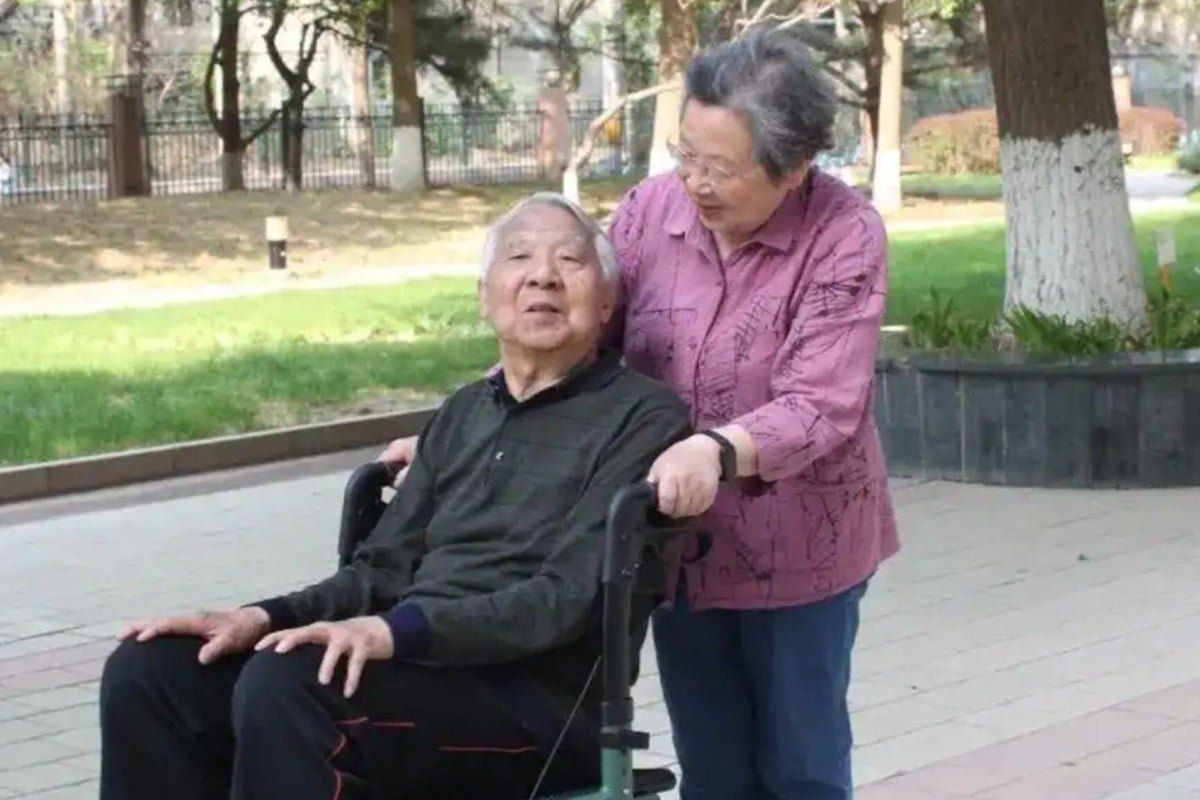
Wen Bo, a nonagenarian living in Beijing, has become an unlikely symbol of compassionate eldercare across China, her daily routines with her husband transformed into a quiet manifesto on human worth during cognitive decline. At 90, she tends to her spouse, who is two years her senior, navigating the progressive ravages of Alzheimer's disease with a philosophy that extends far beyond conventional medical management. Their story, shared through intimate diary entries on the social platform RedNote, has resonated with millions of younger Chinese struggling to envision what ageing with dignity might look like in an increasingly fragmented society.
The couple's narrative spans decades of partnership beginning in the 1950s when they were secondary school classmates. A prolonged courtship conducted across distances eventually culminated in marriage in 1960, followed by the raising of two sons and a lifestyle marked by intellectual and physical engagement. They swam regularly, took walks through their city, and travelled throughout China and internationally, embodying an ideal of active ageing that seemed sustainable until 2023. When memory loss and incontinence began affecting Wen's husband, the diagnosis of Alzheimer's disease shattered the illusion of indefinite vitality, forcing both spouses into an entirely new chapter neither had anticipated.
Wen's decision to become her husband's primary caregiver rather than burden her adult sons with institutional placement reflects both practical constraints and philosophical conviction. While a domestic helper manages cooking and household maintenance, and adult children visit as their schedules permit, the emotional and cognitive labour of care falls entirely on Wen. This arrangement defies the modernization narrative that assumes institutional facilities inevitably replace family bonds, instead reasserting the possibility of home-based dignity even as cognitive capacity deteriorates irreversibly.
Confronted with a disease she did not fully understand, Wen embarked on an autodidactic journey through books and online resources, educating herself about Alzheimer's mechanisms and therapeutic approaches. She transformed this knowledge into daily practice, designing cognitive exercises—arithmetic problems, puzzles, painting sessions—interspersed with physical activity aimed at slowing cognitive decline. The measurable results of her approach appear in small victories: her husband's condition has deteriorated more gradually than typical trajectories, he retains the ability to operate his electric wheelchair independently, and he occasionally reminds her to rest. These small capacities, preserved through deliberate effort, became markers not merely of medical success but of preserved selfhood.
Wen's most poignant conviction centres on the preservation of recognition itself. Terrified that her husband might forget her name entirely, she performs a nightly ritual, reminding him before sleep to call her whenever assistance is needed. Her articulation of this practice carries profound existential weight: "He has to remember my name. I am his wife. I should be the last person he forgets." This statement reclaims caregiving from its instrumentalist frame—as task completion and symptom management—and repositions it as an act of sustaining mutual recognition between two people whose identities remain inextricably bound despite neurological fracturing.
Beyond cognitive exercises, Wen encourages her husband to participate in household tasks at his own pace, resisting the temptation to complete activities for him despite the inefficiency of his involvement. This approach refuses to surrender agency even as capacity diminishes, asserting that the process of attempting a task matters more than its outcome. Her philosophy explicitly rejects the conflation of Alzheimer's with identity, insisting that people with the disease should not be defined by pathology alone.
Central to her advocacy is the argument that Alzheimer's patients require "self-respect, a sense of existence, and the feeling of being needed" as essential components of care, not luxury additions. This framework contests the biomedical model that treats Alzheimer's primarily as a problem of cognitive malfunction to be managed, instead centering the psychological and social dimensions of personhood that persist even as memory fails. By documenting these priorities through her diaries, Wen has articulated a vision of care that transcends her own household to address broader societal questions about what we owe to those experiencing cognitive decline.
Wen has indicated willingness to transition to hospice care if her husband's condition reaches a critical threshold, acknowledging that perpetual home care may become physically unsustainable. This pragmatic acceptance tempers her idealism without negating it—she has chosen home care not as an absolute principle but as the current best expression of her values within her specific capacity. The honesty of this position strengthens rather than weakens her influence, suggesting that dignified care is a direction of effort rather than a binary achievement.
Her story arrives at a moment of demographic urgency for China. The nation's population aged 60 and older surpassed 320 million by the close of last year, constituting over one-fifth of the total population and signalling an unprecedented gerontological challenge. Traditional family-based care systems have fractured under urbanization, migration, and the one-child policy's generational effects, leaving adult children often unable to provide extensive personal care while maintaining their own economic stability. Institutional facilities, meanwhile, proliferate without necessarily advancing in quality or cultural fit, leaving many families caught between inadequate options.
Wen's documentation of her caregiving journey has provided younger Chinese with a tangible alternative model, one that prioritizes presence and dignity over efficiency and institutionalization. Online commentators have articulated the profound impact of witnessing her daily practice. One observer noted that Wen's posts "always bring me comfort" by demonstrating "what an ideal later life could look like: being with the person you love while living independently." Another expressed gratitude for gaining practical guidance and emotional confidence about future caregiving responsibilities toward their own parents. These responses suggest hunger for narratives about ageing that extend beyond medical intervention or economic transaction.
For Malaysia and broader Southeast Asia, where rapid ageing is similarly outpacing the development of formal care infrastructure and where family-centred values remain culturally dominant, Wen's example offers particular resonance. Her approach models how traditional obligations toward elderly parents might evolve without completely abandoning them in a modernizing context. The emphasis on autonomy, dignity, and the capacity to contribute—even in minimal ways—speaks to values shared across the region while adapting them to the specific challenges of cognitive disease.
Wen's influence extends beyond individual families to shape public discourse about what constitutes adequate elderly care in rapidly ageing societies. By insisting that people with Alzheimer's remain subjects of their own lives rather than merely objects of medical attention, she challenges assumptions embedded in both institutional and family care practices. Her work suggests that the question is not whether to institutionalize or familialize care, but rather how to organize whichever setting ensures that individuals retain agency, recognition, and purpose. In an era when demographic change often triggers anxiety about insurmountable burdens, her 90-year-old figure bent over arithmetic problems with her husband offers a quieter insistence that love and creativity remain possible responses even to irreversible decline.

