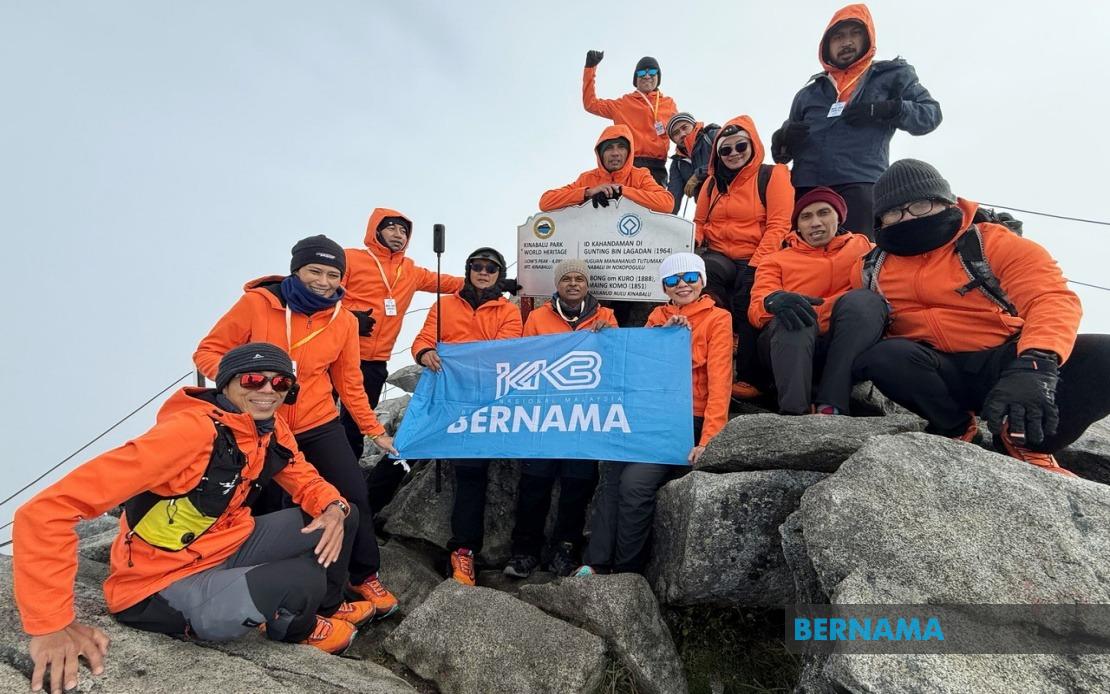
In a landmark achievement for Malaysia's premier news organisation, twenty-three Bernama personnel successfully scaled Mount Kinabalu on July 1, reaching the 4,095.2-metre summit in challenging weather conditions that included heavy rain, thick mist, and strong winds. The expedition, held as part of HAWANA 2026 celebrations honouring National Journalists' Day, represents a significant moment for the Malaysian National News Agency as it seeks to cement its position not merely as a news gathering institution but as an organisation committed to fostering team cohesion and wellness among its workforce.
Editor-in-Chief Arul Rajoo Durar Raj, who personally led the expedition, made history by becoming the first head of Bernama to successfully reach the mountain's peak. His presence underscored the symbolic importance of the climb—a demonstration that leadership within the news agency extends beyond the newsroom into spheres of physical endurance and institutional pride. The team's arrival at the summit occurred at approximately 7.20 am, following an overnight push that began the previous day at Timpohon Gate at 10 am, with climbers resting at Panalaban before resuming their ascent at 2.30 am.
The expedition pursues two distinct Malaysia Book of Records entries, positioning Bernama within a broader narrative about institutional achievement and media sector distinction. The first record targets recognition as the largest single-organisation media practitioner group to climb Mount Kinabalu, a claim that speaks to coordinated institutional effort rarely seen in Malaysian journalism. The second aims to document Bernama's status as the first media organisation to produce news reports in four languages from the mountain's summit itself—a technical accomplishment that reflects the agency's multilingual reach and its commitment to serving Malaysia's diverse linguistic communities even under extreme conditions. This dual-record ambition extends beyond mere symbolic achievement; it demonstrates how Malaysian media institutions are leveraging unconventional platforms to showcase their operational capabilities and cultural significance.
The climbing party encompassed the breadth of Bernama's organisational structure, drawing personnel from reporting divisions, photography units, sub-editorial teams, broadcast television operations, and administrative departments. This cross-functional composition transformed what might have been a simple team-building exercise into a reflection of how contemporary newsrooms operate as integrated units rather than siloed operations. The interdependence required for a mixed-ability group to navigate a challenging mountain environment parallels the collaborative demands of modern news production, where reporters, editors, technicians, and support staff must function as cohesive units under deadline pressure and adverse circumstances.
Mount Kinabalu's status as Southeast Asia's highest peak and a UNESCO World Heritage Site added significant prestige to the undertaking. Situated within the 754-square-kilometre Kinabalu Park and forming part of the Kinabalu UNESCO Global Geopark, the mountain represents not merely a physical challenge but a cultural and environmental icon recognised internationally. For a Malaysian institution to organise a coordinated ascent of such a landmark carries implications beyond tourism or personal achievement—it signals institutional engagement with Malaysia's environmental heritage and the intersection between media responsibility and environmental stewardship.
The Bernama Staff Club, which organised the expedition for the first time, demonstrated institutional commitment to employee wellness and engagement beyond traditional workplace settings. The expedition's stated objectives encompassed multiple dimensions: enhancing the HAWANA 2026 celebration, strengthening interpersonal teamwork, building physical and mental resilience, and promoting healthier lifestyles among personnel. These objectives reflect evolving thinking within Malaysian organisations about workforce development—recognition that institutional strength derives not only from professional competence but from employee wellbeing and organisational cohesion.
The expedition benefited from substantial corporate and institutional support, indicating how Malaysian businesses recognise value in aligning themselves with media sector activities. International sportswear brand BMAI, the airline operator Batik Air, and the beverage manufacturer 100PLUS provided strategic partnership, while additional support came from food industry representatives, airport operators, and national park authorities. This constellation of supporting organisations underscores how major undertakings require ecosystem-wide cooperation and how corporate Malaysia increasingly views association with journalistic institutions as aligned with broader corporate values around health, sustainability, and community engagement.
The challenging weather conditions encountered during the climb—rain, thick mist, and intense wind—tested both physical preparation and psychological resilience. These conditions, far from being incidental to the expedition's narrative, became central to its meaning: the ability of news professionals accustomed to working under informational and deadline pressure to manage physical extremes under uncertain conditions. The overnight climb strategy, with participants ascending in darkness and arriving at the summit before dawn, added technical difficulty and psychological challenge distinct from daylight mountaineering.
For Malaysia's regional positioning, Bernama's institutional achievement carries subtle diplomatic implications. As Southeast Asia's premier news agency based in a major regional economy, Bernama's demonstration of organisational capacity and ambition—even in unconventional domains—contributes to Malaysia's broader narrative of institutional sophistication and commitment to excellence. The pursuit of Malaysia Book of Records entries specifically positions the achievement within a national framework of recognition and benchmarking, embedding institutional pride within state-level frameworks of excellence.
The expedition also highlights evolving relationships between news organisations and their stakeholders in contemporary Malaysia. Rather than confining institutional engagement to traditional news distribution and audience interaction, Bernama has crafted a multidimensional public narrative encompassing physical achievement, multilingual capacity, and organisational integration. This approach positions the news agency not merely as a conduit for information but as an institution worthy of attention and support for its institutional character and values.
Looking forward, the successful ascent and pursuit of record recognition may establish precedent for how Malaysian media institutions demonstrate institutional capability and employee engagement. The model of coordinated, record-pursuing institutional climbs could influence how other organisations conceptualise team-building and public positioning. For Bernama specifically, the expedition represents a moment of institutional visibility and pride that extends the agency's narrative beyond its traditional news production function into domains of physical achievement, organisational integration, and commitment to Malaysia's natural and cultural heritage.

