Prime Minister Narendra Modi's Bharatiya Janata Party has opened a fresh political offensive against the student-led movement that orchestrated high-profile demonstrations in New Delhi last month, arguing that the group's conspicuous restraint in recent Jharkhand protests exposes what the ruling party describes as a calculated political agenda. BJP spokesperson Keya Ghosh levelled the accusation on Tuesday, suggesting that the Cockroach Janta Party, which galvanised widespread anger over university examination irregularities in the capital, has adopted a markedly different stance when confronted with similar institutional failings in India's eastern mineral-producing state.
The Cockroach Janta Party emerged as the catalytic force behind the New Delhi student movement, which ultimately secured the resignation of Education Minister Dharmendra Pradhan in July. That activism demonstrated the group's capacity to mobilise and sustain pressure on the Modi administration, yet Ghosh contended that the same vigour has been conspicuously absent from the Jharkhand disturbances, which have swelled into a significant regional challenge for authorities. The BJP spokesperson characterised the group's posture as hypocritical, arguing that its relative silence reflects not principled consistency but rather a desire to insulate the state administration from unwanted national attention.
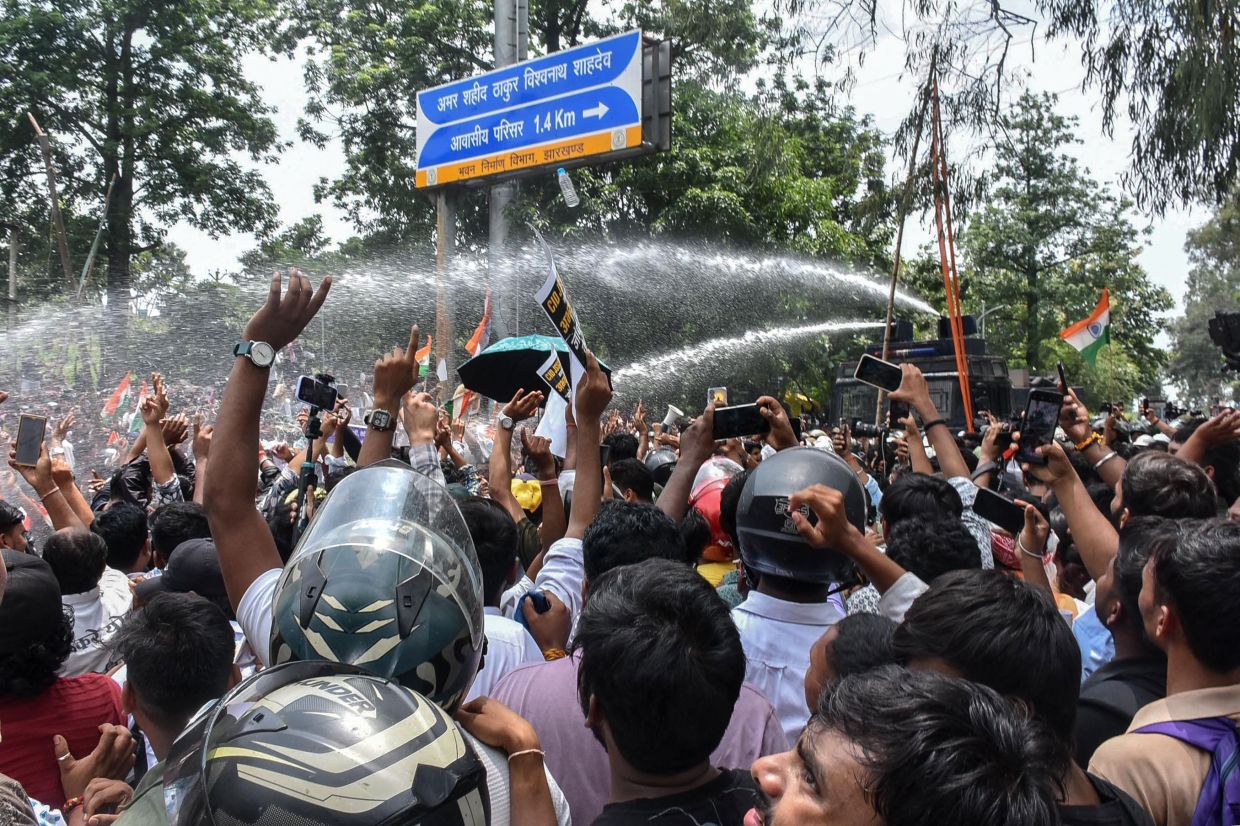
Jharkhand's student protests, now in their second week, centre on allegations of systematic irregularities in state recruitment examinations, with job seekers demanding a comprehensive federal inquiry into the examination process. The disturbances have drawn thousands of demonstrators to key public spaces, with law enforcement deploying water cannons and riot batons against assembled crowds. Unlike the New Delhi movement, which crystallised around a singular institutional failure with clear national reverberations, the Jharkhand agitation remains locally rooted, driven primarily by regional job aspirants rather than national student networks.
Ghosh's critique extends beyond accusations of inconsistency to encompass what she depicts as strategic positioning within India's broader political landscape. The BJP spokesperson questioned the engagement levels of Congress leader Rahul Gandhi, who leads the opposition in Jharkhand's state assembly, suggesting that his reported absence from protest sites reflects reluctance to embarrass a coalition government that includes his own party. This line of attack reflects wider BJP strategy of portraying opposition parties as selectively activist, deploying political causes opportunistically rather than defending principles consistently across geographical and temporal boundaries.
However, the political narrative proves more complicated than the BJP's framing suggests. The Cockroach Janta Party, originally conceived as a satirical social media movement before evolving into an activist force, has indeed maintained an operational presence in Jharkhand, with group members participating actively in demonstrations alongside local student leadership. Akshay Shinde, the organisation's national coordinator, stated publicly that group members are embedded within the Jharkhand protests and committed to remaining engaged until institutional demands are satisfied. This suggests a qualitatively different involvement model rather than outright abstention.
Party founder Abhijeet Dipke has also issued public statements condemning the police response to Jharkhand demonstrators, positioning the movement within a broader narrative about student rights and state accountability. His post on social media platform X drew explicit parallels between the treatment of protesters at Jantar Mantar in New Delhi and the scenes from Jharkhand, framing both as instances of state overreach against legitimate dissent. This rhetorical positioning indicates that the movement has not abandoned its principles but rather adopted different operational strategies suited to the distinct character of regional versus national mobilisations.
The Jharkhand political context introduces additional complexity to the BJP's accusations. The state operates under a coalition government led by the Jharkhand Mukti Morcha, partnered with the Indian National Congress, while the BJP functions as the principal opposition force within the state assembly. This configuration means that any large-scale external mobilisation of protest could theoretically benefit the BJP by destabilising the governing coalition. The BJP's criticism of the Cockroach Janta Party's limited engagement therefore carries an implicit accusation of partisan bias, suggesting the group is deliberately avoiding actions that might strengthen the party's opposition credentials.
Rahul Gandhi's public posture has involved conditional support for student protest rights without direct participation in demonstrations. His social media statement acknowledged students' constitutional entitlement to peaceful assembly while advocating dialogue as the mechanism for resolving grievances. This carefully calibrated response reflects the political constraints facing a national opposition figure operating within a state where his party holds governmental responsibility, a reality that complicates the narratives both the BJP and student activists deploy regarding commitment and consistency.
The broader significance of this intra-left dispute concerns the nature of student activism in contemporary India and its relationship to institutional politics. The Cockroach Janta Party's evolution from satirical commentary to consequential political actor demonstrates how digital-age movements can translate online sentiment into offline power capable of forcing ministerial resignations. Yet this very effectiveness invites scrutiny regarding movement independence and political alignment. The BJP's accusations, whether strategically motivated, touch upon legitimate questions about whether movements sustaining national profile ultimately serve broader political interests beyond their stated institutional demands.
For Malaysian observers, the Indian situation illuminates enduring patterns in South Asian politics whereby student movements, despite claims to non-partisan status, become entangled with existing party rivalries. The mechanics of how protest movements decide when to mobilise intensively and when to adopt lower profiles often reflect tacit calculations about which political forces might ultimately benefit from sustained agitation. Understanding these dynamics proves valuable for regional analysts tracking how student activism shapes governance across South Asia.
The Jharkhand protests themselves represent a distinct category of agitation, rooted in concrete employment concerns rather than abstract questions about educational standards or institutional integrity. Job seekers protesting recruitment irregularities operate from material self-interest in ways that broader student movements sometimes obscure behind universal principles. This particularism may itself explain differential levels of engagement by national protest movements, which typically focus on macro-level institutional reform rather than state-specific employment grievances.
Moving forward, the sustainability and ultimate impact of the Jharkhand demonstrations will depend significantly on whether movement coalitions—encompassing local students, external activist groups, and opposition political parties—maintain sufficient unity to compel institutional response. The BJP's strategy of highlighting divisions within this coalition attempts to undermine its coherence by suggesting that participant motives are fundamentally contradictory rather than complementary.

